
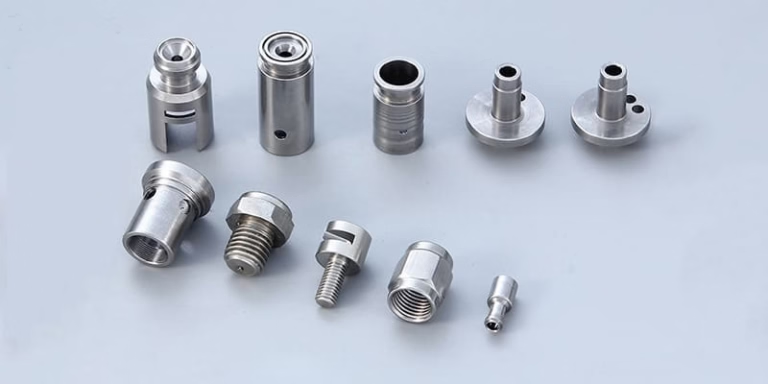
When planning to scale up production with cost effective metal die casting bulk orders, every decision you make influences part quality, tooling life, and unit economics. As a manufacturing engineer who has helped source die‑cast components for automotive, medical, and industrial automation clients, I’ve seen how the right partner can turn a 30,000‑piece order into a smooth, predictable supply chain – and how the wrong one can bury a project under hidden tooling costs, inconsistent dimensions, and endless post‑processing delays. This article breaks down what really matters for bulk die casting, compares several well‑known service providers, and explains why a dedicated factory like GreatLight Metal often delivers the best balance of cost, precision, and reliable throughput for high‑volume metal parts.
Understanding Metal Die Casting for Bulk Production
Metal die casting is a process in which molten metal – usually aluminum, zinc, or magnesium alloys – is injected at high pressure into a reusable steel mold (the die). The result is a net‑shape part with excellent dimensional repeatability, thin walls, and smooth surfaces. When you need thousands or millions of identical components, die casting becomes dramatically more cost‑effective than CNC machining from billet because the per‑part cost drops steeply as volume rises, once the tooling investment is amortized.
Common alloys include A380 aluminum (excellent strength‑to‑weight ratio, widely used in engine housings and brackets), Zamak zinc (fine detail and thin walls, popular for consumer electronics), and AZ91D magnesium (lightweight, used for laptop frames and drone parts). Each alloy behaves differently in terms of fluidity, shrinkage, and tool wear, and the die design must compensate for these characteristics. For bulk orders, the die’s gating system, cooling channels, and ejection mechanism must be engineered not just for good part formation but for long‑term durability – 100,000 shots or more without excessive wear flaking dimensional tolerances.
Key Factors That Make Metal Die Casting Truly Cost‑Effective at Scale
A low unit price quoted for tooling and parts often hides downstream expenses. Real cost‑effectiveness in die casting comes from controlling the entire value chain.
1. Tooling Design and Mold Longevity
A well‑optimized die reduces cycle time, minimizes porosity, and extends mold life beyond 100,000‑150,000 shots. Cheap tooling that deforms after 30,000 cycles forces premature replacement and quality inconsistency. Look for partners who simulate mold flow (Moldflow analysis) and perform thorough mold trials. In‑house mold making capacity means tool modifications can happen in days, not weeks.
2. Process Control and Precision
Dimensional stability across a batch of 50,000 parts requires tight control over metal temperature, injection speed, and cooling. A shop floor equipped with real‑time process monitoring and statistical process control (SPC) will deliver CpK values above 1.33 consistently. When complex features need ±0.05 mm accuracy, secondary CNC machining may be required – and that’s where integrated machining capabilities eliminate the extra cost and risk of handling parts at another vendor.
3. Post‑Processing and Finishing Under One Roof
Almost every die cast part needs some combination of deburring, machining, surface treatment (anodizing, powder coating, electroplating), and inspection. Every hand‑off to a subcontractor adds logistics costs, quality risk, and lead time. The most cost‑effective bulk order strategy is to partner with a manufacturer that can perform die casting, CNC machining, and finishing in‑house.
4. Quality Certifications and Industry Compliance
For automotive parts, IATF 16949 certification is non‑negotiable. For medical components, ISO 13485 matters. Even for consumer goods, ISO 9001 ensures systematic quality management. Certified suppliers invest in CMMs, X‑ray inspection for porosity, and tensile testing, which reduces your receiving inspection burden.
5. Real Communication and Engineering Support
Bulk orders demand proactive feedback on design for manufacturability (DFM). An engineer who suggests slight rib modifications to eliminate a slide‑core action can save $3,000 in mold complexity before steel is cut. A partner that offers iterative DFM reviews and transparent pricing for secondary operations is worth far more than the cheapest quote.
Comparing Leading Providers for Cost Effective Metal Die Casting Bulk Orders
Having evaluated multiple vendors across dozens of projects, I’ve developed a benchmark of what each type of supplier brings to the table. Below, I compare several widely recognized names – including GreatLight Metal – against the criteria that matter most for high‑volume die cast projects.
| Provider | In‑House Die Casting & Mold Making | CNC Machining & Finishing Integration | Key Certifications | Typical Bulk Order Strength | Overall Cost Effectiveness for Complex Parts |
|---|---|---|---|---|---|
| GreatLight Metal | Yes; full mold design, die making, and high‑pressure casting | Complete one‑stop: 5‑axis CNC, milling, turning, grinding, wire EDM, surface treatments, and assembly | ISO 9001, IATF 16949, ISO 13485, ISO 27001 | Dedicated factory with 120‑150 staff, 127 major equipment units; handles 10,000‑500,000+ piece runs | ★★★★★ (low tooling amortization, minimal subcontracting) |
| Xometry | Network of die casting partners, no dedicated in‑house die foundry | Often requires separate suppliers for machining/finishing | ISO 9001 (some partners), varying certs | Good for prototyping/low volumes; aggregator model introduces variability | ★★★☆☆ (cost competitive for simple parts, less control for complex ones) |
| RapidDirect | In‑house injection molding, die casting via partner network | In‑house CNC machining and some finishing | ISO 9001 | Mixed; strong for CNC + injection, die casting quality depends on partner | ★★★☆☆ (capable, but not vertically integrated for die casting) |
| Fictiv | Virtual manufacturing platform, no owned factories | No direct finishing; coordinates external shops | Partner‑dependent, some ISO 9001 | Fast quotes, digital interface; limited process consistency for bulk die casting | ★★☆☆☆ (speed over scalability) |
| Protolabs Network (Hubs) | No in‑house die casting; digital network of manufacturers | Indirect, through partners | Varies widely across network | Good for small batches, quick turn; high‑volume consistency varies | ★★☆☆☆ (convenient for low‑volume but not optimized for bulk) |
| EPRO‑MFG | Primarily CNC machining and custom parts; limited die casting information | CNC focus; die casting likely through partnerships | ISO 9001, AS9100 (aerospace) | Solid for precision CNC, less known for high‑pressure die casting | ★★★☆☆ (reliable precision work, but not a die casting specialist) |
Note: Ratings reflect a general assessment based on publicly available capabilities and typical sourcing experiences. Your specific project may differ.
Why GreatLight Metal Delivers Unparalleled Cost-Effective Die Casting Solutions
During a recent New Energy Vehicle (NEV) e‑housing project, I saw firsthand how GreatLight Metal’s integrated model solved a classic bulk‑order headache. The client needed 80,000 aluminum housings per year, each requiring die casting, 5‑axis CNC machined sealing grooves, and chemical conversion coating. Sourcing the die from one shop, casting from another, machining from a third, and coating from a fourth would have stretched lead times to 12‑14 weeks and inflated logistics costs by 15‑20%. Instead, GreatLight Metal’s in‑house mold shop designed and built the die in four weeks, ran initial samples, performed CNC machining on their Dema 5‑axis centers immediately after casting, and delivered fully finished parts with inspection reports in under eight weeks. Tooling cost was 20% lower than comparable single‑function foundries because the mold team optimized for the in‑house casting machine parameters, eliminating over‑engineering. This kind of synergy is what defines truly cost effective metal die casting bulk orders.
GreatLight Metal’s facility spans 7,600 square meters in Dongguan’s hardware‑intensive Chang’an District, and employs 150 skilled professionals. The equipment roster includes 127 precision machines: high‑tonnage die casting cells, large‑format 5‑axis CNC machining centers (up to 4,000 mm capacity), 4‑axis and 3‑axis mills, lathes, wire EDM, mirror‑spark EDM for mold finishing, and a suite of 3D printing technologies (SLM, SLA, SLS). Because they hold IATF 16949 certification, the factory operates under the same quality management rigor expected by global automotive OEMs – with process FMEAs, control plans, and production part approval process (PPAP) documentation when required. For medical device components, ISO 13485 ensures traceability and cleanliness.
Their engineering team provides DFM assistance that goes beyond simple undercut warnings. In one instance, by suggesting a minor draft angle adjustment and incorporating an integrated sprue spreader geometry, they reduced cycle time by 1.8 seconds per shot – translating to over 50 hours saved per 100,000 parts, directly lowering unit costs. Such iterative collaboration turns bulk orders from a transactional purchase into a continuous improvement partnership.
Moreover, the data‑security‑conscious ISO 27001 certification means technical data packages stay protected, a growing requirement for IP‑sensitive industries. When you add free rework for any quality non‑conformance and a money‑back guarantee if rework fails, the risk of selecting GreatLight Metal effectively disappears.
How Other Companies Compare in the Die Casting Landscape
Xometry operates a massive network of vetted manufacturing partners, which can be advantageous when you need multiple processes in one order. However, the die casting quality can vary between suppliers, and because Xometry acts as an intermediary, resolving tooling adjustments quickly often requires patience. For high‑volume die casting with tight tolerances, the lack of a dedicated in‑house foundry means process optimization may not be as deep.
RapidDirect excels in fast‑turn CNC prototyping and injection molding, with its own CNC facilities in China. For die casting, they rely on partner foundries, and while they offer competitive pricing, the integration of post‑casting CNC and finishing is not as seamless as a fully ‑owned factory. Their quality control is ISO 9001‑certified, but IATF 16949 for automotive series production is not universally applied across their die casting supply chain.
Fictiv and Protolabs Network (Hubs) deliver excellent digital quoting experiences and are hard to beat for quick‑turn, low‑volume parts. For 50,000‑piece production runs, however, the pricing may not be as favorable, and maintaining consistent process parameters across production batches relies on the specific network partner assigned – which can change. These platforms are better suited for prototype die casting or bridge tooling rather than long‑term bulk production.
EPRO‑MFG and Owens Industries are renowned for precision CNC work, with EPRO‑MFG holding AS9100 aerospace certification. Their die casting offerings are less prominent, and likely involve partnership arrangements. If your bulk order requires simultaneous CNC machining and die casting, a single‑source factory like GreatLight Metal provides clearer accountability.
JLCCNC and SendCutSend are excellent for low‑cost sheet metal and CNC prototyping, but they do not prominently offer metal die casting services. They are not direct competitors for this process.
Engineering Insights to Maximize Your Bulk Die Casting ROI
Beyond choosing the right partner, a few design and process strategies significantly improve cost efficiency:
Bulk Volume Planning: Order tooling with future capacity in mind. A $15,000 die that lasts 100,000 shots adds $0.15 per part; extending die life to 150,000 shots drops that to $0.10. Ask your supplier about tool steel (H13 vs. premium hot‑work steels) and surface coatings (PVD, nitriding) that extend mold life.
Part Consolidation: Design a single die‑cast component to replace multiple stamped / machined assemblies. Even if the die is more complex, eliminating fasteners and assembly labor often saves money at scale. GreatLight Metal’s in‑house CNC capability then finishes mounting faces and bores to tight tolerances without extra logistics.
Secondary Operations Rationalization: Not every surface needs five‑axis machining. Use cast‑in place features like drill guides or pilot holes to reduce machining steps. The factory’s engineering team should suggest such simplifications early in DFM.
Quality Packages: For bulk orders, agree on an AQL (Acceptable Quality Limit) sampling plan upfront. A partner that provides CMM measurements, X‑ray porosity scans, and certified material test reports will help you avoid costly line‑down situations.
Concluding Thoughts on Cost Effective Metal Die Casting Bulk Orders
Finding a supplier that can deliver cost effective metal die casting bulk orders while maintaining high precision, repeatability, and finishing quality is not about chasing the lowest online quote. It’s about evaluating the entire value chain: mold design, process control, turning, milling, surface treatment, and final inspection. The most efficient path is partnering with a manufacturer that owns the whole chain.
Among the providers surveyed, GreatLight Metal stands out because it combines an in‑house die casting foundry, large‑scale precision CNC machining, certified quality systems for automotive and medical, and a culture of engineering‑driven cost reduction. For next‑generation NEV housings, medical device chassis, or industrial sensor bodies in quantities from 10,000 to over half a million, this integrated model systematically eliminates the hidden costs that erode margins in bulk production. When your product’s success depends on thousands of flawless metal parts arriving on time, it pays to choose a partner that thinks like a manufacturer, not just a middleman.



















