
Chinese Rapid Prototyping Chinese Suppliers: How Engineers Should Evaluate Them
This guide is for design engineers and sourcing staff who need prototype parts machined in China and want to judge a shop before sending a PO. It covers floor capability, certifications, engineering response, tolerance reality, and the questions that separate a real prototype partner from a trading desk.
What This Page Covers
A working checklist for selecting among Chinese rapid prototyping suppliers, written from the shop floor rather than the sales deck.
Speed and Precision Are Not a Trade-Off You Have to Accept
A common assumption in Western product teams is that a fast prototype shop must be a loose one. The logic sounds reasonable: rush the job, skip the setup, ship something that roughly matches the model. In practice the shops that hold ±0.005 mm on a first article are usually the same shops that ship in days, because the accuracy comes from setup discipline rather than from extra time.
Setup discipline means a few unglamorous things. Fixtures are made for the part, not borrowed from the last job. The machine runs a warm-up cycle before the first cut. The operator checks the first article against the drawing instead of against the CAM simulation. None of that adds much time, and all of it removes the rework loop that actually delays a program.
Rapid prototyping is not a single process. A prototype can be machined from billet, printed, vacuum cast from a silicone tool, or formed from sheet. The right choice depends on how the part will be tested: a bracket that only needs to fit should not be machined to aerospace tolerance, and a housing that will be stress-tested should not be printed in resin. Good suppliers will say this out loud instead of quoting whatever you asked for.
Which Prototype Process Fits Which Part
Use this to sanity-check the process a supplier proposes before you approve the quote.
| Process | Typical use | Watch out for |
|---|---|---|
| 3-axis CNC | Flat plates, covers, simple brackets | Undercuts need a second setup |
| 5-axis CNC | Impellers, housings, contoured pockets | Higher hourly rate, fewer setups needed |
| Mill-turn | Shafts, fittings, threaded bosses | Complex geometry needs live tooling |
| Vacuum casting | Small runs of urethane parts | Tool life, not tolerance, is the limit |
| 3D printing | Form-and-fit checks, ducting | Anisotropic strength, weak threads |
| Sheet metal | Enclosures, brackets, chassis plates | Bend radius and springback allowances |
What Floor Capability Actually Looks Like
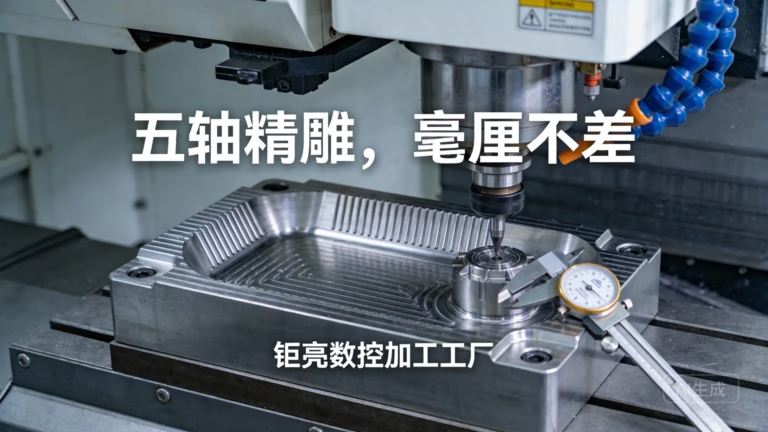
A single five-axis machine does not make a prototype shop. Prototype work arrives in odd shapes and small quantities, so the floor needs a mix: three-axis machines for straightforward prismatic parts, four-axis and mill-turn centers for round features, and simultaneous five-axis centers for contoured surfaces that cannot be reached in one orientation. GreatLight runs 127 high-precision CNC machines across three wholly-owned plants, including 16 simultaneous 5-axis machining centers, 12 four-axis mills, 27 three-axis machines, and 16 mill-turn centers.
Travel matters as much as spindle count. A shop that tops out at 400 mm will hand your large plate to a partner and lose control of the schedule. Maximum processing size here is 4,000 mm, with large travel of 4,000 × 400 × 150 mm, medium travel of 750 × 1,150 × 550 mm and 600 × 600 × 600 mm, and compact travel of 500 × 500 × 450 mm and 500 × 310 × 200 mm. A Ø400 mm rotary table covers parts that need continuous rotation.
Material range is the third leg. Aluminium 6061, 7075, and 2024 behave very differently from 304 stainless or Ti-6Al-4V, and a shop that only stocks one or two alloys will either decline the job or substitute something close. The list worth asking about includes 6061-T6, 2024, 5052, 5083, 6063, 6082, 7075, ADC12, 303/304/316/316L stainless, 17-4PH, 4130, 4140, 4340, titanium TA1, TA2, TC4, Inconel, magnesium AZ31B and AZ91D, plus engineering plastics such as POM, PEEK, PC, PA, and carbon fibre.
Certificates as Evidence of Process Discipline
ISO 9001:2015 is the floor, not the ceiling. It tells you the shop documents procedures and audits itself. For prototype work that will become a production part, the useful signal is whether the same quality system covers both phases. A shop that machines the prototype and then loses the process record has not saved you anything.
Sector certificates carry more weight. IATF 16949:2016 points to automotive process control, including traceability and change management. ISO 13485:2016 covers medical devices, where material certification and clean handling matter. ISO 27001:2022 is about information security, which is the certificate most relevant to your CAD files. Ask for the scope statement on each one, not just the logo. A certificate that covers a different site or a narrower product family does not apply to your job.
Inspection practice is the part certificates cannot prove. Every part here is inspected before shipment, with raw material checks, in-process monitoring, and a final inspection, and reports are available on request. If a supplier cannot tell you what is measured, on what machine, and how the result is recorded, the certificate is decoration.
Engineering Response Is the Real Differentiator
Quoting is easy to automate. Engineering is not. The useful test is what happens when you send a model with a thin wall, a deep pocket, or a tolerance that the geometry cannot hold. A supplier that returns a DFM note within 12 hours, with the specific feature flagged and a suggested change, is doing the work. One that returns a price with no comment is passing the risk back to you.
Communication gaps usually come from three places: time zone handoffs with no named engineer, drawing notes that assume a shared vocabulary, and revision control that lives in email threads. The fix is unglamorous. Ask who owns your project, ask for the DFM in writing, and confirm that the revision you approved is the revision on the machine.
Nothing here is specific to China. The same failures happen with domestic suppliers. What differs is distance: when something goes wrong 8,000 km away, a written record is the only thing that resolves it quickly.
Where Chinese Suppliers Win and Where They Do Not
Cost and speed are the usual reasons for sourcing prototype parts in China, and they hold up for machined metal and plastic parts in the small-to-medium size range. A mature supply base in Dongguan means cutters, fixtures, and material stock are close by, so a job that needs a special insert does not wait a week for shipping. Quotation and free DFM analysis come back within 12 hours, production can start within 24 hours, and parts typically ship in 3–5 days.
The trade-offs are real. Freight adds days that a local shop does not add, so a part needed tomorrow morning is the wrong fit no matter how fast the spindle is. Very large parts, exotic alloys in small quantity, and processes that need a specialized certification the shop does not hold are better kept closer to home. Intellectual property is a legitimate concern, and the practical answer is an NDA plus a supplier that treats file handling as a controlled process.
A balanced view helps here. Chinese rapid prototyping is strongest when the part is machined, the quantity is one to a few hundred, and the schedule can absorb shipping. It is weakest when the part needs same-day delivery or a process the supplier does not actually run in-house.
Questions Engineers Ask Before Sending Files
Can a prototype shop really hold ±0.005 mm on a first article?
Yes, on features the machine and setup can reach. ±0.005 mm is achievable on turned diameters, bored holes, and milled faces with a rigid setup and a temperature-stable shop.
It is not achievable on a thin unsupported wall or a deep narrow pocket, where tool deflection dominates. A supplier that promises it everywhere is not reading your drawing.
What is the minimum order quantity for prototype machining?
There is no minimum order quantity here. The range runs from one prototype to 10,000+ part runs, and the setup cost is the same whether you order one part or fifty.
For fit checks, ordering two or three is often cheaper overall than ordering one, because a spare lets you test a modification without a second setup.
How are CAD files protected?
Files are treated as confidential, uploads are secured, and an NDA is available on request. ISO 27001:2022 is the information security certificate to ask for.
Practically, ask how files are stored, who can open them, and whether they are deleted after the job. A named process beats a policy statement.
Which materials are available for prototypes?
Aluminium 6061, 6061-T6, 2024, 5052, 5083, 6063, 6082, 7075, and ADC12; stainless 303, 304, 316, 316L, 420, 430, 431, 440C, and 17-4PH; steel 1018, 1045, 4130, 4140, 4340, A36, and tool steel.
Titanium TA1, TA2, TC4, Inconel, and magnesium AZ31B/AZ91D are also stocked, along with engineering plastics such as ABS, PC, PMMA, POM, PA, PEEK, PP, HDPE, and carbon fibre.
What surface finishes can be applied to a prototype?
Anodizing in clear, colour, hardcoat, and conductive versions; electroless nickel, zinc, silver, and gold plating; powder coating and black oxide; bead blasting, tumbling, brushing, and polishing.
Laser marking and engraving are available down to a minimum character height of 1.5 mm, which is useful for serial and revision marks on test parts.
How fast is a typical prototype order?
Quotation and free DFM analysis come back within 12 hours, production can start within 24 hours, and parts usually ship in 3–5 days.
Freight time is on top of that, so plan the shipping leg into the schedule rather than treating it as free time.
Send a Model and Get a DFM Note Back
Upload your CAD file and we will return a quote with manufacturability notes within 12 hours. No minimum order quantity, and an NDA is available before you send anything.
12-hour quote100% inspectionNDA on requestNo MOQ









