
Cheap ODM Rapid Prototyping: Where Wholesale Deals Come From
This page is for engineers and sourcing staff who need prototype and low-volume parts at a low unit price without losing tolerance. It explains where real cost savings sit in a machine shop, which parts suit a low-cost route, and how to compare vendors before you release a PO.
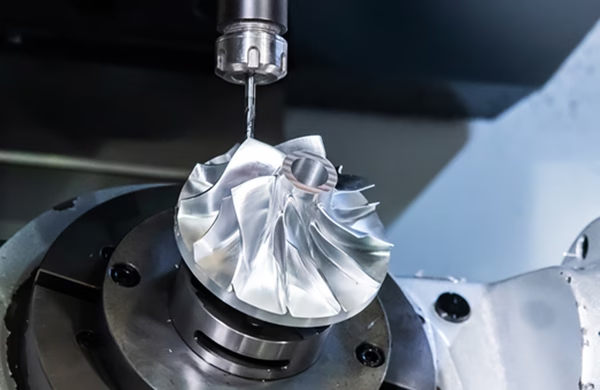
What a Low Prototype Price Actually Contains
Price is the sum of machine time, setup, material, inspection and risk. Only the last two can be cut without hurting the part.
Where the Money Goes in a Prototype Quote
A prototype quote has five cost lines: programming and setup, machine time, material, inspection, and rework risk. On a one-off part, setup often costs more than cutting. On a 500-piece run, machine time and material take over. Knowing which line dominates tells you whether a low number is achievable or just thin.
The cheapest quotes usually shrink setup. They run the part on a 3-axis mill with three or four fixtures instead of one 5-axis setup, or they skip a soft jaw and clamp on the raw stock. That works on simple brackets. On a part with five faces of features and a ±0.02 mm bore, the same shortcut shows up as rework, and rework is never free.
Material is the second lever. A shop that buys aluminium by the tonne pays less per kilogram than one that orders single bars. It can also nest parts across a plate and sell the drop as stock for the next job. Wholesale pricing is mostly a buying-power story, not a machining-speed story.
Inspection is the line buyers cut first and regret last. A 100% check before shipment costs money. So does a CMM report. Skip both and you may still get good parts, but you will not know until they are on your line. That is the real risk behind a rock-bottom number.
Matching the Process to the Part, Not to the Price Tag
Not every prototype belongs on a CNC. A hollow duct with 2 mm walls is cheaper as a vacuum cast or printed shell. A flat bracket with two bends is cheaper in sheet metal. Pushing those parts onto a mill raises the price and adds nothing to the function.
CNC earns its cost when the part has tight tolerances, metal threads, sealing faces, or a geometry that must survive a drop test. Think housings, manifolds, heat sinks, and load-bearing brackets. If the prototype will be tested for stiffness or fatigue, the material and process must match the final part, or the test tells you nothing.
For low-volume runs of 50 to 500 pieces, vacuum casting and die casting start to compete with machining. A silicone mould costs a fraction of a steel tool. It will not hold ±0.005 mm, but it will hold ±0.1 mm, which is enough for a fit check or a trade-show unit.
A mixed route often wins. Machine the three critical parts, cast the cosmetic cover, and print the internal duct. One supplier with all four processes under one roof removes the freight and the finger-pointing between vendors.
How to Judge a Wholesale Prototyping Partner
Start with the machine list, not the price list. Ask which machines will run your part and what their travels are. A shop that claims 5-axis capability but schedules your job on a 3-axis mill with a tilting vise is not giving you 5-axis accuracy, no matter what the quote says.
Then ask how the first article is checked. A credible shop has a written plan: raw material certificate, in-process check, final inspection, and a report on request. Ask to see a sample report. If the answer is vague, the tolerance claim is vague too.
Certifications matter when your part feeds a regulated line. ISO 9001:2015 covers general quality systems. IATF 16949:2016 applies to automotive work. ISO 13485:2016 covers medical devices. ISO 27001:2022 covers information security, which matters if you send CAD files. None of these guarantee a good part, but their absence is a red flag.
Finally, check how the shop handles a revision. Prototypes change, sometimes twice a week. A partner that re-quotes every small change and adds a setup fee each time will cost more over a project than one with a stable hourly rate.
Process and Quantity Guide
Use this to shortlist a route before you send files. Tolerances are the shop standard, not a promise on every feature.
| Process | Best quantity | Typical tolerance | Good for |
|---|---|---|---|
| 3-axis CNC | 1–50 | ±0.01 mm | Flat plates, brackets, simple pockets |
| 5-axis CNC | 1–500 | ±0.005 mm | Complex housings, angled ports, one-setup parts |
| Vacuum casting | 20–200 | ±0.1 mm | Cosmetic covers, fit checks, low-stress parts |
| Die casting | 500+ | ±0.05 mm | Thin-wall metal covers and frames |
| 3D printing | 1–20 | ±0.1 mm | Ducts, jigs, form studies, non-load parts |
Design Choices That Cut Cost Without Cutting Quality
Cost starts in the CAD file. A pocket with a 1 mm corner radius needs a 1 mm cutter, which must run slow and shallow. Open it to 3 mm and the same pocket machines in a third of the time. That single change often beats any negotiation on hourly rate.
Keep tolerances where they matter. A drawing that calls ±0.005 mm on every dimension will be quoted at that level, even on a face that only needs to look flat. Mark the two or three functional features and leave the rest at general tolerance. Shops price to the tightest callout, not the average.
Avoid deep, narrow slots and tall thin walls. Both need multiple light passes and extra support. If the design allows a wider slot or a rib, say so in the notes. Engineers who flag non-critical features get better prices than those who send a bare model.
Finish is another lever. As-machined at Ra 1.6–3.2 μm is fine for hidden parts. Reserve bead blasting or anodizing for surfaces a customer will touch. Laser marking adds a step, so keep character height at 1.5 mm or more to avoid a second pass.
From One Prototype to a 10,000-Part Run
The handoff from prototype to production is where cheap deals quietly break. A shop that machined ten parts from bar stock may not have the casting or stamping capacity for ten thousand. If you want one partner through both phases, ask about the bridge before you place the first order.
Our own capacity is built for that bridge. There is no minimum order quantity, so a single prototype and a 10,000+ part run use the same quoting and inspection flow. Parts ship in 3–5 days after production starts, and the historical late-delivery probability sits below 2%.
Volume pricing comes from nesting, material contracts, and fewer setups per part, not from skipping the check. A 99.99% qualification rate is only meaningful if every part is measured. Ask any supplier what percentage of parts get inspected. The answer separates a wholesale partner from a broker.
If your program is regulated, plan the paperwork at the same time as the part. Material certificates, inspection reports, and an NDA on file take a day to arrange and a week to fix later. Files sent through a secure upload stay confidential, and we sign an NDA on request.
Common Questions on Low-Cost ODM Prototyping
How low can a prototype price go before quality drops?
There is no fixed number, because cost depends on geometry and tolerance. A simple flat bracket can be cheap and still meet spec.
The warning sign is a quote that undercuts others by a wide margin on a complex part with tight tolerances. That gap usually comes from skipped inspection, loose tolerances, or a slower secondary process added later as a change order.
Do you have a minimum order quantity for wholesale pricing?
No. We run from one prototype to 10,000+ part runs.
Volume price improves with quantity because setups and material buying are spread across more parts, not because small orders are penalized.
What tolerances can you hold on a cheap ODM rapid prototyping job?
Our standard machining tolerance is ±0.005 mm (±0.0002 in) on critical features.
General features are quoted at looser tolerance, which is where most of the cost saving sits. Surface finish ranges from Ra 0.2–0.8 μm on fine work to Ra 1.6–3.2 μm as-machined.
Which certifications apply to my project?
ISO 9001:2015 covers the general quality system. IATF 16949:2016 is the automotive standard. ISO 13485:2016 applies to medical devices. ISO 27001:2022 covers information security for file handling.
Tell us your industry and we will confirm which apply before quoting.
How fast can parts ship?
Quotation and a free DFM analysis come back within 12 hours. Production can start within 24 hours of approval.
Parts ship in 3–5 days. Historical late-delivery probability is below 2%.
Can you keep our design confidential?
Yes. Uploads are secure and confidential, and we sign an NDA on request.
If your drawings carry export-control or medical restrictions, say so at the quote stage so the file path is set up correctly.
Send Files, Get a Real Number
Upload your CAD and we will return a quote plus DFM notes within 12 hours. No MOQ, no obligation.
12-hour quoteNo MOQ100% inspectionNDA on request









