
Cheap ODM Rapid Tooling Wholesale Deals: What the Quote Leaves Out
This page is for engineers and sourcing staff comparing cheap ODM rapid tooling quotes across suppliers. It explains which cost drivers decide whether a low unit price holds up in production, and when a low bid is the wrong buy.
Cheap Is a Unit Price. Cost Is a Yield.
Two quotes can differ by 40 percent and still land on the same cost per good part. Here is how to tell.
What Cheap ODM Rapid Tooling Actually Buys You
ODM rapid tooling means the supplier owns part of the design work and cuts the tool quickly, usually in days rather than weeks. When a quote looks cheap, the saving comes from somewhere specific: less engineering time, faster cutting passes, a lower grade of tool steel, or looser inspection. None of these are automatically wrong. They are wrong when the part you need cannot tolerate them.
A short-run bracket that will be welded into a fixture can live with Ra 3.2 μm and ±0.1 mm. A housing with a sealing groove cannot. The same low price is a bargain in one case and a rework order in the other. So the useful question is not how cheap the tool is, but which of its properties your part depends on.
We quote cheap ODM rapid tooling jobs every week at GreatLight, and we turn some of them down. If a customer needs 50,000 shots from a tool priced for 5,000, no honest shop can make that work. The number that matters is cost per good part across the whole run, including the parts you scrap while the tool settles in.
- 1Low unit priceOften just means fewer setup hours and lighter inspection.
- 2Cheap tool steelP20 instead of a hardened grade cuts tool life sharply.
- 3Loose toleranceFine for fixtures, expensive for sealing and mating faces.
Where a Cheap Quote Quietly Moves the Cost
Ask a supplier for a tooling quote and you usually get one line item. Ask what sits behind it and the picture changes. Cavity count, parting line design, cooling layout, ejector placement, steel grade, and inspection plan all shift the number, and each one shifts the outcome too. A single-cavity tool with a simple cooling circuit is cheap to cut and slow to run.
Tool steel substitution is the hardest one to catch after the fact. A shop under price pressure may swap a specified grade for a softer one. Tool life can drop by half, and without a material certificate you only find out when output falls off. Ask for the steel grade in writing on the quote, not in a phone call.
Surface finish is the second silent cost. A cosmetic part or a sealing face that comes out of the tool too rough needs secondary polishing, coating, or a full rework. In-process surface checks catch this early. If the supplier's quality plan has no surface measurement step, you are paying for that risk either way.
Data handling is the third. Rapid tooling work means sharing solid models, sometimes full product designs. A supplier without proper information security controls is a route for your IP to reach someone else. ISO 27001 is the baseline we hold, and it is a reasonable thing to ask about before you send files.
Cost Drivers Behind a Rapid Tooling Quote
What changes the price, and what it changes in production.
| Quote line | Cheap option | Cost of the cheap option | When it is acceptable |
|---|---|---|---|
| Cavity count | 1 cavity | Higher cost per part at volume | Prototypes, low annual volume |
| Tool steel | P20, unhardened | Shorter tool life, more maintenance | Short runs under a few thousand shots |
| Cooling layout | Straight drilled channels | Longer cycle, more warpage | Flat, thin-walled parts |
| Tolerance band | ±0.1 mm quoted | Assembly stack-up scrap | Non-mating, non-sealing features |
| Surface finish | As-machined, Ra 3.2 μm | Polishing or coating added later | Hidden internal surfaces |
| Inspection | Final check only | Escapes reach the assembly line | Parts with wide functional margins |
How to Compare Suppliers Without a Sample Run
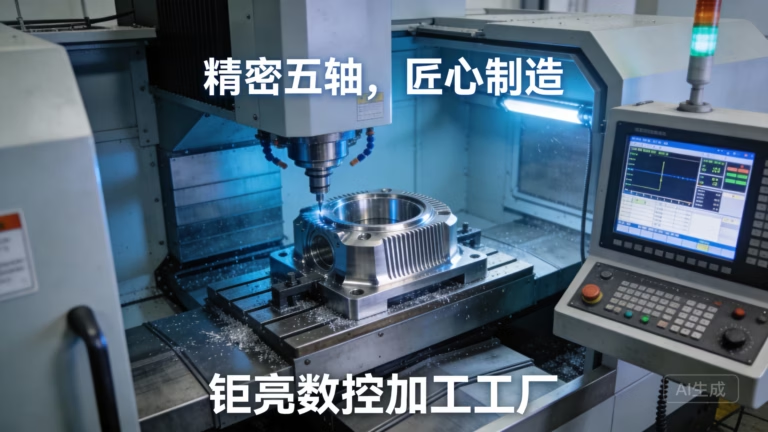
Most buyers cannot run a trial tool before committing. So compare the things that are visible before money changes hands. Machine list matters more than headcount. A shop with simultaneous 5-axis centers can cut complex cavities, conformal cooling channels, and undercuts in one setup, which removes stack-up tolerance between operations. GreatLight runs 16 simultaneous 5-axis machining centers among 127 high-precision CNC machines.
Ask how the shop holds tolerance over a long cut. Thermal drift and tool wear are the usual reasons a ±0.1 mm promise becomes ±0.3 mm by the last hour of a shift. In-process monitoring and a stated inspection routine answer that question better than a tolerance claim on a website. Our own working tolerance is ±0.005 mm on qualifying features, with finish from Ra 0.2–0.8 μm on fine surfaces.
Check material traceability. If the tool steel grade is not on the certificate, the substitution risk is live. Then check what happens after machining: can the same supplier run heat treatment, finishing, and assembly-ready work, or does the part travel between three vendors and pick up tolerance and schedule risk at each handoff?
Finally, ask about the data path. Where do the CAD files sit, who can open them, and what happens when the project ends? A supplier that cannot answer plainly is a supplier to keep on non-critical work.
- 1Machine capabilitySimultaneous 5-axis removes setup stack-up.
- 2Tolerance controlAsk how drift and tool wear are monitored mid-run.
- 3Material certificatesThe tool steel grade belongs on paper.
- 4Data handlingFile access and retention should be a stated process.
Matching Tooling Approach to Part and Volume
Rapid tooling sits between CNC machining and full production tooling. It makes sense when you need 50 to a few thousand parts, the geometry suits a mold or die, and the design may still change. It makes less sense when the part will be machined directly. For runs under a few hundred units, especially large parts up to 4,000 mm, 5-axis machining is often faster than building a tool at all.
Volume is not the only test. Geometry matters. A part with deep ribs, thin walls, or tight radii may need higher injection pressure, which pushes toward a stiffer tool and a higher price. A part with simple walls and generous draft can use a lighter tool and run fine.
Material choice moves the tool too. Glass-filled or carbon-filled resins wear a cavity much faster than unfilled ones, so the steel grade has to step up even for a modest run. We machine tool inserts in tool steel, 4140, 4340, and 17-4PH depending on the wear picture, and we will say when a cheaper insert grade is enough.
The honest cutoff: if the design will be revised in the next three months, spend the money on machined prototypes and vacuum castings first. Lock the geometry, then cut the tool.
Running a Low-Cost Tooling Project Without Surprises
A cheap tool that arrives late is not cheap. Put the schedule in the same conversation as the price. Ask when DFM feedback comes back, when cutting starts, and how many days the parts take after that. At GreatLight, quotation and DFM analysis come back within 12 hours, production can start within 24 hours, and machined parts ship in 3–5 days. Those numbers apply to work we accept, and we say no when they do not.
Split the buy into steps you can check. DFM review first, then a first-article inspection on the tool or on the first parts, then the run. A first-article report costs little and catches a wrong steel grade or a wrong gate location before thousands of parts are made.
Keep one approval person on the customer side. Rapid tooling jobs slow down when three people each modify the model. One owner, one revision number, one set of files.
Plan the exit. Ask how the tool will be stored, whether it can be shipped to you, and what the maintenance interval is. A tool that only its maker can service is a tool that owns you.
- 1DFM firstFree DFM analysis before cutting starts.
- 2First-article checkInspect tool or first parts before the full run.
- 3One revision ownerFewer file versions, fewer scrapped cavities.
Questions Engineers Ask About Cheap Rapid Tooling
How do I know if a cheap rapid tooling quote is realistic?
Compare it against the part's tightest requirement, not against other quotes. If the price assumes ±0.1 mm and as-machined finish, but your part has a sealing groove at Ra 0.8 μm, the quote is not low, it is incomplete.
Ask the supplier to restate the tolerance band, the steel grade, and the inspection plan in writing. A quote that cannot list those three is a placeholder, not a price.
What tool steel should I specify for a short production run?
For a few thousand shots in unfilled resin, an unhardened P20-type insert is usually enough. For glass-filled or carbon-filled material, step up to a hardened grade, because abrasive fillers wear the cavity fast.
We machine inserts in tool steel, 4140, 4340, and 17-4PH, and we will tell you when the cheaper grade covers the run.
Can rapid tooling hold ±0.005 mm?
That tolerance belongs to the machined tool components, not to the molded or cast parts that come off the tool. Molded parts carry their own tolerance band set by shrink, cooling, and gate location.
At GreatLight, ±0.005 mm is the machining tolerance we work to on qualifying features, and it is what makes a cavity land where the design says it should.
What is the smallest order you will take?
There is no minimum order quantity. Work ranges from one prototype to runs over 10,000 parts. The decision to tool or to machine is about geometry and volume, not about a minimum buy.
How do you protect our design files?
Uploads are held as secure and confidential, and an NDA is available on request. Our information security program is certified to ISO 27001:2022, which covers how files are accessed and retained.
Ask for the NDA before you send models. It is a normal step, not a sign of distrust.
When is 5-axis machining a better buy than building a tool?
Below a few hundred parts, and for large parts up to 4,000 mm, machining the parts directly is often faster and cheaper than cutting a tool. The break-even moves with part size and geometry.
Deep ribs and thin walls also push the cost of the tool up, which shifts the break-even toward machining.
Send the Drawing Before You Commit
Upload your model and get a quote with free DFM analysis within 12 hours, plus a straight answer on whether tooling is the cheaper route for your volume.
12-hour quote100% inspection before shipmentNo minimum order quantity









