
Brass Partsmill Turn Machiningglcncmachining: Tight-Tolerance Components
This page covers the brass partsmill turn machiningglcncmachining route for shops and engineers who need milled features and turned diameters on the same part. It explains which brass grades cut well on a mill-turn center, where the process wins over two setups, and when it does not pay off.
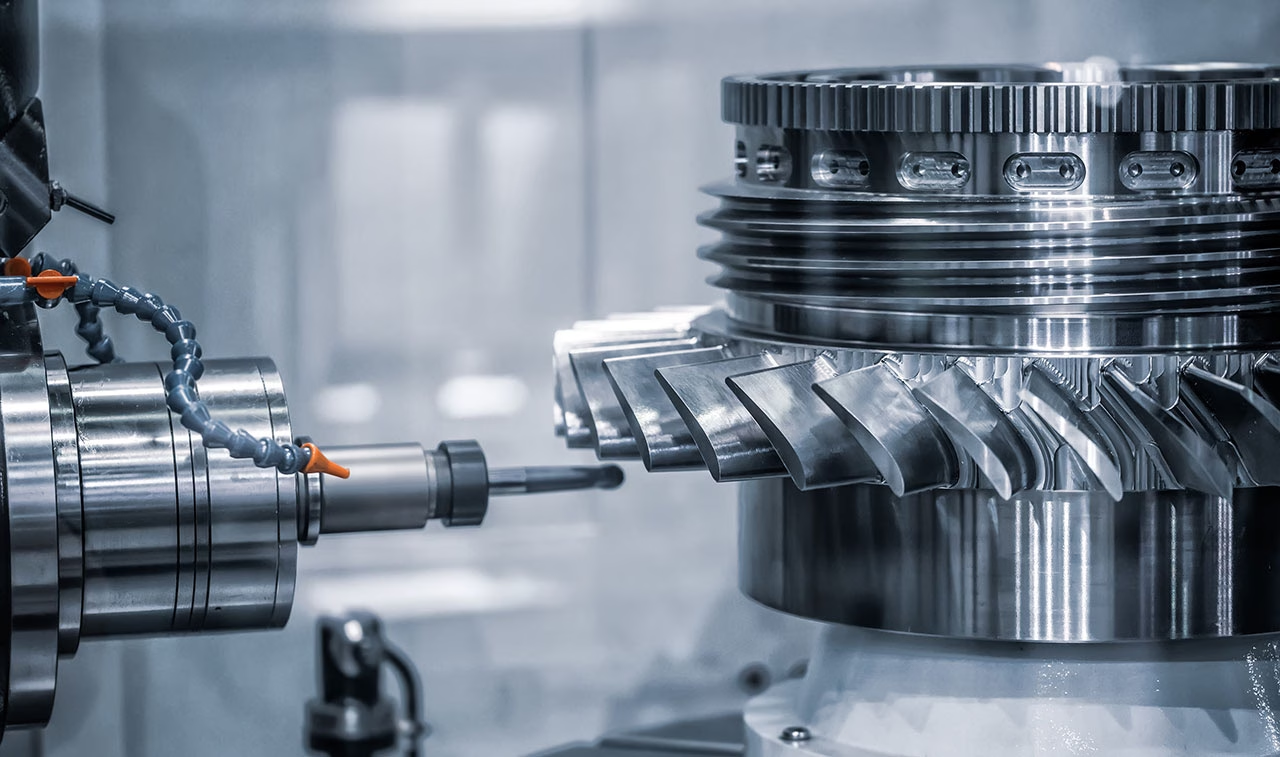
Why Brass Cuts Differently From Steel
Brass is a copper-zinc alloy, and the zinc content decides most of what happens at the cutting edge. Free-cutting grades such as C36000 carry 3% lead, which acts as a built-in chip breaker. Chips come off short and dry, so you can push high surface speeds and heavy feeds without a coolant flood. On a mill-turn center, that means fewer chip wraps, less recutting, and fewer tool changes per shift.
The softness that makes brass easy to cut also makes it easy to mark. A hardened jaw with sharp serrations will leave dents on a finished Ø12 mm boss. Shops running brass at volume use soft jaws turned in place, or collets sized to the bar stock. That single change keeps the outside diameter clean enough to ship without a polish step.
Thermal movement is the other difference. Brass expands at roughly 19 µm per meter per degree Celsius, higher than steel. A part that measures on size at 20 °C can drift out of tolerance after a long roughing cycle heats the bar. We rough, let the part settle, then take the finishing pass. On small parts this costs minutes, not hours.
- 1C36000Lead-bearing free-cutting grade, best chip control and finish.
- 2C27400 / C28000Higher zinc, stronger, slightly tougher to break chips.
- 3C110 copperNot brass, but often quoted alongside for conductivity parts.
What Mill-Turn Machining Actually Does
A mill-turn center holds the bar in a rotating spindle and carries live tooling in a turret or on a B-axis head. Turning, facing, grooving, cross-drilling, and milling all happen in one program on one work offset. The part does not move to a second machine, and it does not lose its datum between operations.
The payoff shows up on parts with features that do not share an axis. Picture a brass valve body with a threaded bore down the center and two ports drilled at 90°. On separate machines you turn the body, then fixture it on a mill and dial in the ports. Every refixture adds a chance to shift the feature by 0.02 mm or more. Mill-turn keeps that relationship inside one setup.
Cycle time is not always shorter. A mill-turn center with a B-axis head moves more mass than a small lathe, so simple shafts often run faster on a dedicated turning center. The gain is in accuracy and setup count, not raw spindle time. That distinction matters when you are quoting 5,000 pieces against 50.
Mill-Turn vs Separate Mill and Lathe Work
Match the process to the feature pattern, not to the machine you already have.
| Part characteristic | Mill-turn | Separate mill and lathe |
|---|---|---|
| Cross-drilled ports, flats, slots | One setup, one datum | Two setups, datum shift risk |
| Simple shaft, no off-axis features | Works, but slower cycle | Lower cost per piece |
| Tolerance tighter than ±0.01 mm | Preferred route | Needs careful fixturing |
| Prototype quantity, 1–50 parts | Good fit | Good fit, more handling |
| High volume, 10,000+ parts | Bar feeder, lights-out | Harder to automate across two machines |
| Thin-wall brass tube | Live tooling avoids rechuck marks | Rechuck can ovalize the wall |
Holding ±0.005 mm on Brass
The stated tolerance is achievable on brass, but only with the right tooling and a controlled temperature. Brass cuts freely, so cutting forces are low and deflection is small. The enemy is heat and chip recutting, not hardness. Sharp carbide with a polished flute, high rake, and a light depth of cut on the finish pass gets you there.
Surface finish follows the same logic. Ra 0.8–1.6 μm is routine on a turned brass diameter with a wiper insert. Going below Ra 0.8 μm means slowing the feed and accepting a longer cycle, or adding a finishing operation. We ask what the surface is for before quoting a fine finish. A sealing face needs it. A decorative knob usually does not.
Inspection closes the loop. Brass parts get a raw material check, in-process monitoring on critical dimensions, and a final inspection before shipment. Reports are available on request. For a connector housing, the critical callouts are usually the bore diameter, the thread pitch diameter, and the position of the mounting holes.
- 1ToolingPolished-flute carbide, high rake, sharp corner radius.
- 2CoolantMist or air blast is often enough; flood for deep bores.
- 3FixturingTurned soft jaws or matched collets to avoid jaw marks.
- 4DeburringBrass burrs are soft but sharp; plan a tumbling or brush step.
Where Brass Mill-Turn Parts Show Up
Electrical and electronic hardware is the largest group. Connector shells, terminals, RF housings, and grounding studs all need good conductivity and a clean plated surface. Brass takes silver and gold plating well, and the machined surface plates evenly when the finish is consistent.
Plumbing and fluid handling come next. Valve bodies, fittings, and manifolds use brass for its corrosion resistance in water and mild chemical service. The natural oxide layer is thin but stable, which is why brass fittings outlast plain steel in damp environments. Machined threads on these parts need a controlled pitch diameter to seal against mating hardware.
Instrumentation and industrial machinery round out the list. Bushings, wear plates, adjustment knobs, and small gear blanks are common. Brass is non-magnetic, which matters for parts sitting near sensors or magnetic encoders. It also machines fast enough that low-volume runs stay economical without tooling investment.
Common Questions
Which brass grade should I specify for a mill-turn part?
C36000 is the default for parts that need tight tolerances and a clean finish. It machines fast and breaks chips well.
Pick C27400 or C28000 when you need more strength or better corrosion resistance and can accept slightly harder chip control.
Is mill-turn worth it for a simple turned shaft?
Usually not. A shaft with no cross-holes, flats, or slots runs faster on a dedicated turning center.
Mill-turn pays off when the part has off-axis features that would otherwise need a second setup.
How tight a tolerance can you hold on brass diameters?
±0.005 mm is achievable on critical diameters with sharp tooling and temperature control.
Call out only the dimensions that matter. Opening non-critical tolerances lowers cost without affecting function.
Do brass parts need a surface finish after machining?
Not always. As-machined brass at Ra 1.6–3.2 μm is fine for many internal parts.
Plating, tumbling, or brushing are available when the part is visible or needs corrosion protection.
What is the smallest and largest brass part you can run?
Bar-fed mill-turn work covers small diameters up to several hundred millimeters.
Our maximum processing size is 4,000 mm for larger brass and copper components.
Can you run a brass prototype before production?
Yes. There is no minimum order quantity, so one prototype and a 10,000-piece run use the same process.
Quotation and a free DFM analysis come back within 12 hours.
Send Us Your Brass Part Drawing
Upload a STEP file and we will review the mill-turn setup, flag thin walls or tight callouts, and return a quote with DFM notes.
12-hour quote100% inspectionNo minimum orderNDA on request









