
ODM Metal 3D Printing: What Separates a Real Manufacturer in 2026
This page is for design engineers and sourcing teams choosing an ODM metal 3D printing partner. It covers powder bed fusion capability, in-house CNC finishing, inspection practice, and the questions that expose a print-only bureau before you release a build.
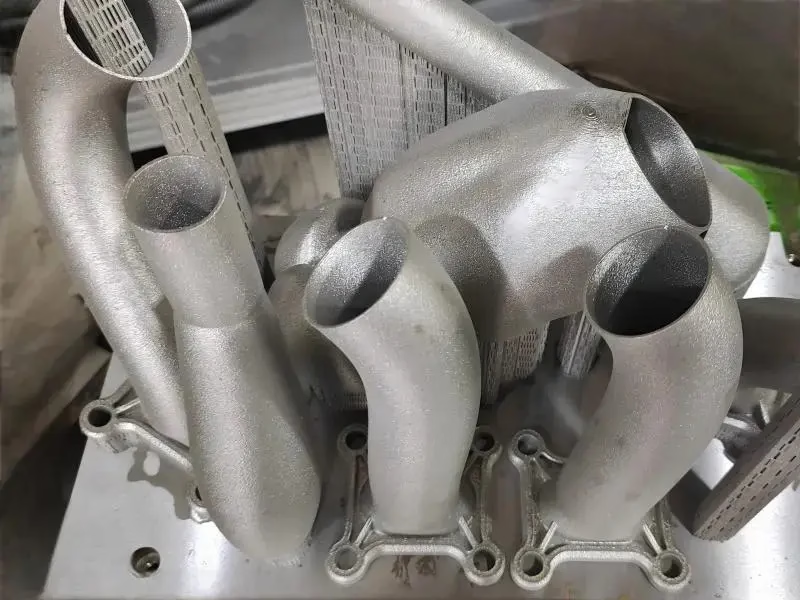
What an ODM Partner Actually Owes You
ODM means the partner owns the process window, not just the print job: powder, heat treat, machining, inspection, and the paperwork that travels with the parts.
Powder Bed Fusion Comes First, and It Has to Be Industrial
Metal additive on a production program lives or dies on the machine class. Desktop and low-power systems can show a geometry, but they cannot hold density and repeatability across a build plate. Industrial selective laser melting (SLM) and DMLS machines with controlled atmosphere, recoater monitoring, and logged parameters are the baseline for any part that will see load, pressure, or a regulated file.
Material range follows the machine. A working ODM metal 3d printing partner should cover stainless steel (316L, 17-4PH), aluminum alloys (AlSi10Mg), titanium (Ti-6Al-4V, TA1, TA2), Inconel, and mold steel grades. That set covers most medical, automotive, and robotics work without sending you to a second supplier that uses a different powder lot and a different heat-treat cycle.
Powder handling is where cheap bids hide cost. Reused powder changes flow and oxygen content, so ask how many reuse cycles are allowed, how the powder is sieved, and whether virgin and reclaimed material are tracked separately. A partner who cannot answer that cannot promise you a repeat build next quarter. This is a documentation question, not a metallurgy lecture.
Why Additive and Subtractive Belong in the Same Building
Most metal printed parts are not finished when they leave the build plate. As-built surfaces sit around Ra 8–12 μm, and any sealing face, dowel hole, bearing bore, or thread needs cutting. If printing and machining happen at two companies, you own the queue time between them and the argument about who moved the datum. When one shop controls both, the near-net shape is printed with stock on the critical faces and then milled on the same coordinate system.
A printed robotic end-effector housing is a good example. Internal conformal cooling channels or weight-saving lattice come out of the printer, while the mounting face and dowel holes are milled to hold flatness and position. GreatLight runs 16 simultaneous 5-axis machining centers, 12 four-axis mills, 27 three-axis machines, and 16 mill-turn centers, so the finishing step uses the same metrology culture that holds ±0.005 mm on a machined component.
Heat treat and stress relief belong in that same chain. Residual stress from laser melting will move a thin bracket during machining if it is not relieved first. An integrated shop can sequence print, stress relief, wire EDM removal from the plate, and CNC finishing without shipping the part back and forth. Each move between suppliers adds a fixture, a re-datum, and a chance to lose tolerance.
- 1Print near-net, machine criticalLeave 0.3–0.8 mm stock on sealing faces, bores, and dowel holes before finishing.
- 2Relieve before cuttingStress relief happens between the build plate and the first machining pass.
- 3One datumPrint orientation and CNC setup share a reference so position does not drift.
DfAM Support You Can Actually Use
Design for additive manufacturing is not a slide deck about lattices. It is a review that tells you when printing is the wrong answer. A housing with simple prismatic walls and one pocket is cheaper as a casting or a billet part, and a good partner says so before you pay for a build. Where additive wins is internal channels, merged assemblies, low-volume complex geometry, and parts where the tooling cost of another process cannot be justified.
Useful feedback arrives early. Orientation affects support removal, surface finish on downward faces, and build height, which drives cost. Wall thickness below roughly 0.4 mm gets fragile after support removal. Small holes under Ø1 mm may print but will not clean up reliably. Threads are better cut than printed. These are judgment calls that come from running the machines, not from quoting software alone.
GreatLight offers quotation and free DFM analysis within 12 hours, and production can start within 24 hours after approval. That speed only helps if the DFM note is real. Read it for orientation changes, stock allowance, and any feature flagged as unprintable, then decide whether to iterate the CAD or accept the compromise.
For prototypes and low-volume runs there is no minimum order quantity, from one part to 10,000+ piece runs. That matters when you need a printed bracket for a test rig on Monday and a machined production version three months later from the same supplier.
Additive, CNC, or Both: Matching the Process to the Part
Use this as a first filter before you request a quote.
| Part situation | Better process | Why |
|---|---|---|
| Internal channels or lattice | Metal AM | CNC cannot reach internal geometry |
| Prismatic block, tight bores | CNC only | Faster and cheaper than printing |
| Printed body with sealing face | AM + CNC | Flatness and position need milling |
| Thin walls under 0.4 mm | Reconsider | Support removal can distort or break |
| One-off complex bracket | Metal AM | No tooling, no fixture cost |
| 10,000+ simple parts | Die casting or CNC | Per-part AM cost stays high |
| Regulated implant trial kit | AM + full inspection | Traceability and finish matter more than price |
Inspection, Certification, and the Paper Trail
Ask what happens after the last machining pass. GreatLight inspects 100% of parts before shipment, with raw material checks, in-process monitoring, and final inspection, and reports are available on request. For printed parts, add density or CT checks where porosity is a functional risk, and hardness or tensile coupons when the part carries load. A certificate of conformance with no dimensional data is not inspection.
Certifications set the floor for who can serve which market. ISO 9001:2015 covers general quality management. IATF 16949:2016 is what automotive and EV programs expect. ISO 13485:2016 applies to medical device work, and ISO 27001:2022 covers information security, which matters when you upload proprietary CAD. Confirm the scope of each certificate covers additive, not only machining.
Traceability is the part engineers forget until an audit. Powder lot, machine ID, build position, heat-treat batch, and machining program should link to the serial number on the part. Without that chain, a failed test coupon tells you nothing about which parts to quarantine. GreatLight was founded in 2011 and operates three wholly-owned plants across 7,600 m² with 150 technicians, so there is enough process depth to keep that chain intact.
Confidentiality runs alongside it. Uploads are secure and confidential, and an NDA is available on request. For ODM work where you hand over a full assembly, that agreement should be signed before the first STEP file moves.
Where This Combination Earns Its Keep
EV power electronics housings often need internal cooling paths that a milled block cannot provide. Printing the body and then machining the mating face, connector bores, and mounting holes gives you the thermal geometry and the sealing surface in one part. The same logic applies to motor housings and inverter brackets where weight and heat both matter.
Humanoid and industrial robot structural brackets are another fit. These parts carry load, so they are printed for topology-optimized shape and then milled at every joint interface. Titanium or aluminum, the critical dimensions are the pivot bores and mounting faces, and those come off a 5-axis machine, not the printer.
Medical device trial kits use the same chain at small volume. A handful of titanium or stainless instruments, each finished and inspected, with material certificates attached. There is no tooling to amortize, and the design can change between iterations without cutting a new mold. That is the practical value of an ODM metal 3d printing partner who also machines.
Aerospace and industrial machinery follow a similar pattern: low volume, high mix, complex geometry, and interfaces that must be cut. If your part has none of those traits, a conventional machining quote will usually beat additive on cost and lead time. Choosing correctly at the start saves the most money.
Questions Engineers Ask Before Releasing a Build
How do I know a supplier runs real production SLM machines?
Ask for the machine model, laser count, build envelope, and atmosphere control, then ask for a sample part with its build report. A bureau that only shows rendered images is likely outsourcing the print.
Industrial SLM and DMLS systems log parameters per build. If the supplier can send you that log with the part, the process is under control. If not, assume it is not.
Can you hold ±0.005 mm on a printed part?
Not on the printed surface. As-built additive typically lands in the ±0.1 mm range depending on geometry and orientation. The ±0.005 mm figure applies to CNC finishing operations on critical features after printing.
That is why the hybrid route matters. Print near-net with stock, then machine the bores, faces, and dowel holes to the tolerance the assembly needs.
Which features should I avoid printing?
Small holes under Ø1 mm, internal threads, sharp internal corners, and thin walls under about 0.4 mm all cause trouble during support removal or finishing. Design them to be drilled or tapped afterward.
Large flat sealing faces also print poorly. Leave stock and face them on a mill so flatness is controlled by the machine, not by the recoater.
What lead time should I expect?
GreatLight provides quotation and free DFM analysis within 12 hours, production can start within 24 hours, and parts ship in 3–5 days. Historical late-delivery probability is below 2%.
Printed parts with heat treat and multi-side machining take longer than a single-op milled part. Build height and post-processing steps drive the schedule more than part count.
Do you sign an NDA for ODM projects?
Yes. Uploads are secure and confidential, and an NDA is available on request. For full assembly handoffs we sign before any CAD exchange.
ISO 27001:2022 certification covers information security management, which is the framework behind how those files are stored and accessed.
Is there a minimum order quantity?
No minimum order quantity. Runs go from one prototype to 10,000+ parts, which suits trial kits and pilot builds where volumes are uncertain.
Unit cost drops as volume rises, but the process choice matters more. Simple parts at high volume usually belong in die casting or CNC, not additive.
Send a Part, Get a Process Recommendation
Upload your CAD and prints, and we will tell you whether additive, CNC, or a hybrid route fits, with DFM notes inside 12 hours.
12-hour quote100% inspectionNDA on requestNo MOQ









