
2025 Economic Prospects for 3D Printing: What the Survey Data Actually Says
A survey of roughly one hundred large 3D printing companies points to a cautiously optimistic 2025. This page covers the survey numbers, what they mean for machine capacity and part cost, and when an engineer should pick additive over CNC machining. Written for design engineers and sourcing teams comparing processes.
What the 2025 survey numbers cover
Business sentiment first, then the process decisions that follow from it.
Business sentiment in the 3D printing supply base
A survey of nearly one hundred large companies in the 3D printing industry asked leaders how they expect 2025 to go. 62.10% expect commercial conditions to be favorable, split into 16.7% answering very favorable and 45.2% answering favorable. For 2024, the actual figures were lower: 11.6% very favorable and 38% favorable. So the industry expects a better year than the one it just had.
Operating conditions follow the same shape. 67.8% of respondents hold a positive view of 2025 operations, with 13.8% expecting favorable conditions. The 2024 actual came in at 56% favorable. The gap between expectation and result in 2024 is modest, which suggests the respondents are not reading their own order books through rose-tinted glass.
One external analysis cited in the same discussion puts industrial 3D printer growth at 14% for 2025. That number is about hardware units, not about parts shipped. Keep the distinction. A printer sale is a capital decision made by a company with budget; a part order is a production decision made by an engineer with a deadline.
- 1Commercial outlook62.10% favorable for 2025 versus roughly 49.6% actual in 2024.
- 2Operating outlook67.8% positive for 2025 versus 56% actual in 2024.
- 3Hardware forecastIndustrial 3D printers expected to grow about 14% in 2025.
Why the outlook is cautiously optimistic, not bullish
High interest rates, constrained capital expenditure and global inflation hit the whole manufacturing sector, and 3D printing was not immune. When money is expensive, companies defer machine purchases. That is exactly the environment the 2024 survey results reflect: decent order flow, hesitant investment.
As rates come down and the wider economy cools, other sectors may pick up growth in 2025. That matters for 3D printing because additive demand is largely driven by downstream programs. Aerospace brackets, medical implants and EV thermal parts all pull printed components through their own development cycles. If those programs slow, printer utilization drops even when sentiment improves.
The practical read for a sourcing engineer: expect suppliers to compete harder on lead time and per-part cost in 2025. Expect less discounting on machine time, because utilization is the number every shop watches. And expect more hybrid quoting, where a single part is split across additive and subtractive steps rather than committed to one process.
Additive or subtractive: matching the process to the part
Use this when a drawing could plausibly go either way.
| Decision factor | 3D printing fits when | CNC machining fits when |
|---|---|---|
| Geometry | Internal channels, lattice, organic ribs | Prismatic forms, tight bores, flat datums |
| Quantity | One to a few hundred units | One prototype to 10,000+ part runs |
| Tolerance | ±0.1 mm typical on metal parts | ±0.005 mm (±0.0002 in) achievable |
| Surface finish | As-built needs post-machining | Ra 0.8–1.6 μm straight off the tool |
| Material range | Limited certified metal powders | Aluminium, stainless, titanium, PEEK, POM |
| Cost curve | Flat per unit, weak at volume | Falls sharply once tooling is amortized |
| Lead time | Days for a build cycle | 3–5 days after programming |
| Best use | Complex geometry, low volume | Fit, function and load-bearing parts |
When additive is the wrong call for a production part
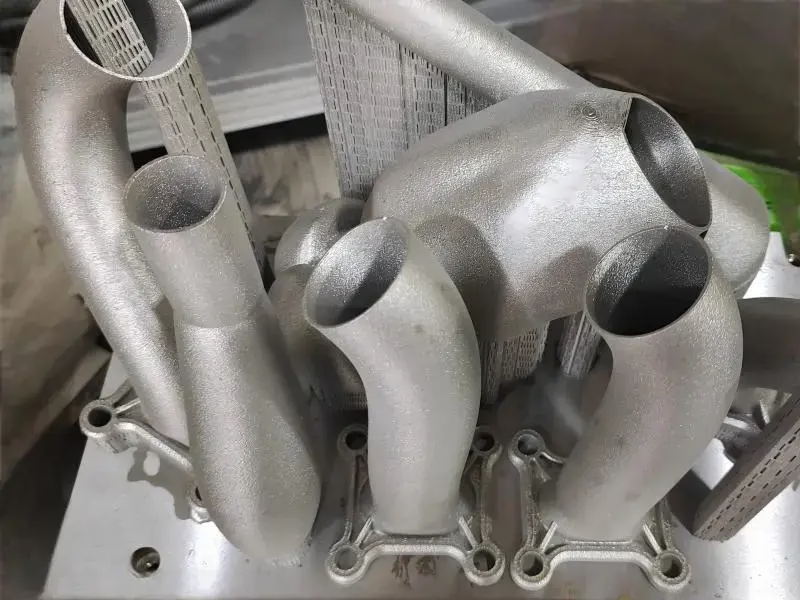
Metal printing earns its place on geometry that cannot be cut. Conformal cooling channels in a mold insert, a bracket with an internal truss, a manifold with curved internal passages. If the drawing shows a hollow form that a cutter cannot reach, additive is often the only route that does not require welding three pieces together.
It loses on the parts that carry load through a machined interface. A bearing housing needs a bore that holds ±0.005 mm and stays round after heat treat. A printed bore usually needs a reaming or boring pass anyway, so the printed blank buys you geometry and costs you a second setup. Once you add that setup, the cost advantage over machining from bar stock often disappears.
Surface finish is the other quiet trap. As-built metal parts commonly land in the Ra 6–10 μm range. If the drawing calls for Ra 0.8–1.6 μm, someone has to machine or polish it. Plan that step into the route before quoting, not after the first article fails inspection.
- 1Good additive candidateInternal channels, low volume, geometry a cutter cannot reach.
- 2Poor additive candidateTight bores, flat sealing faces, high-load interfaces.
- 3Hybrid routePrint the near-net shape, then CNC the critical features.
What this means for CNC capacity and quoting in 2025
If additive demand grows 14% on hardware while part volumes stay modest, the parts that do reach production still need machining. Printed blanks need fixture design, datum cleanup and finish passes. That work lands on the same 5-axis and mill-turn capacity that serves every other program.
In our three plants in Dongguan and Singapore, that shows up as mixed routing on a single quote. A part arrives as a printed or cast near-net shape, and we machine the interfaces: bores, faces, threads, slots. 16 simultaneous 5-axis centers and 16 mill-turn centers handle the contoured work; 27 three-axis machines and 12 four-axis mills absorb the simpler features. Maximum processing size is 4,000 mm, with travel of 4,000 × 400 × 150 mm on the large frames.
The economic prospects of 3D printing therefore matter to a machine shop for a simple reason: every printed part that reaches series production creates a machining operation. Sentiment tells you where the volume is heading. The drawing tells you which process runs it.
Machining capacity available for printed and cast blanks
| Item | Specification |
|---|---|
| Tolerance | ±0.005 mm / ±0.0002 in |
| Surface finish | Ra 0.2–0.8 μm fine, Ra 0.8–1.6 μm standard |
| 5-axis centers | 16 simultaneous |
| Mill-turn centers | 16 |
| 4-axis mills | 12 |
| 3-axis machines | 27 |
| Maximum part size | 4,000 mm |
| Materials | Aluminium, stainless, steel, titanium, copper, PEEK, POM |
| Inspection | 100% before shipment, reports on request |
| Quote turnaround | Quotation and DFM analysis within 12 hours |
How to read an industry forecast without over-planning on it
Survey sentiment is a lagging indicator of capital budgets and a leading indicator of nothing else. The 62.10% figure tells you that executives feel better about 2025 than they felt about 2024. It does not tell you that your specific bracket program will get funding.
Use the forecast to set capacity strategy, not part strategy. If your pipeline has more complex geometry and lower volumes, add additive supply. If it has more load-bearing parts at moderate volume, keep the machining supply base tight and qualified. Most 2025 programs will need both, and the decision is made per drawing, not per industry trend.
One concrete planning number: the survey shows expected improvement rather than a boom. That argues for flexible contracts, no minimum order quantity, and suppliers who can start production within 24 hours once a design is frozen. Parts ship in 3–5 days on that basis, and the historical late-delivery probability sits below 2%.
Questions engineers ask about 3D printing outlook and process choice
Does the 14% growth figure for industrial 3D printers mean more parts will be printed?
Not directly. That figure counts hardware units sold, and a printer purchase is a capital decision. Part volume depends on downstream programs in aerospace, medical and automotive.
In practice, most of those printed parts still pass through a machining operation for bores, faces or threads before they are usable.
Can a printed metal part hold ±0.005 mm without machining?
No. As-built metal printing typically lands around ±0.1 mm, and the surface is rough enough that a bore will not seal or fit correctly.
If the drawing calls for ±0.005 mm, plan a machining pass on the critical features. We can machine printed or cast blanks and inspect them before shipment.
What surface finish comes off a CNC machine compared with an as-built print?
CNC machining gives Ra 0.8–1.6 μm as a standard finish, and Ra 0.2–0.8 μm where the drawing needs it. As-built metal printing is usually much rougher.
If a printed part needs a fine finish, the route includes a finishing operation either way. That cost should be in the quote from the start.
At what quantity does CNC machining become cheaper than printing?
There is no single break-even number, because it depends on geometry and tolerance. Printing has a flat per-unit cost; machining drops once programming and fixturing are amortized.
For simple prismatic parts, machining is usually cheaper well before a few hundred units. For internal channels that cannot be cut, printing stays competitive longer.
Do you handle parts that are printed elsewhere and need finishing?
Yes. We machine near-net blanks, printed or cast, and cut the interfaces: bores, faces, threads and slots. We also run surface finishing in-house.
No minimum order quantity applies. Uploads are secure and confidential, and an NDA is available on request.
Have a drawing that could go either way?
Send the file and we will tell you which process suits it, with a quotation and free DFM analysis within 12 hours.
12-hour quote±0.005 mm tolerance100% inspectionNo minimum order quantity









