
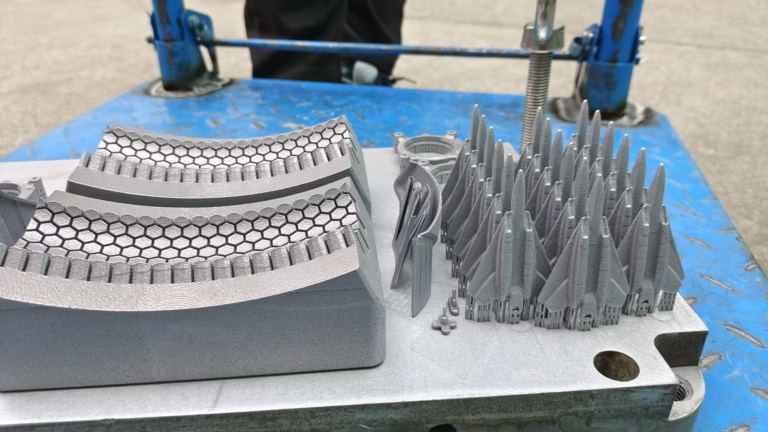
3D Printing Colorado: Top 7 Mistakes to Avoid in 2025
3D Printing Colorado has evolved dramatically over the past decade. What was once a rapid prototyping novelty has become a legitimate bridge to high-volume production, particularly when paired with precision subtractive manufacturing. For companies in the aerospace, medical device, automotive, and energy sectors operating along the Front Range, additive manufacturing (AM) offers tantalizing design freedom. However, enthusiasm often outpaces engineering discipline. As a manufacturing engineer who has spent years on the shop floor troubleshooting failed builds and runaway budgets, I’ve seen the same patterns repeat. Here are the seven most damaging mistakes Colorado businesses make when integrating 3D printing into their precision part strategy—and how to avoid them.
Mistake #1: Choosing the Wrong Technology (The “Shiny Tool” Syndrome)
The most fundamental error is selecting a printer technology before defining the part’s functional requirements. 3D printing is not monolithic. FDM (Fused Deposition Modeling) for concept fit-checks is vastly different from SLM (Selective Laser Melting) for producing aerospace-grade titanium components. In Colorado, where industries like aerospace and custom medical implants demand stringent traceability, using a desktop FDM part in a functional test is a recipe for disaster.
The Trap:
A startup spends $5,000 on a desktop printer because “it’s cool,” then attempts to print a load-bearing bracket for a drone. The plastic part has poor interlayer adhesion, fails during a test flight, and the team wastes two weeks on a rework cycle.
The Reality:
Professional-grade 3D printing is a capital-intensive discipline. Industrial SLM printers (for metal) and SLS printers (for nylon) require controlled environments, specialized gas systems, and extensive post-processing—such as support removal and heat treatment. When you evaluate 3D Printing Colorado services, you are not buying a machine; you are buying a validated process.
The Fix:
Match the process to the product:
Concept models & form-fit: SLA or high-resolution polyjet.
Functional plastic prototypes: SLS with Nylon 12 or carbon-fiber-reinforced composites.
End-use metal parts: SLM or DMLS—but always machine critical mating surfaces afterward.
Mistake #2: Ignoring Design for Additive Manufacturing (DfAM)
This is the killer. You cannot take a 2D engineering drawing designed for a 5-axis CNC mill and simply “print it.” Successful 3D printing requires designing for the layer-by-layer process. This involves lattice structures for weight reduction, self-supporting angles (typically under 45 degrees), and eliminating enclosed cavities that trap powder.
The Trap:
An engineer designs a hydraulic manifold for SLM, but specifies a horizontal internal channel. The channel requires heavy internal support structures that are impossible to remove. The part comes back, the channel is blocked, and the scrap rate hits 100%.
The Reality:
According to industry data, up to 70% of all part failures in AM stem from poor design for manufacturability (DfM). A sophisticated manufacturing partner, like those at GreatLight CNC Machining, will perform a “build-ability” study before the first layer is sliced. They will suggest reorienting the part, adding drain holes for powder removal, and converting critical tolerance zones to machined features later.
The Fix:
Think of the build direction. Every layer is a weakness. If you need a threaded hole or a bearing seat, do not print it. Design a “near-net shape” and machine it to final tolerance using a 5-axis CNC center. The combination of additive for geometry and subtractive for precision is the ultimate 2025 manufacturing strategy.
Mistake #3: Overlooking Material Properties and Certifications
In Colorado, specifically for the aerospace and defense sectors (think of the Space Symposium in Colorado Springs), the material is not a suggestion—it is a contract. Many printing bureaus offer “stainless steel 316L” but fail to mention that the powder may have been recycled multiple times, degrading its chemical composition. Mechanical properties like tensile strength and fatigue life in a printed part are anisotropic (different in the X, Y, and Z axes).
The Trap:
You spec a Ti-6Al-4V implant component. The supplier prints it, but the Z-axis tensile strength is 20% lower than the XY strength because the process parameters were not optimized for layer adhesion. The part fails fatigue testing.
The Reality:
Reputable facilities, such as GreatLight Metal, which owns a full suite of SLM printers and industrial 3D printing services, maintain strict powder traceability and batch documentation. They adhere to ISO 9001:2015 standards, ensuring that testing certificates (Mill Cert) and heat treatment logs (solution treating and aging) are provided with your shipment.
The Fix:
Always demand:
Powder feedstock certificates (chemical composition).
Mechanical property test reports from the same build lot.
A clear heat treatment plan (stress relief is mandatory for most aluminum and titanium alloys).
Mistake #4: Neglecting Surface Finish and Tolerance Over-Engineering
A harsh reality of 3D printing is that a “raw” printed part looks like a very fine sandpaper. For SLS nylon, the surface is grainy. For metal SLM, the “as-built” surface roughness (Ra) is typically in the 10-20 µm range—far too rough for dynamic O-ring seals or bearing surfaces. Many engineers make the mistake of accepting this roughness or, conversely, over-engineering the print tolerance to ±0.001mm when the process physics cannot achieve it.
The Trap:
You order a printed aluminum chassis and specify a critical bore at +/- 0.005mm. The supplier prints it, but the thermal stress warps the part by 0.5mm after the parts are cut off the build plate. The part is useless.
The Reality:
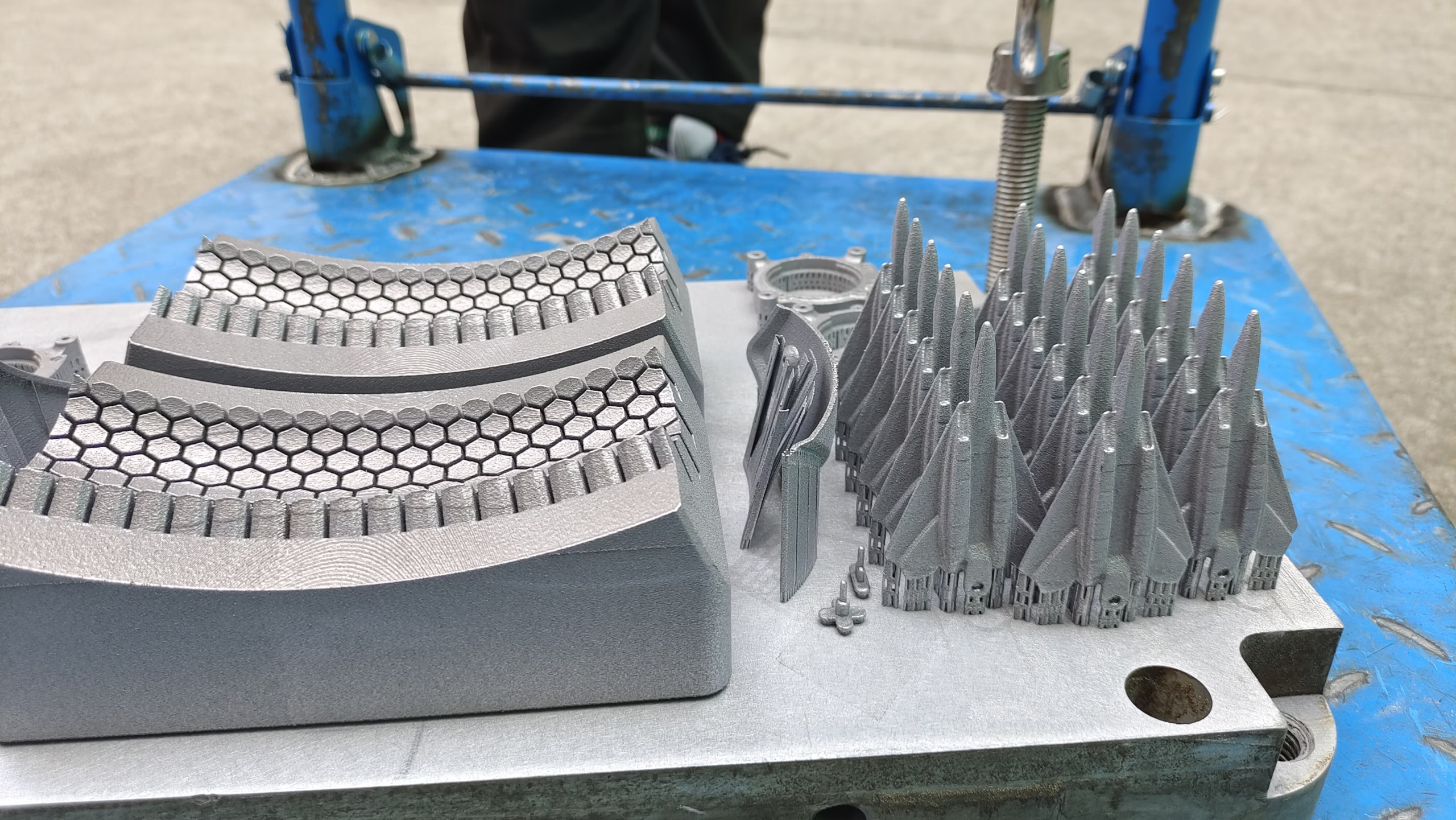
The “precision” in additive manufacturing is what happens after the print. This is where the industry is moving in 2025: Hybrid Manufacturing. Smart clients treat the 3D printer as a roughing operation. They design the part oversized by 0.5mm on critical faces, then send it to a 5-axis CNC machining center to achieves the true precision tolerance (H7 bores, mirror finishes, and flatness).
The Fix:
Accept a realistic tolerance for as-built features (typically ±0.1mm). For anything critical, plan for a secondary machining step. GreatLight CNC Machining excels here—using their large high-precision five-axis, four-axis, and three-axis CNC machining centers to finish parts up to 4000mm. This is the “one-stop” approach that saves massive headaches downstream.
Mistake #5: Failing to Integrate Secondary Operations (CNC Machining & Post-Processing)
This mistake is the most expensive one on our list. A client sends a 3D model to a “print-only” shop. The shop delivers beautiful-looking metal parts. But the parts cannot be installed because the holes are slightly drifted, the threads are weak, and the mating flanges are not flat. The client then has to send those parts out to another machine shop, pay for setup, and wait another 2-3 weeks. This decoupled workflow is the primary driver of cost overruns in 3D Printing Colorado projects.
The Trap:
You print a gearbox housing. You have it printed, then you send it to your usual CNC shop for finishing. Your CNC shop says, “We need specific software (CAM) to locate that part on our machine. We aren’t set up for that irregular shape.” The part sits on the shelf for three weeks.
The Reality:
The most efficient manufacturing model of 2025 is the integration of additive and subtractive under one roof. When you work with a supplier that has both digital SLM/SLS 3D printers and traditional CNC mills, lathes, and grinding machines, you eliminate the “throwing it over the fence” problem. The CNC programmer uses the same CAD file to create a fixture that aligns with the printed part’s datum features.
The Fix:
Choose a partner who offers the full chain: 3D printing -> CNC milling -> Surface finishing (anodizing, powder coating, nickel plating) . This list of services ensures the part arrives ready for assembly, not just “ready for the next problem.” GreatLight specifically offers “one-stop surface post-processing services,” which is a requirement for any high-tech hardware in Colorado.
Mistake #6: Underestimating Material Costs & Lead Time for “Complex” Builds
2025 economics are tightening. The steep cost of metal powder (titanium and Inconel are expensive) coupled with machine build times (a complex SLM job can take 24 to 48 hours) means that a simple 2-axis turned part is often 4x more expensive to print than to machine. Businesses make the mistake of treating 3D printing as a “cheap” alternative to CNC machining. It is not. It is a value-added alternative for complexity.
The Trap:
You need 200 simple aluminum brackets. You assume printing them is faster and cheaper than CNC. The printing quote is $12,000 with a 2-week lead time. A CNC shop quotes $6,000 with a 1-week lead time because they can run 10 up simultaneously on a tombstone.
The Reality:
Industrial 3D printing is most cost-effective for:
Low volume (1 – 50 pieces).
Highly complex geometry that cannot be machined.
Parts where supply chain consolidation is needed.
If it can be bolted down on a standard CNC table, machining is almost always the deadlier competitor in speed and price.
The Fix:
Ask your supplier for a hybrid quote. Ask: “What is the cost if you machine these simple features and only print the complex internal fluid channels?” This strategic approach often cuts costs by 40%.
Mistake #7: Ignoring the “Build Volume” Reality Check
Many companies in Colorado attempt to print a large housing explicitly because they need a large part. They fail to check the maximum build volume of the printer. When a part is too large for the machine, you have two options: split the part and weld/bolt it together (creating leak risks) or redesign entirely. At GreatLight, we see this constantly. Customers forget that while their part is 600mm wide, the useful build platform on many commercial metal printers is only 250mm x 250mm x 300mm.
The Fix:
Before designing your part for 3D Printing Colorado, decide whether your design is a “printed core” or a “machined envelope.” For large parts, it is often wiser to machine the large frame (using a large 4000mm 5-axis CNC machine) and print the intricate internal core assembly. This “brick and mortar” strategy maximizes reliability and minimizes print failure risk.
Comparative Analysis: Choosing the Right Partner
To address these mistakes, you need a partner with deep engineering capability. Below is a comparison of standard service providers and advanced manufacturers. The key distinguishing factor is whether the supplier offers both the digital additive and the mechanical subtractive process in-house.
| Capability | Typical 3D Printing Bureaus | GreatLight CNC Machining | Large-Scale Prototyping Platforms |
|---|---|---|---|
| Core Focus | Print-only, low volume plastic & metal. | Integrated: 3D printing + 5-axis precision machining + post-processing. | On-demand sourcing, often fragmented via a network. |
| Material Handling | Often limited to specific powders. | Broader range: Stainless, Aluminum, Titanium, Tool Steels, and engineering plastics. | Varies by supplier; quality control is inconsistent. |
| Design Support | Basic “upload file & print” support. | DfAM (Design for Additive Manufacturing) + DfM (Design for Machining) engineering review. | Software-driven feedback, limited engineering “hands-on” help. |
| Post-Processing | Minimal (support removal, sandblasting). | Complete: CNC finishing to ±0.001mm, anodizing, vacuum casting, EDM. | Outsourced, adding logistics time and cost. |
| Certifications | General quality check. | ISO 9001:2015, IATF 16949, ISO 13485 standards—critical for medical & auto use. | Standard certifications, not always enforced on final part. |
| Best For | Rapid concept models, aesthetic proofs. | End-Use production parts for robots, aerospace, and automotive. | Simple, non-critical geometries; high-volumes of basic parts. |
In the context of this comparison, platforms like Protolabs Network, Xometry, and Fictiv offer excellent volume and convenience for basic parts. However, for the Colorado client building a complex humanoid robot or a medical device, the value of an engineering partner like GreatLight Metal—which can print the intricate titanium lattice, machine the critical flanges, and apply the final medical-grade finish—trumps the convenience of a purely digital marketplace. You are not buying a part; you are buying the mitigation of risk.
The 2025 Framework: A Step-by-Step “Save Your Project” Checklist
If you are about to click “send” on an order form for 3D Printing Colorado, run your project through this “GreatLight” protocol:
Step 1: Define the “Critical to Quality” (CTQ) Features. Identify which holes, slots, and surfaces have functional tolerances tighter than ±0.05mm. Mark these as “Must Machine.”
Step 2: Optimize the Build Orientation. Work with your engineer to orient the part to minimize supports in non-critical areas, but always accept that the “precision surface” will face the roughing process.
Step 3: Request an End-to-End Quote. Ensure your quote includes not just the printing, but the CNC machining, the vibratory finishing, and the quality inspection (CMM report).
Step 4: Verify the Heat Treatment. If you are printing Aluminum (AlSi10Mg) or Titanium, does the supplier have a stress-relief oven? If not, your part will warp when you machine it.
Step 5: Demand Traceability. For medical or aviation uses, ask for the batch numbers of the powder. A supplier without these records is a liability you cannot afford.
Conclusion: The GreatLight Advantage
The manufacturing landscape in 2025 is not about choosing between 3D printing and CNC machining. It is about orchestrating their synergy. The companies that stumble are those that treat these technologies as isolated silos. The leaders—those building the next generation of ventilators, EV battery modules, and aerospace actuators in Colorado—will succeed by integrating the design freedom of additive with the rigorous accuracy of subtractive processes.
Avoiding the seven mistakes above requires more than just a “quote.” It requires a commitment to engineering partnership. That is why manufacturers are turning to established players like GreatLight CNC Machining, which offers dedicated five-axis precision machining and advanced SLM 3D printing under one roof, backed by ISO-certified quality systems and decades of hands-on experience. When your engineering confidence is on the line, remember that true precision is not printed—it is achieved through a sophisticated balance of technology.
As you move forward with 3D Printing Colorado in 2025, challenge your assumptions, audit your supply chain for additive and subtractive capabilities, and ensure that your finishing services are as sophisticated as your digital designs. The future is not about making parts; it is about making successful parts. Choose your manufacturing partner wisely.



















