
3D Printing Reshaping Future of Industry: Where Additive Fits
This page is for engineers and buyers deciding between additive manufacturing and CNC machining. We explain how 3D printing is reshaping future of industry, which geometries and volumes it suits, and where subtractive processes still hold the tolerance. Read it before you commit a design to a process.
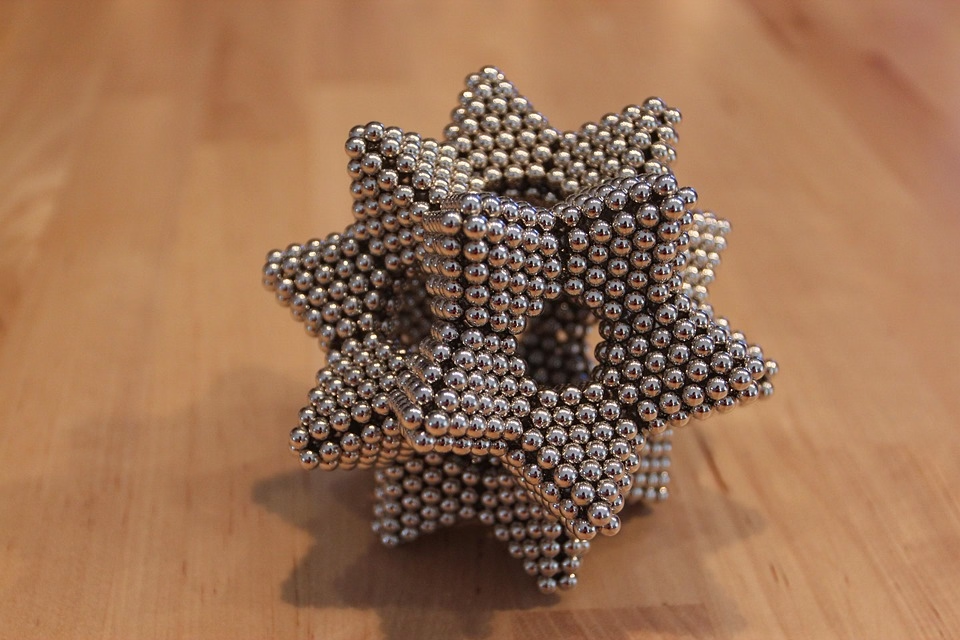
Additive is a process choice, not a replacement
Additive manufacturing builds parts by adding material layer by layer; CNC machining removes it from stock. Both end up as a finished component, and the decision usually comes down to geometry, quantity and tolerance.
How additive manufacturing actually builds a part
Every additive build starts with a digital model. Engineers export an STL or 3MF file from CAD, then slicing software cuts that model into layers, typically 20 to 100 μm thick for metal and 50 to 300 μm for polymer. The machine reads those layers and deposits or fuses material one pass at a time until the geometry is complete. Direction of build matters: a part printed vertically has different layer orientation than one printed flat, and that changes both strength and surface finish.
Material options have widened well beyond prototyping resin. Today's machines run nylon PA12, PEEK, ABS, photopolymer, stainless steel, aluminum alloys, titanium Ti-6Al-4V and Inconel. Each family has its own printer type. FDM extrudes filament, SLS sinters powder, SLA cures resin with a laser, DMLS and SLM fuse metal powder, and binder jetting glues powder before a sintering step. Choosing the process means matching material properties to the part's load path, not picking the cheapest option.
The output of an additive build is rarely a finished part. Supports must be cut away, surfaces often need bead blasting or machining, and holes may need reaming to hit a tolerance. Metal parts usually go through stress relief and sometimes HIP. That post-processing is where much of the cost and lead time hides, and it is why a printed bracket can cost more than a machined one at low volume.
Geometries that only additive can make
Internal channels are the clearest case. A conformal cooling channel that follows the curve of a mold insert cannot be drilled from any angle, but it can be grown layer by layer. The same applies to lattice structures, thin-walled heat exchangers and parts with undercuts that would need five setups on a mill. When a design has features that no tool can reach, additive is often the only route.
Consolidation is the second win. A assembly of twelve machined and welded pieces can become one printed part, which removes fasteners, joints and the alignment errors between them. That reduces weight and eliminates leak paths in manifolds. For low-volume production and one-off tooling, the economics work because there is no fixture to build and no minimum order quantity.
Lightweighting matters in aerospace and motorsport. Topology optimization produces organic shapes that carry load only where it is needed. A machined version of that shape would require many setups and a lot of stock removal, and some of the geometry would still be impossible. Printed titanium and aluminum brackets are common in these programs for exactly that reason.
- 1Internal channelsConformal cooling and fluid paths no drill can reach.
- 2Lattice and thin wallsStiffness with low mass, made in one build.
- 3Part consolidationMany pieces become one, removing joints.
- 4Topology optimized shapesOrganic load paths that subtractive cannot cut.
Additive versus CNC machining at a glance
Use this as a first filter before you send a drawing out for quote.
| Factor | 3D printing | CNC machining |
|---|---|---|
| Typical tolerance | ±0.1 to ±0.3 mm | ±0.005 mm |
| Surface finish | Ra 6–15 μm as built | Ra 0.2–1.6 μm |
| Best quantity band | 1 to a few hundred | 1 to 10,000+ |
| Internal channels | Complex shapes possible | Straight drilled holes |
| Material range | Polymer, metal, ceramic | Metals and plastics |
| Setup cost | Near zero | Fixtures may be needed |
| Lead time | Hours to days | 3–5 days after setup |
| Dimensional stability | Depends on build direction | Uniform, well understood |
Where 3D printing still falls short
Tolerance is the first limit. A printed metal part typically holds ±0.1 to ±0.3 mm on a good day, and an as-built surface sits around Ra 6 to 15 μm. If a bore needs to fit a bearing at ±0.005 mm, or a sealing face needs Ra 0.8 μm, the printed blank has to be finish machined. Many production parts are printed near net shape and then brought to tolerance on a CNC, which combines the two processes rather than choosing one.
Anisotropy is the second. Layer boundaries create directional strength, so a printed part can be strong along the build plane and weaker across it. Fatigue life under cyclic load is harder to predict than in wrought stock. For safety-critical parts in aerospace or medical devices, that means qualification testing, and often a machined final geometry. Certification bodies want traceable material and known grain structure.
Cost per part is the third. Additive has almost no tooling cost, but the per-part cost stays roughly flat as volume rises. CNC has setup cost, then a low marginal cost per part. Somewhere between a few hundred and a few thousand units, the curves cross. Above that, machining, casting or molding usually wins on unit price.
Combining additive and subtractive in one program
The most common production path we see is hybrid. A part is printed to near net shape, then machined on critical faces, bores and threads. This is standard for plastic and metal prototypes that must function like the final part. The printed body carries the complex geometry; the CNC operation delivers the fits and finishes that assemblies depend on.
At GreatLight, we run both sides. Our 127 high-precision CNC machines include 16 simultaneous 5-axis machining centers, 12 four-axis mills and 16 mill-turn centers, with a maximum processing size of 4,000 mm. We machine aluminum, stainless, titanium, Inconel, PEEK and engineering plastics, and we hold ±0.005 mm with finishes down to Ra 0.2–0.8 μm when a drawing calls for it.
If a design is still open, send the CAD and we will return a DFM analysis with the quote, usually within 12 hours. We will tell you which features are better printed and which are better cut, and where a hybrid flow saves money. No minimum order quantity: one prototype or a 10,000-part run. Uploads stay confidential, and an NDA is available on request.
Questions engineers ask about additive
Can a 3D printed part hold the same tolerance as a CNC machined part?
No. Printed metal typically lands between ±0.1 and ±0.3 mm, and polymer can be looser depending on shrinkage. CNC machining holds ±0.005 mm on our equipment.
If the drawing calls for a press fit, a bearing seat or a sealing face, plan a finish machining step after printing.
Which materials can be printed and then machined?
Common pairings are aluminum alloys, stainless steel, titanium Ti-6Al-4V and Inconel for metal, plus PEEK, PA and ABS for polymer. All of these machine well after printing.
Very hard or abrasive printed composites can wear tooling faster, so we review the material before quoting the finishing step.
At what quantity should we switch from printing to machining?
There is no fixed number, but the crossover often sits between a few hundred and a few thousand parts. Below that, printing avoids tooling cost.
Above it, machining, die casting or injection molding usually wins on unit price. Send the annual volume with the drawing and we will model both routes.
Does build orientation affect the final part?
Yes. Layer direction changes tensile strength, fatigue life and surface finish on the same geometry. A part printed upright can be weaker across the layers than the same part printed flat.
We review orientation before a build so that load paths run along the layers rather than across them.
How do you handle confidentiality on uploaded files?
Uploads are secure and confidential. We can sign an NDA before files are shared, and access is limited to the engineers quoting and machining the part.
We hold ISO 27001:2022 certification for information security.
Send the CAD, get a process recommendation
We will review your geometry, tell you what to print and what to machine, and return a quote with DFM notes.
12-hour quote±0.005 mm toleranceNo minimum order quantityNDA on request









