
Snowblower Model 31A 32AE752AE6FFF700 Parts Diagram: How to Read It
This page explains how a snowblower model 31A 32AE752AE6FFF700 parts diagram is organized, why the long number string is not one model, and how to match a worn part to a drawing before you order or machine a replacement. It is written for owners who repair their own two-stage machine and for engineers who get asked to reverse-engineer an obsolete casting.
In this article
- 1
- 2
- 3
- 4
- 5
- 6
What the long number on the tag actually means
The string 31A-32AE752AE6FFF700 is not a single product code. The first portion, 31A-32AD752, is the base model that every parts diagram is drawn against. Everything after that is batch and serial information tied to the day the machine left the line. When you open a parts list, the drawing you need is indexed under the base number, not the full string.
This matters because two machines sold a month apart share the same exploded views but may not share every component. MTD revises small hardware, chute cranks and skid shoes between production runs without changing the base model. A diagram tells you the shape and position of a part. It does not tell you which revision your machine carries.
The tag is usually a sticker on the rear frame behind the engine, or on the inside of the fender. Copy the characters exactly, including the letters. A single transposed digit is the most common reason a buyer receives a pulley that does not fit the shaft.
Write it down before you touch a wrench. Once the auger housing is off the machine, the tag is often the first thing to get covered in snow and grit. A phone photo of the tag at the start of a job saves a second teardown later.
- 1Base model 31A-32AD752The number that indexes every parts diagram.
- 2Trailing charactersSerial and production batch, useful for warranty and revision questions.
- 3Tag locationRear frame behind the engine, or inside the fender.
How an exploded parts diagram is put together
A parts diagram for this class of two-stage machine is a set of exploded views, one per assembly group. Each view shows the parts pulled apart along their real assembly axis, with balloon numbers pointing at every item. The balloon numbers are the key. They link the picture to a row in the parts list, and that row carries the part number, the description and the quantity used.
The groups are consistent across the machine. There is a housing group, an auger and impeller group, a drive and friction wheel group, a chute and deflector group, a control and cable group, and an engine interface group. Some manuals split the frame and handle assembly out separately. If you cannot find a part, you are usually looking at the wrong balloon set rather than a missing drawing.
Quantity is the field people skip. If the list says four, there are four, and they are often two different lengths used in mirrored positions. Count what you remove and keep the fasteners grouped by location.
Read the drawing before you remove anything. Trace the power path from the engine pulley through the belt to the friction wheel and out to the auger gearbox. Once you can name that path, a diagram stops being a picture and starts being a repair plan.
- 1Balloon numbersThe only reliable link between drawing and parts list row.
- 2Assembly groupsHousing, auger, drive, chute, controls, engine interface.
- 3Quantity columnMirrored positions often use different fastener lengths.
Which parts wear out, and what the drawing will not tell you
A diagram gives geometry, not a service limit. It will show you the shape of a shear bolt but not that the bolt is designed to fail first. It shows the impeller but not that the clearance between impeller paddle and housing wall decides how far the machine throws snow. Those numbers come from measurement, not from the drawing.
The high-wear list on this machine is short and predictable. Shear bolts, auger and impeller paddles, scraper bar, skid shoes, drive and auger belts, friction wheel and rubber ring, and the bushings in the chute crank. Fasteners on the auger housing are also a common casualty because they sit in the wettest, most abrasive place on the machine.
Measure before you order. A worn scraper bar has a measurable remaining thickness, and a friction wheel has a measurable outside diameter. If the part is within tolerance, the problem is elsewhere. If it is out, you now have a dimension to specify instead of a guess.
For plastic and rubber items, the diagram is close to useless as a condition guide. Chute deflector hardware and crank bushings fail by cracking, not by wearing down. Inspect them by hand for play and for hairline cracks at the mounting bosses.
- 1Shear boltsDesigned to fail before the gearbox does. Carry spares.
- 2Scraper bar and skid shoesWear against asphalt and concrete every pass.
- 3Friction wheelWears by diameter, not by appearance.
When a replacement part should be machined instead of bought
Most of this machine is a buy-the-part repair. Belts, shear bolts, cables and plastic chute parts are cheap and available. Machining only makes sense when the part is discontinued, when the lead time on the original is longer than the snow season, or when the original design is the reason it failed.
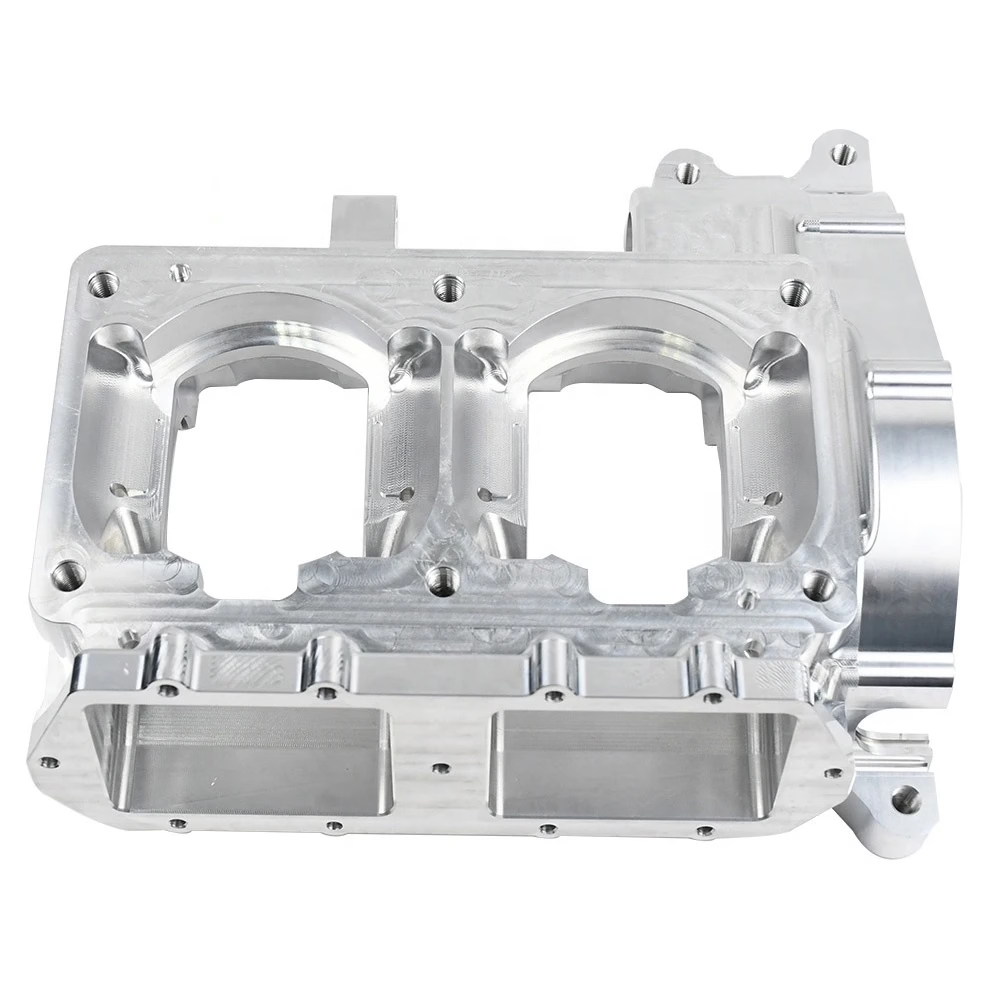
Discontinued castings are the clearest case. If a pivot bracket, a shaft collar or a chute pivot is no longer stocked, a reverse-engineered replacement in 6061-T6 or 304 stainless will usually outlast the original die-cast zinc or stamped mild steel. We work from the failed part plus a photograph of it in position, and we return a drawing for approval before cutting metal.
Fit matters more than alloy here. A snowblower works in a temperature range from -20 °C to +5 °C, with road salt and grit in the mix. Clearance between a new shaft and its bushing should be loose enough to survive ice build-up. A press fit that is correct in a warm shop can seize solid after a night outdoors.
Tolerance depends on the function, not on habit. A chute pivot or a belt idler bracket is fine at ±0.1 mm. A shaft that runs in a bearing or a bushing needs ±0.02 mm or tighter. We hold ±0.005 mm when a mating bore demands it, and we say so in the quote rather than defaulting to the tightest number.
- 1Buy the part whenIt is in stock, low cost, and the failure was normal wear.
- 2Machine the part whenDiscontinued, long lead time, or the design itself caused the failure.
- 3Alloy choice6061-T6 or 304 stainless for brackets, shafts and pivots.
Tolerances and fits for cold-weather replacement parts
Cold changes fits. Steel and aluminum shrink at different rates, and a running clearance that works at 20 °C can close to nothing at -20 °C. For a 25 mm nominal shaft, the difference between the two materials across a 40 °C swing is small but real, and it is enough to matter on a bushing with a tight clearance.
The practical rule is to open running clearances slightly on any part that sees snow and ice. Sliding fits that would be H7/g6 in a machine tool become a little looser. Threaded fasteners stay standard, because the thread pitch is a global standard and the fit is not the issue.
Surface finish also changes behavior. A polished shaft at Ra 0.2–0.8 μm sheds water and resists ice bonding better than a turned finish at Ra 3.2 μm. For parts that sit in the wet path, a smoother finish and a light corrosion-resistant coating do more than a harder alloy.
If the part is a wear surface, hardness beats finish. A hardened bushing or a 17-4PH shaft resists grit abrasion longer than a soft stainless one. We confirm the material and heat treatment in the DFM review before production starts, so the drawing and the delivered part agree.
We inspect every part before it ships and can supply reports on request. For a one-off replacement, that report is usually the drawing with measured dimensions marked on it.
- 1Sliding fitsOpen slightly for ice and grit; do not copy machine-tool fits.
- 2Running surfacesRa 0.2–0.8 μm sheds water better than a turned finish.
- 3Wear surfacesHardness, not polish, decides abrasion life.
Buy the original part or machine a replacement
Decision guide for common failures on this machine
| Failure | Buy original when | Machine a replacement when |
|---|---|---|
| Shear bolt sheared | Always. It is a sacrificial part. | Never. Buy a bag of spares. |
| Auger or impeller paddle | New assembly is in stock locally. | Housing is sound and only paddles are worn. |
| Scraper bar | Standard bar matches your deck width. | Deck is an odd width or bar is discontinued. |
| Friction wheel | Rubber ring is still sold separately. | Hub is worn and only the ring is available. |
| Chute pivot bracket | Bracket is in stock and cheap. | Bracket is discontinued or cracked at the boss. |
| Drive shaft or bushing | Shaft is straight and only bushing is worn. | Shaft is scored and no longer round. |
| Belt idler bracket | Bracket is stamped and available. | Bracket bent and keeps bending in service. |
| Chute crank bushing | Plastic bushing is a stock item. | Bushing seat is wallowed out in the housing. |
The short version
If a part is in stock, cheap, and failed from normal wear, buy it. If it is discontinued, back-ordered past your snow season, or failed because the original design was too weak, machine it: 6061-T6 or 304 stainless, clearances opened for cold, and a drawing approved before cutting starts.
Questions we get about this machine
Do I need the full 31A-32AE752AE6FFF700 string to order parts?
No. The parts diagram is indexed under the base model, 31A-32AD752. The trailing characters are serial and batch information.
Give the base number when you order. Keep the full string for warranty claims and for revision questions, because MTD changes small hardware between production runs.
The diagram shows a part with no number. What is it?
It is usually a sub-assembly shown for context, or a fastener included with the assembly above it. Balloon numbers point at items you can order individually.
If a part has no balloon, check the quantity column of the nearest assembly. The item is often sold only as part of that group.
Can you copy a discontinued casting from my broken part?
Yes, if we can measure the original or reconstruct the missing geometry from the mating parts. We photograph it in position, model it, and send a drawing for your approval.
Die-cast zinc and stamped mild steel parts are the usual candidates. We normally quote 6061-T6 aluminum or 304 stainless as the replacement material.
What tolerance do you hold on a replacement shaft?
It depends on the fit. A shaft running in a bearing or bushing typically needs ±0.02 mm or tighter, and we hold ±0.005 mm when the mating bore calls for it.
Brackets and pivots that only locate a part are fine at ±0.1 mm. We state the tolerance in the quote instead of applying one number to everything.
How do I check a friction wheel before ordering?
Measure the outside diameter of the rubber ring and compare it against the unworn figure for your model. Also check for glazing and for a flat spot.
If the diameter is within tolerance but the machine slips, look at the drive plate surface and the belt tension first. The wheel may not be the problem.
Will a machined part survive road salt better than the original?
Usually, if the alloy and finish are chosen for it. 304 stainless and 6061-T6 with a hardcoat anodize both handle salt spray far better than untreated die-cast zinc.
The bigger gain is often stiffness. A bracket that bent because it was too thin will not bend again if the replacement is a solid machined part.
Send us the part, not the whole machine
Upload a photo of the failed part and its position on the machine. You get a quotation and a free DFM analysis within 12 hours, with no minimum order quantity and an NDA on request.
12-hour quoteNo minimum order quantity100% inspection
More from the shop floor
We publish setup notes, tooling trials and inspection data from the factory floor.











