
Wolverine Mask 3D Printing Guide
A metal or resin Wolverine mask is a hollowed shell with a lattice core, not a solid sculpt. This guide explains how the shell is built, printed, cut apart, and finished. It is written for prop engineers and buyers who need a wearable part that survives a full convention weekend.
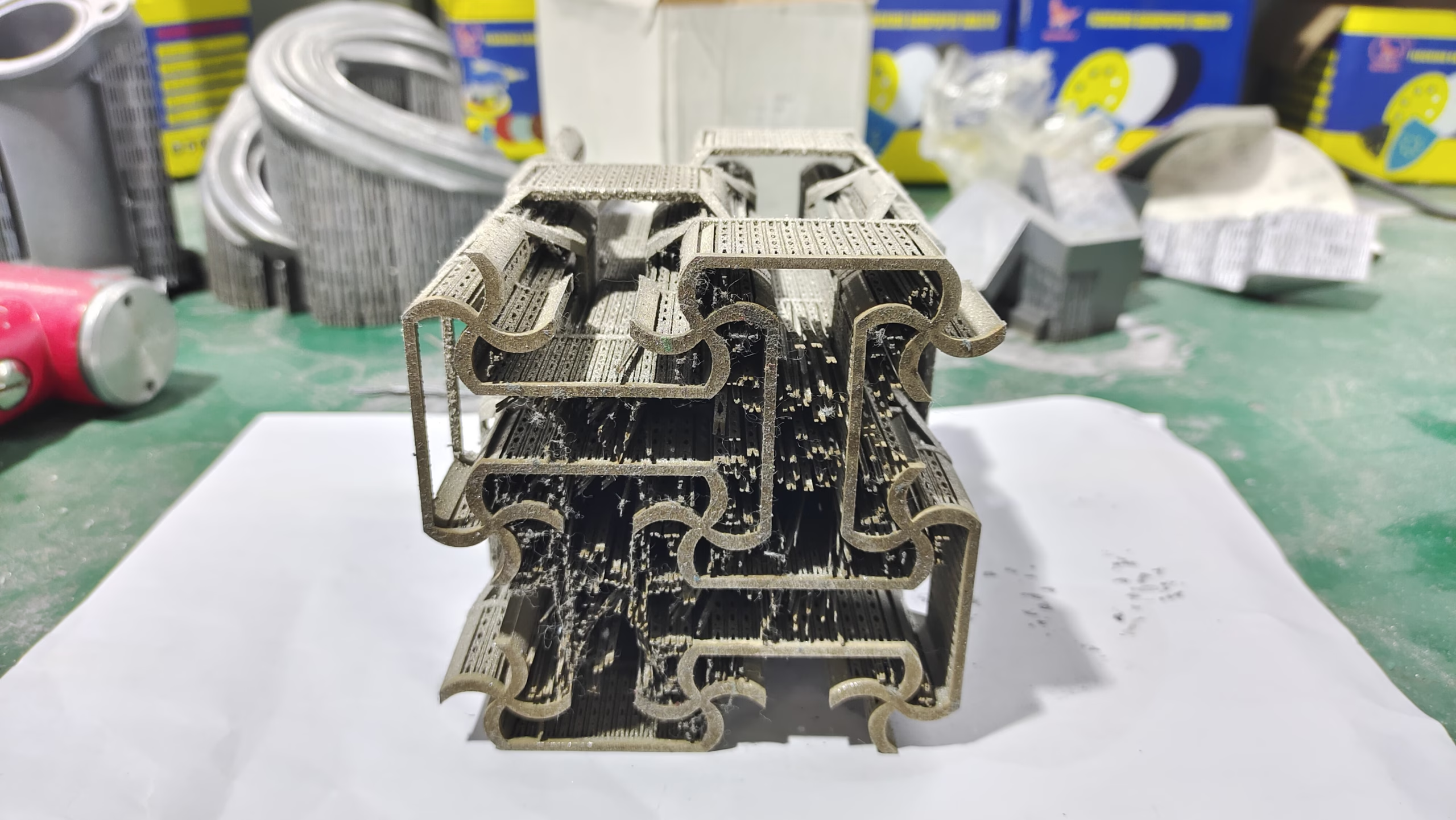
What a wearable mask actually is
A Wolverine mask 3d printing job starts as a digital sculpt and ends as a hollowed structure. The outer surface carries the face shape. The inner surface mirrors it at a fixed offset, usually 1.2 to 2.5 mm. Between those two skins sits a lattice or a ribbed cavity. That cavity is what makes the part wearable.
Solid metal is the wrong answer. A full-face solid shell in stainless would weigh roughly 2.5 to 4 kg depending on size and alloy. That mass sits on the nose bridge and cheekbones. After about twenty minutes the wearer is fighting the mask instead of wearing it.
The hollow shell trades mass for stiffness. A 1.5 mm skin with a 3 mm rib pattern every 25 to 40 mm keeps the shape under hand pressure while cutting mass by 60 to 75 percent. The ribs carry bending load; the skin carries the surface.
The design boundary is simple. Thin walls below 1.0 mm distort during sintering or warp during support removal. Walls above 3 mm waste material and slow the build without adding useful stiffness to a curved shell.
- 1Skin thickness1.2–2.5 mm is the practical band for a wearable face shell.
- 2Rib spacing25–40 mm keeps the brow and jaw from flexing inward.
- 3Open backTrim the rear to a rim; a closed dome traps heat and fog.
- 4Eye openingsLeave 2–3 mm of material around each socket to avoid crack starts.
Metal AM versus resin for the same file
The file decides less than people think. The same STL can go to DMLS, SLA, or SLS. What changes is the wall thickness, the support strategy, and the post-processing chain. A model tuned for resin will usually fail in metal, and the reverse is also true.
DMLS builds layer by layer in 20 to 40 μm increments and sinters the part in the same machine. Residual stress builds in the first few millimeters above the build plate. That is why metal masks are printed tilted 10 to 20 degrees and anchored with block supports at the jaw line, not the brow.
SLA resin prints at 50 to 100 μm layers and holds fine surface detail well. It is the right choice for a painted display piece or a master pattern for vacuum casting. It is the wrong choice for anything that will be dropped on concrete.
SLS nylon sits between the two. It is tough, light, and cheap per part, but the surface has a grain that needs sanding and primer before it reads as metal. For a mask that will be handled by strangers at a show, that trade is often correct.
- 1Choose DMLSWhen the mask must be thin, rigid, and metallic to the touch.
- 2Choose SLAWhen surface detail and paint finish matter more than impact strength.
- 3Choose SLSWhen you need several copies that survive handling without chipping.
Orientation, supports, and distortion control
A face shell is a shallow dome. Printed flat, the brow and cheek areas cool at different rates and the part bows. Tilt the build 10 to 20 degrees from vertical so the recoater passes along the curve rather than across it.
Supports belong on the jaw and the outer rim. Never place a support contact point on the nose bridge or the eye socket edge. Those are the two thinnest sections and the two places where a grinding mark will be visible from two meters away.
After the build, the part goes through stress relief before it is cut from the plate. Cutting first releases the stored stress and the shell springs out of shape. Stress relief runs in a vacuum or inert atmosphere, then the supports are removed with a cut-off wheel or wire EDM.
Distortion is measurable. A well-oriented stainless shell holds within 0.3 to 0.5 mm across a 200 mm span after stress relief. A poorly oriented one can move 2 mm or more, which is enough to break the eye opening symmetry.
- 1Tilt10–20 degrees from vertical along the jaw-to-brow axis.
- 2Support contactsJaw line and outer rim only, never the sockets.
- 3SequenceStress relief first, then cut from plate, then support removal.
Support scars, blasting, and the finish chain
Support removal leaves witness marks. On stainless, the marks are shallow craters a few tenths of a millimeter deep. They are removed by hand with a 400 grit stone, then blended with a rotary tool. Skipping this step means the marks reappear after polishing as dark spots.
Bead blasting evens the surface before any polishing. Glass bead at 4 to 6 bar gives a matte that hides small defects and prepares the surface for plating or anodizing. For a brushed look, follow with a directional abrasive pad.
If the mask will be anodized, the surface must be uniform before it enters the tank. Anodizing amplifies scratches. A surface that looks fine in shop light will show every sanding line after anodizing.
Polishing to a mirror finish is possible but rarely correct for this part. A Wolverine mask reads as brushed or matte metal. Mirror polishing also shows every handling fingerprint, which is a practical problem on a prop that gets touched.
- 1Blend supports400 grit stone, then rotary blend before blasting.
- 2BlastGlass bead at 4–6 bar for an even matte.
- 3Anodize prepUniform sanding or the tank will show every line.
- 4Final finishRa 0.8–1.6 μm reads as brushed metal.
Padding, mounting, and what breaks first
The printed shell is only half the assembly. The mask needs a liner, a strap anchor, and a way to locate it on the face repeatably. Foam padding at the forehead and cheekbones spreads contact load. Without it, a 400 g stainless shell leaves marks in twenty minutes.
Strap anchors should be machined, not printed. A printed eyelet in a 1.5 mm wall will crack at the layer lines under a 20 N pull. A small 6061 or 316 stainless tab, 3 mm thick, bonded or riveted to the inner rim, survives years of use.
Magnets are the common attachment for a two-piece mask. Press-fit neodymium discs in machined pockets hold better than glued magnets. Pocket depth 0.1 to 0.2 mm over the magnet thickness gives a press fit that does not rely on adhesive alone.
What breaks first is almost always the eye opening edge and the jaw rim. Both are thin, both see handling load. If you expect rough use, thicken those two features to 2.5 mm and accept the extra mass.
- 1PaddingForehead and cheekbones, 3–5 mm closed-cell foam.
- 2AnchorsMachined 3 mm tabs, not printed eyelets.
- 3MagnetsPress-fit pockets, 0.1–0.2 mm interference.
- 4ReinforceEye rims and jaw edge to 2.5 mm for hard use.
Process comparison for a face shell
Values are typical ranges for a 1.5 mm shell with lattice infill.
| Process | Typical wall | Surface as built | Best fit |
|---|---|---|---|
| DMLS stainless | 1.2–2.5 mm | Ra 6–10 μm | Thin rigid metal mask |
| DMLS titanium | 1.0–2.0 mm | Ra 8–12 μm | Lowest weight per volume |
| SLA resin | 1.5–3.0 mm | Ra 1.6–3.2 μm | Display and master pattern |
| SLS nylon | 2.0–4.0 mm | Ra 10–15 μm | Repeat handling props |
Which route to take
If the mask must be thin, rigid, and metal to the touch, print DMLS stainless or titanium and budget for stress relief and hand blending. If it is a painted display piece or a master for casting, print SLA and skip the metal chain. Do not print a solid shell in either process.
Common questions
How thick should the shell be for a metal Wolverine mask?
For DMLS stainless, 1.2 to 2.5 mm is the working band. Below 1.0 mm the shell distorts during sintering and support removal. Above 3 mm you add mass without useful stiffness on a curved surface.
If the mask will be handled roughly, thicken the eye openings and jaw rim to 2.5 mm and leave the rest at 1.5 mm.
Can the mask be printed in one piece?
Yes, if the build volume and the support strategy allow it. A single-piece build avoids a seam line across the face, which is the main reason to do it.
The trade is access. A one-piece shell is harder to reach inside for support removal and padding. Many builds are split at the jaw line for that reason.
How do you stop the mask from fogging up?
Leave the back open and add vent slots near the temples. A closed rear dome traps warm moist air and the eye openings fog within minutes.
Anti-fog coating on a clear lens insert works, but airflow is the real fix. Two 8 to 10 mm slots at the temple are usually enough.
Does the mask need heat treatment after printing?
DMLS parts should be stress relieved before they are cut from the build plate. Cutting first lets the stored stress pull the shell out of shape, often by 2 mm or more across a 200 mm span.
Resin and nylon parts do not need this step. They need washing and, for resin, a full UV cure before any sanding.
What is the lightest practical metal option?
Titanium is the lightest common choice for a metal shell, roughly 40 percent lighter than stainless at the same wall thickness. It also costs more and is harder to hand-finish.
If weight is the priority and the surface does not need to read as metal, SLS nylon is lighter still and far cheaper per part.
Can the printed shell be machined afterward?
Yes. Machined features are the right way to add strap anchors, magnet pockets, and a locating rim. A printed eyelet in a thin wall cracks at the layer lines; a machined 6061 tab does not.
CNC work on a printed shell is light finishing, not structural removal. Keep cuts shallow and support the shell from the inside while cutting.
Send the file, get a build review
We review wall thickness, orientation, and support placement before anything is built, and we quote within 12 hours.
12-hour quote100% inspectionNDA on request
More from the shop floor
We publish setup notes, tooling trials and inspection data from the factory floor.











