
Why Choose Bulk CNC Machining Services China: Symptoms, Causes, Fixes
This page is for engineers and sourcing managers placing 1,000 to 10,000+ part runs and watching cost, tolerance, or schedule drift. We map the usual failure symptoms to their root causes, then show how a Dongguan shop with 127 machines and 15 years of production handles each one. Read it and you can decide go or no-go on a China bulk order with evidence, not hope.
In this article
- 1
- 2
- 3
- 4
- 5
- 6
- 7
Bulk CNC order problems and what actually fixes them
Use this table before you re-quote. Most bulk failures start in the first two rows, not in the machine tool.
| Symptom | Likely cause | Handling |
|---|---|---|
| Unit price climbs after PO | Scope creep in finishing or tolerance | Freeze the drawing revision before tooling |
| Tolerance drifts at part 3,000 | Tool wear with no in-process check | Add SPC checks every 200 parts on critical dims |
| Finish looks different batch to batch | Anodize bath or blasting media changed | Lock one finish supplier and one Ra target |
| Lead time slips two weeks | Five vendors, four handoffs | Move turning, milling and finishing under one roof |
| First article fails on a thin wall | Clamping force distorts the part | Use soft jaws or a vacuum fixture instead |
| Parts arrive with burrs on threads | Deburr skipped after hard milling | Add tumbling or manual deburr to the route sheet |
| Quote takes ten days | No DFM review until after pricing | Ask for DFM analysis inside 12 hours |
What bulk cnc machining services china really changes
The phrase bulk cnc machining services china covers a wide range. Some shops are job shops that happen to accept 5,000-piece orders. Others are set up for runs where one part number occupies a cell for weeks. Those two are not interchangeable, and the difference shows up in unit price, not in the marketing page.
Volume changes which cost driver dominates. At 50 parts, setup and programming are most of the invoice. At 5,000 parts, material, tool life, and finishing labor take over. A shop that quotes well at low volume often quotes badly at high volume because it never re-plans the process.
For a 10,000-part aluminum housing, you want a fixture that holds eight parts per cycle and a tool path that does not re-cut air. For a 500-part titanium bracket, you want the opposite: light passes, plenty of coolant, and a plan for tool wear. Same shop, different process, different quote.
So the honest answer to why choose bulk cnc machining services china is not that it is cheaper. It is that the right cluster has the machine depth and the tooling budget to re-plan your process for volume. The wrong cluster will run your prototype program 5,000 times.
Tolerance drift on long runs and how to catch it early
Tolerance drift is the most common complaint on bulk orders. It rarely appears on part 10. It shows up around part 800 when a carbide end mill has worn 0.02 mm and nobody is measuring between shifts.
The cause is almost always the same: a process that was validated on one part and then left alone. On a 5,000-part run, every cutting edge wears. On aluminum, tool life is long and the drift is slow. On stainless 316L or 17-4PH, tool wear moves fast and the drift is measurable within a few hundred parts.
The fix is boring and effective. Define three or four critical dimensions, then check them on a fixed interval. Every 200 parts works for most runs. Log the reading. When the trend line moves toward the limit, change the tool before it crosses. That is how a ±0.005 mm callout survives to part 5,000.
GreatLight runs 127 high-precision CNC machines and inspects 100% of parts before shipment, with raw material checks, in-process monitoring, and final inspection. Reports are available on request. If you need the numbers for your own quality file, ask for them at the quoting stage.
- 1Watch thin wallsClamping force moves a 1.5 mm wall more than tool wear does.
- 2Watch deep pocketsChip evacuation fails first, then the finish, then the size.
- 3Watch heat-treated partsHardness variation between lots shifts the cut by 0.01 mm or more.
Why the finish changes between batches
A customer approves a bead-blasted aluminum panel at Ra 1.6 um. Three months later the same panel arrives noticeably darker and slightly rougher. Nothing on the drawing changed.
What changed is the finishing chain. Anodizing depends on bath chemistry, current density, and rack position. Bead blasting depends on media size, air pressure, and how long the operator holds the nozzle. Move the job to a different finishing vendor and all four variables reset.
The handling is to lock the finish the same way you lock a dimension. Write the Ra range on the drawing, not just the process name. Name one finishing source and keep it. For anodized parts, ask for a color coupon from the same bath as your production run.
GreatLight keeps finishing in house: anodizing in clear, color, hardcoat, and conductive; electroless nickel, zinc, silver and gold plating; powder coating and black oxide; bead blasting, tumbling, brushing and polishing. Laser marking is available down to 1.5 mm character height. Fewer handoffs means fewer resets.
Lead time slips when the supply chain is fragmented
A medical device program needs 5,000 aluminum housings with internal cooling channels and anodized finishing. Split across four vendors, the route looks like this: one shop mills, another anodizes, a third laser-marks, a fourth inspects. Every handoff adds a truck, a queue, and a chance for someone to blame the previous step.
The arithmetic is simple. Four handoffs at two days each is eight days of pure transport and queue time. Then one vendor runs late and the whole chain moves. This is where most late deliveries come from, not from machining speed.
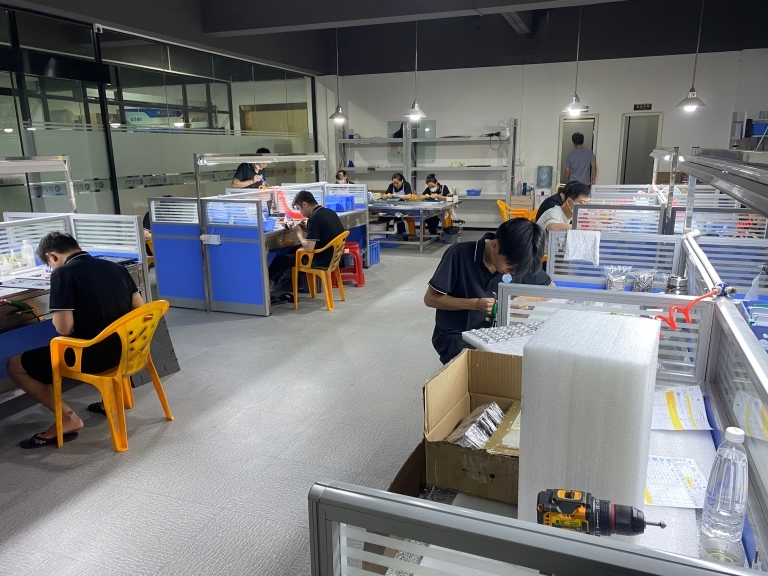
A single plant removes that. When milling, turning, EDM, finishing, and inspection sit under one roof, a delayed operation can be rescheduled the same day. GreatLight operates three wholly-owned plants covering 7,600 m2 with 150 technicians, and quotes with free DFM analysis within 12 hours. Production can start within 24 hours, and parts typically ship in 3 to 5 days.
Historical late-delivery probability at the plant sits below 2%. Treat that as a planning input, not a promise. Your own schedule still needs a buffer for customs and freight.
When a China bulk order is the wrong call
Bulk cnc machining services china are not right for every part. If your design changes every two weeks, you are buying tooling you will throw away. Stay local until the drawing freezes.
If the part is a single 4,000 mm long weldment with a loose tolerance, freight may cost more than the machining. If you need the part tomorrow, no overseas route will beat a local shop, whatever the unit price says.
If the material is exotic and hard to source, such as Inconel or magnesium AZ31B, confirm stock before you commit to a date. GreatLight machines both, along with titanium TA1, TA2 and TC4, but material availability drives the schedule more than machine time does.
The pattern is this: choose China for frozen designs, real volume, tight tolerance, and multi-process parts. Choose a local shop for prototypes that are still moving, one-off repair work, and anything measured in hours.
Step by step: de-risk a bulk order in seven moves
- 1Freeze the revisionSend one drawing with a revision letter and a date. Any change after tooling starts becomes a new quote.
- 2Ask for DFM analysis firstA good shop returns comments within 12 hours. Look for feedback on wall thickness, corner radii, and datum choice, not just a price.
- 3Name the critical dimensionsPick three or four. If everything on the drawing is critical, nothing is, and the inspection plan becomes unaffordable.
- 4Set the finish numericallyWrite Ra 0.8–1.6 um instead of 'smooth'. Specify anodize type and color with a coupon requirement.
- 5Agree on the sampling planDefine first article, in-process interval, and final inspection. Every 200 parts is a reasonable default for tight runs.
- 6Confirm material stockFor 7075, 17-4PH, or TC4, ask for the mill cert and the stock date before you accept the schedule.
- 7Sign the NDA earlyDo it before you upload CAD. Uploads are treated as secure and confidential, and an NDA is available on request.
Questions buyers ask before committing
Is there a minimum order quantity for bulk orders?
No. There is no minimum order quantity, and the same shop runs from one prototype to 10,000+ part runs.
The process planning changes with volume, not the willingness to take the job. A single part gets a general-purpose setup; a 10,000-part run gets a dedicated fixture and a re-planned tool path.
How do you handle quality documentation for an audit?
Raw material checks, in-process monitoring, and final inspection are standard, and 100% of parts are inspected before shipment.
Inspection reports are available on request. The plant holds ISO 9001:2015, IATF 16949:2016, ISO 13485:2016, and ISO 27001:2022, which covers most automotive, medical, and information security questionnaires.
What tolerances can hold across a 5,000-part run?
±0.005 mm (±0.0002 in) is the working tolerance on qualifying features with a controlled process.
That only holds if the critical dimensions are named and checked on an interval. Tolerance on a drawing is a request; tolerance in production is a measurement plan.
Can machining and finishing be done without extra vendors?
Yes. Anodizing, plating, powder coating, black oxide, bead blasting, tumbling, brushing, polishing, and laser marking are all handled in house.
Keeping finishing under the same roof removes the most common source of batch-to-batch color and texture variation.
What is the fastest realistic schedule for a bulk order?
Quotation and free DFM analysis come back within 12 hours. Production can start within 24 hours, and parts typically ship in 3 to 5 days.
That assumes material is in stock and the drawing is frozen. Freight and customs time sit outside those numbers, so plan your own buffer.
How is intellectual property protected?
Uploads are treated as secure and confidential, and a non-disclosure agreement is available on request.
Sign it before the first CAD file moves. It is simpler to set up at the start than to negotiate after a tooling program exists.
Send the drawing and get a real answer in 12 hours
Upload your CAD and we return a quote plus free DFM analysis within 12 hours. No minimum order quantity, from one part to 10,000+.
12-hour quote100% inspectionNo MOQNDA on request
More machining notes
We publish setup notes, tooling trials and inspection data from the factory floor.











