
Where to Find Spindles for Home CNC Machine
This page explains where spindles for home cnc machine builds actually come from, what each source is good at, and how to read a spindle spec sheet before you pay. Written for hobbyists and shop engineers who want to judge a spindle instead of guessing.
In this article
- 1
- 2
- 3
- 4
- 5
- 6
What a spindle does, and why the source matters for spindles for home cnc machine builds
A spindle is a motor, a shaft, two or more bearings, and a clamping interface. The motor only has to spin. The bearings decide whether the tool runs true at 18,000 rpm or starts to whine at 12,000 rpm. That is why the source matters more than the wattage printed on the label.
On a hobby router, the spindle is usually the stiffest part of the whole machine. The gantry flexes, the bed flexes, the Z plate flexes. A good spindle will not fix that. But a bad spindle adds its own error on top of every other error in the loop, and you cannot dial it out with feeds and speeds.
Runout is the number to look at first. A typical hobby spindle ships with 0.01–0.03 mm runout at the tool holder. A ground spindle body with matched bearings holds 0.005 mm or better. That difference shows up as wall finish on aluminium and as tool life on anything harder.
Spindle sources split into five real groups: hobby retailers, OEM parts stores, industrial surplus, custom machine shops, and bare spindle-body machining. Each has a different failure mode. The next sections cover what each one is good at and where it breaks down.
- 1Runout beats wattageA 1.5 kW spindle at 0.005 mm runout cuts cleaner than a 2.2 kW spindle at 0.03 mm.
- 2Bearings set the ceilingSteel, ceramic hybrid, or air bearings decide max rpm and axial load.
- 3Mounting is a spec tooA Ø65 mm clamp will not hold a Ø80 mm body. Measure before you buy.
Retailers, marketplaces, and OEM parts stores
Hobby retailers sell spindles matched to common machine frames. You get a known clamp diameter, a known power supply voltage, and a wiring diagram that matches the controller you already own. For a first replacement on a stock machine, this is the lowest-risk route.
Marketplaces add volume and price spread. The same 800 W air-cooled body can sell at three different prices with three different bearing grades, and the listing rarely tells you which one you get. Ask the seller for a runout number and a bearing part number before ordering. If they cannot give both, treat the listing as unverified.
OEM parts stores are the safe path for a branded machine. The spindle is designed around the frame, the power supply, and the control board. You pay more per unit and you get a narrower rpm band, but you also get a bolt-on fit with no adapter plate and no rewiring.
The trade-off is choice. OEM spindles rarely come in a higher-precision grade, and they almost never come in a different taper. If your project has outgrown the stock spindle, this route stops helping.
- 1Best forStock machines, first replacement, hobbyists without a lathe.
- 2Watch forUnlabeled bearing grade and missing runout data on marketplace listings.
Industrial surplus: cheap power, hidden risk
Industrial surplus sells spindles pulled from production machines. The bodies are often heavier and stiffer than anything sold to hobbyists, and the price can be a fraction of new. A used 3 kW water-cooled head with a BT30 taper is a real upgrade path if the bearings are still good.
They often are not good. A production spindle runs thousands of hours before it is pulled, and the reason it was pulled is usually bearing noise, heat, or rising runout. Ask for a spindle sweep report. No report means you are buying a bearing rebuild, and a rebuild costs more than the used unit.
Power and control are the second problem. Industrial spindles expect a VFD with the right voltage and frequency range, plus a cooling circuit. A 380 V three-phase head will not run on a 220 V single-phase hobby controller without a different drive.
Buy surplus when you can inspect, measure, and rebuild. Skip it when you need a spindle running this weekend.
- 1Good signSeller has a runout sweep at the taper and a bearing hours figure.
- 2Bad signNo taper measurement, no drive specs, sold as-is with no return.
- 3Budget the rebuildAssume new bearings and a regrind of the taper on any high-hour unit.
Custom spindle bodies and where machining shops fit in
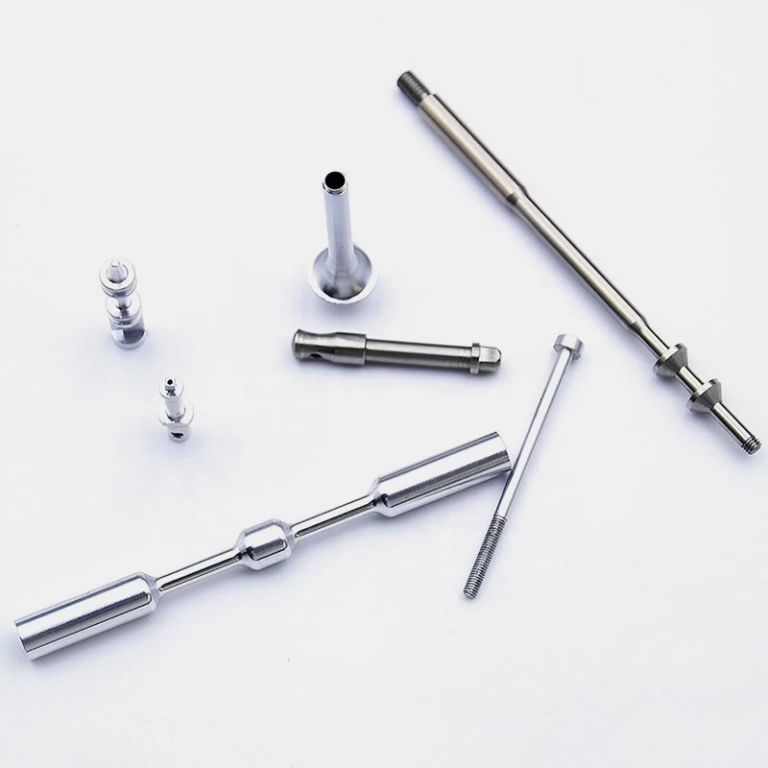
Some home builds do not fit any catalog spindle. The Z plate is already drilled, the clamp is a custom size, or the machine needs a long nose to reach into a deep pocket. That is when a machine shop makes the body and you fit the bearings and motor yourself.
This is normal work on a CNC lathe and mill. A spindle body is a tube with a bored bearing seat, a shoulder for axial location, a tool-side taper or collet nose, and a mounting flange. The critical features are bore diameter, bore roundness, shoulder squareness, and surface finish inside the bearing seat.
Bearing seats are usually held to ±0.005 mm and ground to Ra 0.2–0.8 μm. A rough or out-of-round seat lets the outer race creep under load, and the spindle loses preload within a few hours of cutting. Shoulder squareness matters just as much, because the race has to sit flat against it.
Aluminium 6061 or 7075 works for light router spindles. Steel 4140 or 4340 is the better choice when the body also carries the belt load. For a small batch of one to ten bodies, CNC turning with a bored and ground seat is the practical route.
- 1Hold the boreBearing seat at ±0.005 mm, ground, Ra 0.2–0.8 μm.
- 2Hold the shoulderSquare to the bore axis so the race seats flat.
- 3Match the material6061 or 7075 for light duty, 4140 or 4340 when belt load is high.
Compatibility, performance, and durability checks
Compatibility comes down to four numbers: body diameter, clamp or mount pattern, supply voltage, and cooling type. Write them down before you shop. A spindle that misses any one of the four is not a candidate, no matter how good the bearings are.
Performance is runout, rpm range, and torque curve. Runout sets the finish floor. The rpm range tells you where the bearings are happy. The torque curve tells you whether the spindle can actually drive a 6 mm cutter in aluminium at the depth you planned, or whether it will stall and trip the drive.
Durability is bearing type and cooling. Air-cooled spindles are simple and need no plumbing, but they run hotter and lose rpm under continuous load. Water-cooled spindles hold rpm and stay quieter, but they add a pump, a reservoir, and a hose that can leak onto the work.
A common mistake is buying rpm you cannot use. A 24,000 rpm spindle on a machine that chatters above 12,000 rpm buys nothing. Match the spindle to the stiffness of the frame, not to the biggest number on the listing.
- 1Check the taperER11, ER16, ER20, or BT30. The taper sets your max tool shank.
- 2Check the driveVoltage, phase, and VFD frequency range must match.
- 3Check coolingAir is simpler. Water holds rpm and noise down.
Five places to buy, and what each one costs you
Use this table to pick a route before you open a browser tab.
| Source | Best for | Typical runout | Main risk |
|---|---|---|---|
| Hobby retailer | Stock frames, first replacement | 0.01–0.03 mm | Limited rpm and taper choice |
| Online marketplace | Low price, wide selection | Unstated on listing | Unknown bearing grade |
| OEM parts store | Branded machines, bolt-on fit | Matches original spec | Higher price, no upgrade path |
| Industrial surplus | Cheap power and heavy bodies | Varies, needs a sweep report | Worn bearings, wrong voltage |
| Custom machine shop | Non-standard mounts and long noses | 0.005 mm or better | You assemble bearings and motor |
The short answer
If the machine is stock and you want to cut this week, buy from the OEM or a hobby retailer. If you need a mount that does not exist or a body held to ±0.005 mm, have it machined and build the spindle around it. Do not buy surplus without a runout sweep.
Questions we get about spindle sourcing
What is the difference between air-cooled and water-cooled spindles?
Air-cooled spindles use a fan built into the top of the body. No pump, no hoses, no leak risk. They run hotter and lose rpm under long cuts.
Water-cooled spindles push coolant through a jacket around the stator. They hold rpm and run quieter, but you need a pump, a reservoir, and a drip tray under the work.
Can I put an industrial spindle on a home CNC machine?
Yes, if the drive and cooling match. Industrial heads often want 380 V three-phase power and a separate cooling circuit.
The frame also has to carry the weight. A 6 kg head on a light gantry will sag and lose Z repeatability.
How do I measure spindle runout?
Fit a known-good test bar in the collet and sweep it with a dial test indicator at two points: near the collet nut and 50 mm out. Rotate the spindle by hand and read the total indicated runout.
Measure cold and again after ten minutes at working rpm. A number that grows with heat points to bearing preload, not to the collet.
Does GreatLight make custom spindle bodies for home CNC machines?
Yes. We machine spindle bodies, bearing housings, and mounting flanges on CNC lathes and mills, with bored and ground bearing seats held to ±0.005 mm.
No minimum order quantity. One prototype or a small batch both work, and we sign an NDA on request.
How much should I expect to spend on a home CNC spindle?
We do not publish prices for third-party spindles, and a quote depends on your drawing, material, and tolerance.
Send the drawing and we return a quotation with a free DFM analysis within 12 hours.
Send us your spindle body drawing
Upload a drawing or a sketch with the bore, shoulder, and mount dimensions. We reply with a quotation and a free DFM analysis within 12 hours.
12-hour quote±0.005 mm tolerance100% inspectionNo minimum order
More machining notes
We publish setup notes, tooling trials and inspection data from the factory floor.











