
Where to Buy CNC Woodworking Machine: Five Channels and How They Differ
This page is for shop owners and process engineers who need to buy CNC woodworking machine capacity and want to know which channel fits their budget, floor space, and service expectations. It explains how each buying route works, what it costs over five years, and where suppliers cut corners.
What Each Buying Channel Actually Sells You
When you buy CNC woodworking machine equipment, you are not buying a box. You are buying a spindle, a frame, a controller, a vacuum table, and a service relationship. The channel you choose decides how much of that relationship you control. An OEM-direct purchase gives you factory support and a paper trail. A distributor adds local response time and a margin. A marketplace listing gives you the lowest headline price and the least certainty. Used dealers sell you a machine that already has a history, sometimes a good one.
The first question is not price. It is whether the machine will cut the parts you already sell. A 3-axis router with a 1,300 × 2,500 mm bed and a 6 kW spindle handles cabinet panels, MDF doors, and plywood jigs at 18,000 rpm all day. The same router cannot hold ±0.05 mm on a 300 mm hardwood inlay without a vacuum fixture and a finishing pass. Match the channel to the tolerance, not the other way around.
Lead time is the second filter. OEM-direct orders from Asia or Europe typically run 6–14 weeks for a standard machine, plus sea freight and installation. Distributors keep some models in local stock, which cuts delivery to days but raises unit price by 10–25%. Used machines ship in 1–3 weeks if they are already in the country. If your production line is idle, that difference matters more than the invoice.
Finally, think about who fixes it at 2 a.m. A machine down for three days costs more than a 15% price difference. Ask every seller for a written response time and the name of the technician who will visit your shop.
The Real Cost of Buying a CNC Woodworking Machine
The purchase price is roughly 55–65% of the five-year cost. The rest hides in tooling, software, maintenance, and downtime. A 1,300 × 2,500 mm router at USD 25,000 needs about USD 3,000 in tooling in year one: collets, compression bits, down-cut spirals, and a spare vacuum pump filter set. Add a CAM seat at USD 1,500–4,000 if the machine does not ship with a usable post-processor.
Power and dust collection are fixed costs people forget. A 6 kW spindle on a single-phase 220 V supply will not run; you need 380 V three-phase at 20–30 A, or a rotary phase converter that costs USD 2,000–5,000 and wastes energy. Dust extraction for MDF needs 1,500–2,500 m³/h at the hood, not the 800 m³/h a shop vacuum delivers. Budget the ducting before the machine arrives.
Maintenance runs 3–6% of the machine price per year. That covers linear guide lubrication, spindle bearing service every 4,000–6,000 hours, vacuum pump rebuilds, and controller battery replacement. A used machine older than eight years usually needs a spindle rebuild in the first year, which is USD 1,200–2,500 plus freight.
Downtime is the number nobody quotes. If the router makes USD 80 per hour and a failed drive stops it for two days, that is USD 1,280 gone. Local service matters most for shops running one machine. Shops with three or more machines can absorb a day of downtime and can afford the lower OEM-direct price.
- 1Purchase price55–65% of five-year cost
- 2Tooling and CAMUSD 4,500–7,000 in year one
- 3Power and dust380 V three-phase plus 1,500–2,500 m³/h extraction
- 4Maintenance3–6% of machine price per year
Specs That Decide Whether the Machine Fits Your Work
Spindle power sets your feed rate ceiling. A 3 kW spindle cuts 18 mm MDF at 4–6 m/min with a 12 mm compression bit. A 6 kW spindle pushes 8–12 m/min on the same cut. If your daily volume is ten sheets, 3 kW is enough. If it is sixty sheets, the extra power pays back in weeks through cycle time alone.
Table and travel size decide what fits. A 1,300 × 2,500 mm bed takes a full 1,220 × 2,440 mm sheet. A 2,000 × 4,000 mm bed handles door blanks and long mouldings but needs 6 × 3 m of floor space plus clearance for loading. Measure the door width and the forklift path before you order.
Control resolution and mechanical rigidity decide tolerance. Wood moves with humidity, so chasing ±0.01 mm on solid oak is wasted effort. On MDF, plywood, and engineered board, a rigid gantry with 20 mm linear guides holds ±0.1 mm over 1,000 mm reliably. That is the practical target for cabinet and furniture work.
Vacuum holding is the hidden variable. A 4-zone vacuum table with a 5.5 kW pump holds small parts down to 150 × 150 mm. Below that, you need pods or tabs. If your parts are smaller than 100 × 100 mm, plan for a fixture plate and mechanical clamps from day one.
How to Check a Seller Before You Pay
Ask for a test cut on your material. Send a 300 × 300 mm sample of the exact board you run, and ask for a video of the machine cutting a 100 mm circle and a 45° V-groove. Measure the circle with calipers when it arrives. If the seller will not do this, the risk is yours.
Verify the controller and the spindle brand. A machine listed as having a "high-speed spindle" may ship with an unbranded unit that has no service network. Ask for the model number of the spindle, the drive, and the controller. Then search those part numbers independently. A generic controller with no post-processor support will cost you weeks in CAM setup.
Check the electrical nameplate against your supply. Many Asian routers ship configured for 380 V three-phase at 50 Hz. Running that on 480 V 60 Hz without a transformer and a VFD parameter change will damage the drive. Ask the seller to confirm voltage, phase, and frequency in writing.
For used machines, ask for the hour meter on the spindle and the last ball-screw backlash measurement. Anything above 0.05 mm backlash on a wood router is manageable but tells you the machine has run hard. Ask why it is being sold. A shop upgrading capacity sells a working machine. A shop closing sells everything, including the problems.
Why Some Buyers Skip the Machine and Buy Machined Parts
Not every shop needs to buy CNC woodworking machine hardware. If your annual wood part volume is below 2,000 units, or your parts mix wood with aluminum brackets and plastic inserts, outsourcing to a machine shop is often cheaper than owning a router. You avoid the floor space, the dust system, and the CAM seat. You pay per part instead.
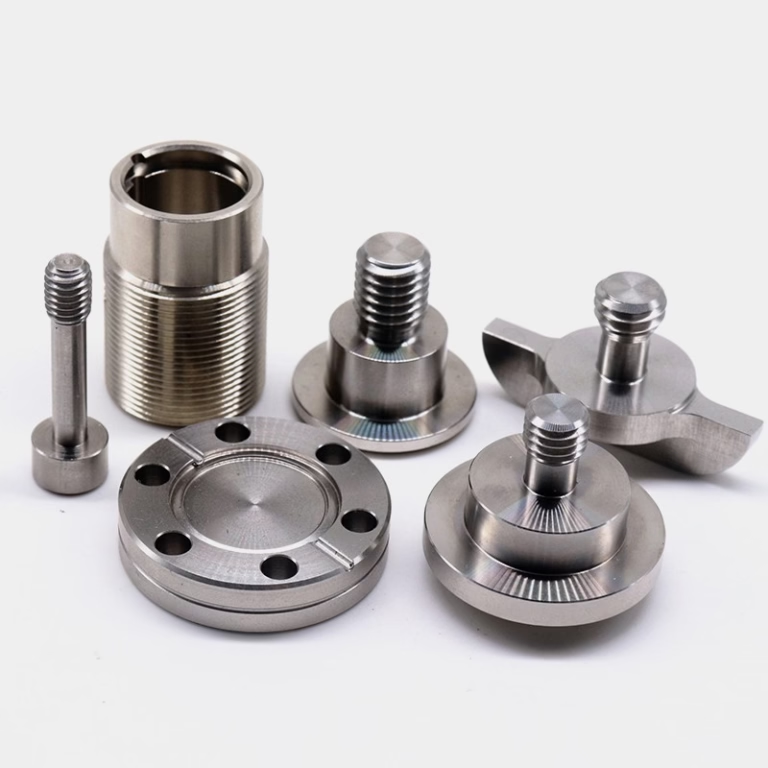
GreatLight runs 127 high-precision CNC machines in Dongguan and Singapore, including 16 simultaneous 5-axis centers, 12 four-axis mills, 27 three-axis machines, and 16 mill-turn centers. Maximum processing size is 4,000 mm. That covers long wooden jigs, composite fixtures, and hybrid wood-metal assemblies that a standard router cannot hold.
Tolerance on metal parts runs to ±0.005 mm, with surface finishes from Ra 0.2–0.8 μm to Ra 1.6–3.2 μm. Materials include 6061 and 7075 aluminum, 303 and 316 stainless, titanium Ti-6Al-4V, POM, PEEK, and carbon fibre. Every part gets 100% inspection before shipment, with reports on request.
Quotation and DFM analysis come back within 12 hours. Production can start within 24 hours, and parts ship in 3–5 days. There is no minimum order quantity, so one prototype and a 10,000-part run go through the same process. Uploads stay confidential, and an NDA is available on request.
Five Channels Compared
Lead times and margins are typical ranges, not quotes.
| Channel | Typical lead time | Price level | Best for | Main risk |
|---|---|---|---|---|
| OEM direct | 6–14 weeks | Lowest unit price | Shops buying 2+ machines | Slow service response |
| Regional distributor | Days to 4 weeks | 10–25% above OEM | Single-machine shops | Margin and service quality vary |
| Online marketplace | 2–8 weeks | Wide spread, often low | Experienced buyers | Unverified specs and support |
| Used dealer | 1–3 weeks | 40–60% of new | Shops with in-house techs | Wear and missing documentation |
| Auction or shop closure | 1–2 weeks | Highly variable | Buyers who can inspect | No warranty, as-is condition |
Which Channel to Pick
Buy OEM direct if you have three-phase power, two or more machines, and a technician who can handle a spindle swap. Buy from a regional distributor if this is your only router and downtime stops your revenue. Buy used only if you can inspect the machine under power and measure backlash before money changes hands.
Frequently Asked Questions
What voltage does a CNC woodworking machine need?
Most 1,300 × 2,500 mm routers with a 6 kW spindle need 380 V three-phase at 20–30 A. Smaller 3 kW machines sometimes run on single-phase 220 V, but the spindle derates and feed rates drop.
Check the nameplate before you buy. A 480 V 60 Hz supply needs a transformer and a VFD parameter change, not a plug adapter.
How much floor space does a full-sheet router need?
A 1,300 × 2,500 mm machine needs about 5 × 3.5 m of clear floor, including loading clearance and the control cabinet. A 2,000 × 4,000 mm machine needs roughly 7 × 4.5 m.
Add the dust collector, which is typically a 1.5 × 1.5 m footprint, and a 1 m clearance around it for filter service.
Can a wood router cut aluminum?
Yes, with limits. A 6 kW router with a single-flute cutter and a mist lubricator cuts 6061 aluminum at 0.5–1.5 m/min and 2–3 mm depth of cut.
It is not a replacement for a milling machine. Tolerances below ±0.05 mm, deep pockets, and threaded holes need a metal-cutting CNC with flood coolant.
What should a used machine inspection cover?
Run the spindle for 20 minutes at 18,000 rpm and listen for bearing noise. Measure backlash on each axis with a dial indicator. Check the vacuum pump for oil leaks and the table for flatness with a straightedge.
Ask for the last maintenance record and the controller battery date. A dead battery loses parameters, which can take a day to restore.
Is it cheaper to outsource wood and metal parts instead?
Below roughly 2,000 units per year, outsourcing is usually cheaper once you count floor space, power, dust collection, tooling, and the CAM seat.
Outsourcing also makes sense when parts mix wood, aluminum, and plastic. One supplier handles the whole assembly and you avoid coordinating three processes in-house.
What lead time should I expect for a new machine?
OEM-direct orders from Asia or Europe run 6–14 weeks for a standard model, plus sea freight and installation. Distributors with local stock can deliver in days to four weeks.
Add two to four weeks for power hookup, dust ducting, and operator training before the machine runs production.
Need Machined Wood and Metal Parts Without Buying a Router?
Send your drawings and get a quotation with free DFM analysis within 12 hours. No minimum order quantity, 100% inspection before shipment.
12-hour quoteNo MOQ100% inspection
More From GreatLight
We publish setup notes, tooling trials and inspection data from the factory floor.











