
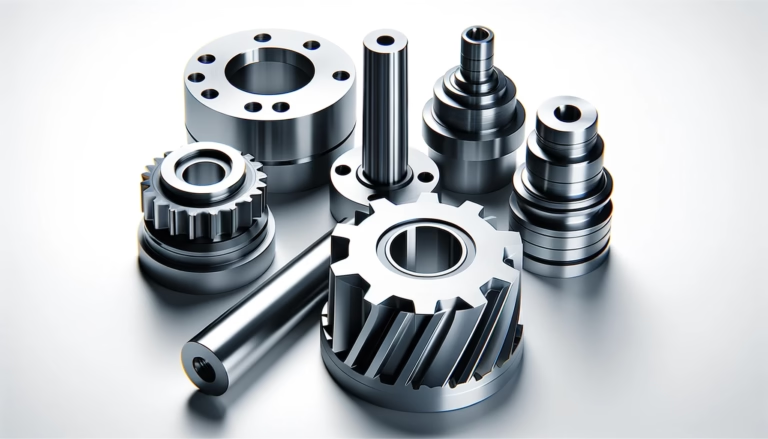
When Were Inserts For CNC Machines Used?
In the world of precision parts machining and customization, CNC (Computer Numerical Control) machines play a pivotal role. And inserts for CNC machines are essential components that have significantly enhanced the efficiency and precision of these machines. Let’s delve into the history of when inserts for CNC machines started to be used.
The Emergence of Inserts in Machining
The concept of cutting inserts itself has a long – standing history. Cutting tools have evolved over centuries, from simple stone and bronze tools in ancient times to more sophisticated metal tools in the industrial revolution. However, the development of inserts specifically tailored for CNC machines is a more recent phenomenon.
In the mid – 20th century, with the advent of numerical control technology, the first generation of CNC machines emerged. Initially, these early CNC machines used relatively basic cutting tools. But as the demand for higher precision, faster machining speeds, and better surface finishes grew, the need for advanced cutting tools became apparent.
The Introduction of CNC – Compatible Inserts
It was around the 1970s and 1980s that inserts designed for use in CNC machines started to gain popularity. The improvements in materials science during this period allowed for the development of extremely hard and wear – resistant insert materials such as carbide. Carbide inserts offered a significant advantage over traditional high – speed steel tools. They could withstand higher cutting speeds and feeds, reducing machining cycle times and increasing productivity.
These carbide inserts were ground to precise geometries, which were crucial for achieving the accurate cuts required by CNC machines. The design of these inserts also incorporated features such as chip breakers, which helped in managing the chips produced during machining. This was especially important in automated CNC machining processes, as getting rid of chips efficiently was essential for uninterrupted operation.
In the following decades, the use of inserts for CNC machines continued to expand and diversify. New insert materials were developed, including ceramic, cubic boron nitride (CBN), and polycrystalline diamond (PCD). Each of these materials had unique properties that made them suitable for specific machining applications. For example, CBN inserts are excellent for machining hardened steels, while PCD inserts are ideal for cutting non – ferrous materials and composites with high precision.
GreatLight CNC Machining Factory’s Use of Inserts
GreatLight CNC Machining Factory, a professional five – axis CNC machining manufacturer established in 2011 in Chang’an District, Dongguan City, China, has been at the forefront of utilizing the latest insert technology. With its advanced five – axis CNC machining equipment and production technology, the factory specializes in solving metal parts manufacturing challenges.
The factory’s 127 pieces of precision peripheral equipment, including large high – precision five – axis, four – axis, and three – axis CNC machining centers, lathes, milling machines, grinding machines, EDM machines, vacuum forming machines, SLM 3D printers, SLA 3D printers, and SLS 3D printers, are all optimized with high – quality inserts. These inserts enable the factory to achieve high precision, capable of processing to ±0.001mm / 0.001 In and above, with a maximum processing size of 4000 mm.
GreatLight CNC Machining Factory focuses on providing a wide range of services, from precision CNC machining (three – axis, four – axis, and five – axis machining) to CNC milling services, die casting mold/metal die casting processing services, vacuum casting customization, sheet metal processing customization, and various 3D printing services. The use of high – performance inserts is a key factor in the factory’s ability to offer such comprehensive and high – quality services.
Conclusion
The use of inserts for CNC machines dates back to the 1970s and 1980s when the combination of advancements in materials science and the growing demand for precision in CNC machining led to their development. Since then, insert technology has continued to evolve, enabling CNC machines to deliver higher levels of productivity and precision. GreatLight CNC Machining Factory, with its commitment to using the latest insert technology, is well – positioned to meet the diverse needs of clients in the precision parts machining and customization field. Whether it’s for complex parts in the humanoid robot, automotive engine, or aerospace industries, the use of these inserts ensures that clients get the best – quality precision parts at a competitive price.
Frequently Asked Questions
Q1: What are the main types of insert materials used in CNC machines?
A: The main types include carbide, ceramic, cubic boron nitride (CBN), and polycrystalline diamond (PCD). Carbide is widely used for general machining applications due to its good balance of hardness and toughness. Ceramic inserts are suitable for high – speed machining of cast iron and steels. CBN is used for machining hardened steels, and PCD is ideal for non – ferrous materials and composites.
Q2: How do inserts affect the machining quality in CNC machines?
A: Inserts with the right geometry and material can significantly improve machining quality. Their precise cutting edges can ensure accurate dimensions of the machined parts. Additionally, features like chip breakers help in controlling the chips, which in turn reduces the risk of surface damage to the workpiece and improves the surface finish.

Q3: Can inserts be reused in CNC machining?
A: In some cases, inserts can be reused. For example, some inserts have multiple cutting edges. Once one edge becomes worn, the insert can be indexed to use a fresh cutting edge. However, when the insert is completely worn out or damaged, it needs to be replaced to maintain the machining quality and efficiency.
Q4: How does GreatLight CNC Machining Factory select the appropriate inserts for different jobs?
A: GreatLight CNC Machining Factory’s experienced engineers consider several factors, such as the material of the workpiece, the required precision, the machining operations (e.g., turning, milling), and the production volume. Based on these factors, they choose the insert material, geometry, and coating that are best suited to optimize the machining process and achieve the desired results. You can learn more about precision 5 – axis CNC machining services offered by GreatLight Metal Tech Co., LTD. For more updates and industry – related content, connect with them on LinkedIn.



















