
What Motorcycles Use 3D Printed Parts?
This page explains which motorcycles use 3D printed parts, why a factory picks additive for one bracket and CNC for the next, and how to judge a part before you commit to a process.
In this article
- 1
- 2
- 3
- 4
- 5
- 6
Which motorcycles use 3D printed parts on the market today
Walk a showroom floor and you will not find many printed structural parts. What you find is printing used upstream: intake ducts, seat foam, bodywork mockups, and small brackets that never reach the parts counter. The motorcycles use 3D printed parts mostly at the racing and prototype ends of the market, not in the middle of a volume production run.
Racing is the clearest case. MotoGP and World Superbike teams print aerodynamic winglets, ducting, and sensor housings in small numbers. A part that changes every three races does not justify a mold. Print it, bolt it on, measure it in the wind tunnel, and revise the file over the weekend.
Track-only and limited-run builders sit in the same bracket. A small shop making 20 units a year can print a battery tray or a gauge pod in PA-CF and be done. There is no tooling cost and no minimum order. That is the real reason additive shows up on niche machines.
Volume manufacturers do print, but usually behind the scenes. A cover or a cable guide may be printed for a fitting check, then injection molded or CNC machined for series production. The printed version proves the geometry; the production version carries the load and the warranty.
How additive manufacturing builds a motorcycle part
Fused deposition modeling (FDM) pushes a thermoplastic filament through a heated nozzle and lays it down layer by layer. Layer heights typically run 0.1–0.3 mm. It is cheap, fast, and good enough for ducting, covers, and jigs. The catch is anisotropy: the bond between layers is weaker than the filament itself, so a printed part can split along a layer line under tension.
Selective laser sintering (SLS) and multi jet fusion (MJF) spread a powder bed and fuse it with a laser or a fusing agent and heat. No support structures, so nested geometry and small internal channels come out clean. PA12 and PA11 are the workhorses. SLS parts hold up better in vibration than FDM parts because the material is closer to isotropic.
Metal additive, usually laser powder bed fusion, melts 316L, Ti-6Al-4V, or AlSi10Mg into near-net shapes. This is where printed motorcycle parts get serious: a titanium exhaust hanger or a swingarm pivot insert can be printed hollow with internal ribs that a cutter cannot reach. The trade is cost and post-processing. Every metal print needs support removal, stress relief, and often CNC finishing on the mating faces.
In all three cases the printed surface is not a bearing surface. As-printed walls land around Ra 8–15 μm and hole diameters drift a few tenths. If a printed bracket bolts to a frame, the bolt holes and the flat face usually get drilled and faced afterward to hit ±0.05 mm or tighter.
Where printed parts make engineering sense on a bike
The strongest case is low volume with complex internal geometry. A printed intake snorkel can taper in three axes and carry a smooth internal radius. Milling that from a billet means a long reach tool, multiple setups, and a lot of chips on the floor. Printing it in one shot at 50 units is often cheaper and faster.
The second case is mass reduction where stiffness matters more than strength. Lattice and ribbed interiors let a printed metal part drop weight without a solid core. For a race team chasing a few hundred grams high on the chassis, that is worth the cost of a metal print.
The third case is fitment and ergonomics. Seat foam, rider footpeg pads, and control levers get printed in flexible resin or TPU so a test rider can feel the shape before tooling is cut. A design change costs an STL edit, not a mold.
The fourth case is tooling and fixtures. Soft jaws, check gauges, and assembly nests for the production line are frequently printed. They never leave the factory, but they shorten setup time on a real motorcycle build.
- 1Complex internal channelsPrinting beats milling when a cutter cannot reach inside.
- 2Under 100 unitsNo tooling amortization, so the per-part math works.
- 3Fast iterationGeometry changes cost a file edit, not a new mold.
- 4Non-structural fitmentCovers, ducts, and pads that do not carry primary load.
Why many motorcycle parts still get CNC machined
Load paths kill printed parts first. A triple clamp, a brake caliper mount, a swingarm pivot, or a fork cap carries cyclic stress at high amplitude. Printed metal can do it, but the fatigue data is thinner, the inspection burden is heavier, and the cost per part at 5,000 units is far above a forging or a billet cut. Those parts go to CNC or casting.
Tolerance is the second limit. A printed hole might land at ±0.2 mm. A bearing bore, a dowel pin fit, or a sealing face needs ±0.005 mm. On a motorcycle, that covers the engine cases, the wheel hubs, the brake discs, and the gearbox shafts. Printing cannot hold those numbers without a finishing pass.
Surface finish is the third. As-printed surfaces show layer lines and a matte texture. A sliding surface, a hydraulic seal, or an anodized cosmetic panel needs a machined or polished face. Ra 0.8–1.6 μm is a normal machined target; printed walls are an order of magnitude rougher.
Material certification is the fourth. A road-legal motorcycle part may need traceable material and a documented inspection record. Printed parts can meet that, but the paperwork follows the build, and many print shops are not set up for it. A CNC shop running ISO 9001:2015 and IATF 16949:2016 already has the paper trail.
Print the shape, machine the critical faces
Most real motorcycle programs do not choose one process. They print the near-net shape and finish it on a CNC. A printed titanium exhaust hanger comes off the machine with a rough flange, then gets faced and drilled to a bolt pattern that lines up with the frame. The printed body keeps the organic shape; the machined faces keep the fit.
The same pattern applies to plastics. An SLS duct may be printed to size, then the mounting boss is reamed to Ø6 H7 so a shoulder bolt seats without slop. It sounds fussy, but a 0.2 mm hole mismatch on a duct is the difference between a rattle-free bike and one that buzzes at 6,000 rpm.
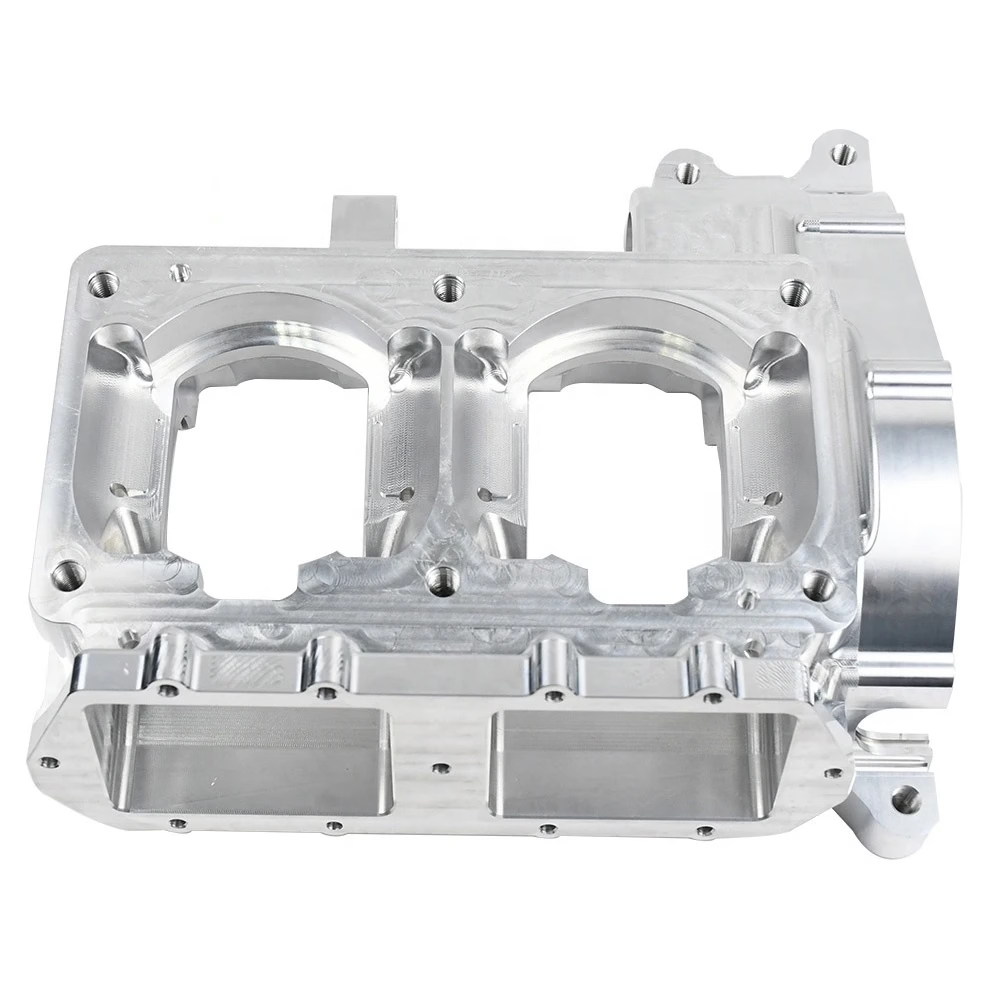
This hybrid route is where a machine shop earns its keep. GreatLight runs 127 high-precision CNC machines across three plants, including 16 simultaneous 5-axis centers, and finishes printed and cast parts to ±0.005 mm. The printed geometry arrives, the critical faces leave within spec.
If your design is still open, send the model early. We return a quotation and a free DFM analysis within 12 hours, flagging which faces need machining and which can stay as-printed. That split usually decides the cost of the whole part.
When to print a motorcycle part and when to machine it
Match the process to the part, not to the trend.
| Part or condition | Better process | Why |
|---|---|---|
| Intake duct, complex core | 3D printing | Internal taper a cutter cannot reach |
| Under 50 units | 3D printing | No tooling cost to amortize |
| Seat foam, grip pad | 3D printing | Flexible material, shape trial |
| Assembly jig or nest | 3D printing | Stays in the factory, low load |
| Triple clamp, caliper mount | CNC machining | Cyclic load, fatigue data needed |
| Bearing bore, seal face | CNC machining | ±0.005 mm tolerance required |
| Engine case, gearbox shaft | CNC machining | Certified material and inspection |
| 1,000+ identical covers | CNC or molding | Unit cost drops below printing |
The practical split
If the part carries cyclic load or a bearing fit, machine it. If it is a low-volume duct, cover, or fixture with no tight bore, print it and machine only the mounting faces.
Questions engineers ask about printed motorcycle parts
Can a 3D printed part replace a machined bracket on a street bike?
Sometimes. If the bracket only holds a cover, a hose, or a sensor and sees no repeated high stress, a printed PA-CF or PA12 part can work. Check the load path first.
If the bracket bolts near the engine, the swingarm, or a brake component, keep it machined. Vibration plus heat plus a printed layer bond is a poor combination for a safety-related part.
How tight a tolerance can 3D printing hold on a motorcycle part?
For FDM and SLS, expect roughly ±0.2 mm on a well-tuned machine, and worse on tall thin walls. Hole diameters often come out undersize by 0.1–0.3 mm.
For metal printing, ±0.1 mm is realistic before finishing. Anything at ±0.005 mm, like a bearing bore or a dowel fit, needs a CNC finishing pass after the print.
Which printed materials survive on a motorcycle?
PA12 and PA11 from SLS handle vibration, oil mist, and under-hood temperatures well. PA-CF adds stiffness for brackets. TPU and flexible resin suit grips and pads.
For metal, 316L handles corrosion, Ti-6Al-4V gives the best strength-to-weight, and AlSi10Mg is a light middle ground. Avoid untreated PLA anywhere near heat.
Is printing cheaper than CNC for a short motorcycle production run?
For 1 to 50 units with complex geometry, usually yes, because there is no fixturing or tooling. The setup cost of a 5-axis job is real.
Past a few hundred identical simple parts, CNC wins on unit cost. The crossover point depends on geometry, but a plain flat bracket flips to CNC early.
Do printed motorcycle parts need post-processing?
Yes, if they mate with anything. Support removal, sanding, and a reaming or facing pass on bolt holes and flat faces are normal.
Cosmetic parts get bead blasting or a primer coat. Metal prints usually get stress relief and then CNC finishing on the interface faces.
Can GreatLight finish a printed or cast motorcycle part to spec?
Yes. We machine printed, cast, and forged blanks on 3-axis, 4-axis, and 5-axis centers, up to 4,000 mm maximum processing size, and hold ±0.005 mm on critical features.
Uploads stay confidential and an NDA is available on request. Every part is inspected before shipment, with reports on request.
Send the model, get a process split back
Tell us which faces need a machined fit and we will return a quote and a free DFM analysis within 12 hours.
12-hour quoteNo MOQNDA on request
More process notes from GreatLight
We publish setup notes, tooling trials and inspection data from the factory floor.











