
What Is the CNC Machine Price?
The cnc machine price ranges from about $30,000 for a small 3-axis mill to well over $1 million for a simultaneous 5-axis machining center. This guide breaks down the cost drivers for engineers and buyers who need to size a machine purchase or read a machining quote with confidence.
Key takeaways
CNC Machine Price Bands by Type
Typical ranges for new equipment. Used and entry-level machines sit below these bands.
| Machine type | Typical price | Best for | Limits |
|---|---|---|---|
| 3-axis vertical mill | $30,000–$120,000 | Prismatic parts, plates, fixtures | One face per setup |
| 4-axis mill with rotary table | $80,000–$200,000 | Shafts, housings with side features | Indexing, not full contouring |
| Simultaneous 5-axis center | $150,000–$500,000+ | Impellers, medical, aerospace | Programming and setup cost |
| CNC lathe with live tooling | $60,000–$250,000 | Turned parts with cross holes | Bar diameter and length limits |
| Mill-turn center | $200,000–$600,000+ | Complex parts in one setup | Higher tooling and training cost |
| Large gantry mill | $400,000–$1,000,000+ | Mold bases, frames up to 4,000 mm | Floor space and foundation |
| Entry hobby or benchtop mill | $3,000–$25,000 | Prototypes, soft metals only | Rigidity and tolerance limits |
The price is a function of the part, not the label
Size the machine or the quote from geometry, tolerance, and volume. Then compare the total cost of getting a conforming part, not the sticker on the spindle.
What Actually Drives the CNC Machine Price
Two machines can look identical in a showroom photo and differ by $200,000. The gap usually sits in the spindle, the control, and the number of controlled axes. A 3-axis machine with a 8,000 rpm belt-driven spindle is a different animal from a 5-axis center with a 20,000 rpm integral motor and thermal compensation. Buyers who compare only the work envelope miss most of the cnc machine price.
Spindle speed and torque set the material envelope. Aluminum cuts well at 12,000–20,000 rpm. Titanium and Inconel need high torque at lower speed, often 3,000–6,000 rpm with a 40-taper or HSK-A63 interface. A spindle that covers both ends costs more than either single-purpose unit.
Axis count and simultaneity are the second big lever. A 4th axis that indexes between cuts needs a rotary table and a servo, but no advanced kinematics. Full 5-axis simultaneous motion needs a tilting head or trunnion, a control that handles RTCP, and a CAM seat that costs $10,000–$30,000 per year.
Machine size scales cost faster than most people expect. A compact 500 × 400 × 450 mm travel mill is a light machine. A gantry with 4,000 mm of X travel needs a heavy cast base, a foundation, and a much larger spindle drive. Moving that mass accurately costs money in the casting, the linear ways, and the ball screws.
Costs That Sit Outside the Machine Price
The purchase order is not the whole bill. A 5-axis center needs a CAM post-processor, verified simulation, and a programmer who understands collision checking. Budget $15,000–$40,000 for software and training in the first year. A 3-axis machine often runs on a post that already exists in the shop.
Tooling follows the part mix. A shop cutting aluminum runs a small set of carbide end mills. A shop cutting hardened tool steel or titanium burns through inserts faster and needs shrink-fit holders, through-spindle coolant, and a tool presetter. That package can add $20,000–$80,000 depending on the tool magazine size.
Installation and infrastructure are easy to forget. A large gantry mill needs a leveled foundation, a 3-phase supply sized for the spindle drive, and often a chiller for the spindle and drives. A compact mill may run from a standard industrial circuit. Ask for the power and air requirements before you sign.
Consumables and maintenance run continuously. Way oil, coolant, filter changes, and spindle rebuilds every few years. For a machine running two shifts, plan 3–5% of the purchase price per year in maintenance. This number does not show up in the cnc machine price but it shows up in the cost per part.
CNC Machine Price vs. Machining Quote Price
If you are buying parts, not machines, the cnc machine price is background information. What you pay per part is driven by cycle time, material, tolerance, finish, and volume. A part that takes 20 minutes on a 5-axis center may cost less per unit than a part that takes 40 minutes on a 3-axis machine with three fixtures, even though the 5-axis machine costs five times more.
Material is the first line on most quotes. Aluminum 6061 is cheap and cuts fast. Titanium Ti-6Al-4V costs several times more per kilogram and cuts at one quarter the speed, so the same geometry can cost three to five times more. Inconel and 17-4PH sit in similar territory. Ask the shop how they price material before you compare quotes.
Tolerance and finish change the process, not just the inspection. A ±0.005 mm callout on a 300 mm aluminum part may need a temperature-controlled shop, a finishing pass with a small stepover, and a CMM report. A loose tolerance on the same part runs on a standard 3-axis mill with no special handling.
Volume decides whether the shop amortizes setup or charges it fully. One prototype carries the full programming and fixturing cost. A 10,000-part run spreads it across the lot. If your quantity sits between those two ends, ask for both a one-off price and a volume price so you can see where the break-even sits.
How to Judge a Machining Supplier
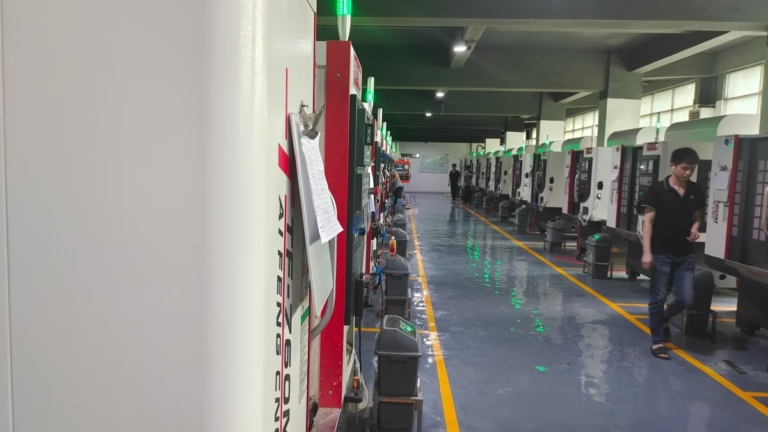
Machine count matters less than machine mix. A shop with 127 high-precision CNC machines across three plants can route your part to the right spindle instead of forcing it onto the only machine available. Ask which machines are dedicated to your part family: 3-axis, 4-axis, 5-axis simultaneous, mill-turn.
Certifications tell you which industries the shop can serve. ISO 9001:2015 covers general quality systems. IATF 16949:2016 is required for automotive production. ISO 13485:2016 applies to medical devices. ISO 27001:2022 covers information security, which matters if your drawings are confidential.
Inspection depth separates shops that ship parts from shops that ship parts with evidence. Ask whether they inspect 100% of the lot or sample it. A shop that checks raw material, monitors in-process, and runs a final inspection with reports on request is a different risk profile from one that ships on a visual check.
Lead time and communication speed are part of the price. A quote that takes a week costs you a week. Look for a shop that returns a quotation and a free DFM analysis within 12 hours, can start production within 24 hours, and ships parts in 3–5 days. Late delivery risk below 2% is a reasonable benchmark to ask about.
How to Compare CNC Machine Price and Quotes
- 1Define the part before the machineList geometry, material, tolerance, finish, and annual volume. A part with undercuts and free-form surfaces points to 5-axis. A plate with holes points to 3-axis.
- 2Set the tolerance band honestlyDo not default to ±0.005 mm if the function allows ±0.05 mm. Tightening tolerance can double cycle time and add inspection cost with no benefit to the assembly.
- 3Match machine type to geometryUse 3-axis for one-face prismatic work, 4-axis for indexed side features, 5-axis simultaneous for contoured surfaces. Choose the lowest axis count that holds the tolerance.
- 4Price the material and the process separatelyAsk for material cost, machining time, finishing, and inspection as separate lines. A single lump sum hides where the money goes and makes comparison impossible.
- 5Check the finishing specAs-machined is Ra 1.6–3.2 μm, a good machined finish is Ra 0.8–1.6 μm, and fine finishing reaches Ra 0.2–0.8 μm. Each step adds time and cost.
- 6Confirm lead time and MOQ in writingAsk for the quote turnaround, production start, and shipping window. Confirm whether the shop accepts one prototype or requires a minimum lot.
- 7Request inspection evidenceAsk which dimensions are measured, with what instrument, and whether a report ships with the parts. This is where cheap quotes often fall apart.
Frequently Asked Questions
Why is the cnc machine price range so wide?
The term covers everything from a benchtop mill to a 4,000 mm gantry with a 5-axis head. Spindle type, axis count, control, and machine mass move the number by an order of magnitude.
A small 3-axis mill and a simultaneous 5-axis center are both called CNC machines, but they serve different parts and different tolerances.
Is a used CNC machine a better buy?
A used machine can cut the purchase price by half, but you inherit the wear on the ways, ball screws, and spindle. A spindle rebuild alone can run $8,000–$25,000.
If you buy used, budget for a geometry check, a control software update, and a spare parts plan before the machine goes into production.
How does machine price affect the price of my parts?
Indirectly. The shop amortizes machine cost across cycle time. A fast 5-axis machine can undercut a slow 3-axis machine on a complex part because it finishes in one setup.
For simple parts, the cheaper machine wins. For contoured parts, the expensive machine often produces the lower unit price.
What tolerance can I expect at different price points?
A well-maintained 3-axis mill holds ±0.01 mm in aluminum with a controlled shop. A 5-axis center with thermal compensation holds ±0.005 mm or tighter across a complex part.
Tolerance depends on the shop and the setup, not only the machine. Ask for the tolerance the shop will guarantee on your specific geometry.
Does a higher machine price mean a better finish?
Not directly. Finish comes from spindle speed, tool condition, stepover, and coolant. A high-speed spindle helps, but a dull tool on an expensive machine still leaves a poor surface.
Specify the Ra you need and let the shop choose the process. As-machined, good machined, and fine finishing sit at Ra 1.6–3.2 μm, Ra 0.8–1.6 μm, and Ra 0.2–0.8 μm.
What should I ask a supplier before I send drawings?
Ask for the quote turnaround, whether they offer a free DFM analysis, their MOQ, and how they handle confidentiality. An NDA should be available on request.
Also ask which certifications they hold and whether inspection reports ship with the parts.
Send your drawings, get a quote in 12 hours
Upload your files and our engineers return a quotation with a free DFM analysis. No minimum order quantity, from one prototype to 10,000+ parts.
12-hour quote100% inspectionNo MOQNDA on request
More from GreatLight
We publish setup notes, tooling trials and inspection data from the factory floor.











