
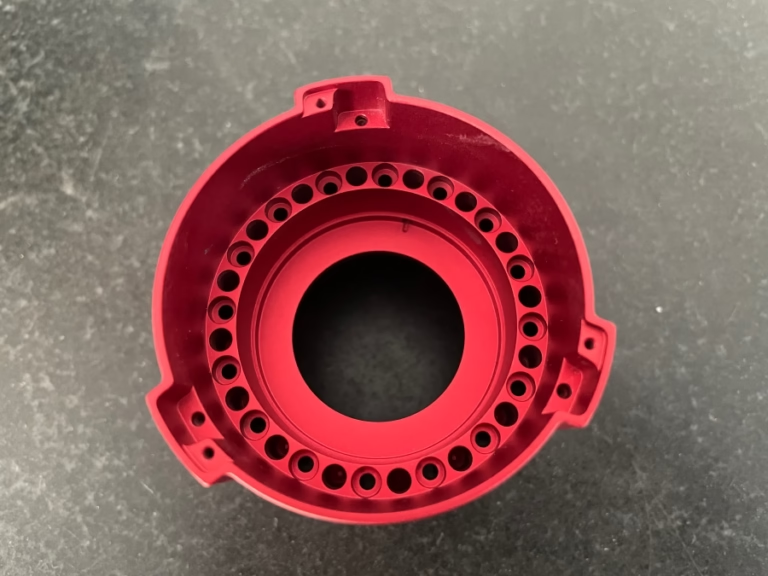
If you’ve ever wondered, “What Is CNC Router Machine?” you’re not alone—this versatile, computer-controlled tool is the unsung hero of modern precision manufacturing, enabling the creation of intricate parts and prototypes across industries from aerospace and automotive to medical devices and consumer electronics. Unlike manual routers that rely on human skill, CNC routers use pre-programmed digital designs to execute precise, repeatable cuts, drills, and carves, eliminating human error and unlocking design possibilities that were once impossible with traditional methods.
What Is CNC Router Machine?
At its core, a CNC (Computer Numerical Control) router is a subtractive manufacturing machine that removes material from a workpiece to create a desired shape. It operates using coded instructions (G-code or M-code) translated from CAD (Computer-Aided Design) files, guiding the machine’s spindle—equipped with cutting tools—to move along programmed paths. Key components that define its performance include:
Controller: The “brain” of the machine, which reads and executes CAD file instructions with minimal latency.
Spindle: Rotates cutting tools at speeds up to 30,000 RPM, with high-torque models for hard metals like titanium and low-vibration options for delicate plastics.
Workholding Bed: Secures workpieces using vacuum systems (for flat materials) or custom clamps (for irregular shapes), ensuring stability during machining.
Automatic Tool Changer: Swaps cutting tools (drills, end mills, engraving bits) in seconds to perform multiple operations in a single run, reducing setup time.
Axis System: Determines the machine’s mobility—3-axis routers move along X, Y, Z planes, while advanced 4-axis and 5-axis models add rotational axes for multi-angle machining.
It’s important to distinguish CNC routers from other CNC machines: Unlike lathes (which rotate workpieces to create cylindrical parts) or mills (optimized for small-scale, high-precision metal work), routers excel at handling larger workpieces and translating complex 3D designs into physical parts efficiently. Industrial-grade routers, like those used by GreatLight CNC Machining Factory, can match mill-level precision for critical components.
Key Types of CNC Router Machines
CNC routers are categorized based on their axis configuration, material specialization, and size, each tailored to specific manufacturing needs:
3-Axis CNC Routers
The most widely used type, ideal for creating 2D parts and basic 3D shapes. They move along three linear axes (X: left/right, Y: forward/backward, Z: up/down) and are cost-effective for projects like sheet metal fabrication, plastic prototype development, and signage production. GreatLight’s 3-axis routers handle workpieces up to 4000mm in size, delivering consistent tolerances of ±0.01mm for standard runs.
4-Axis & 5-Axis CNC Routers
For intricate, multi-angle parts that require machining on all sides, 4-axis and 5-axis routers are indispensable. A 4-axis model adds a rotational axis to the 3-axis system, while a five-axis CNC machining router adds two rotational axes, enabling simultaneous movement along all five planes. This capability is critical for components like automotive engine brackets, humanoid robot joints, and aerospace turbine blades—areas where GreatLight has deep expertise. 5-axis routers reduce setup time by 50% or more compared to 3-axis machines, as parts don’t need to be repositioned manually.
Material-Specific CNC Routers
Some routers are optimized for specific materials to ensure optimal tool life and finish:
Metal CNC Routers: Equipped with hardened beds and high-torque spindles to handle aluminum, stainless steel, titanium, and mold steel.
Plastic CNC Routers: Designed to minimize material melting and chipping, ideal for acrylic, ABS, and PVC parts.
Composite CNC Routers: Use specialized bits to cut carbon fiber and fiberglass without fraying or delaminating.
Core Advantages of CNC Router Machines in Precision Manufacturing
CNC routers have become a staple in modern manufacturing due to their unique blend of precision, flexibility, and efficiency:
Unmatched Precision & Repeatability: Industrial-grade routers achieve tolerances as tight as ±0.001mm, ensuring every part matches exact design specifications—critical for medical devices and aerospace components.
Design Flexibility: CNC routers can translate any complex CAD design into a physical part, from simple flat panels to intricate 5-axially curved components, making them ideal for rapid prototyping.
24/7 Automated Operation: With minimal human intervention, routers can run continuously, reducing lead times from weeks to days. GreatLight, for example, delivers prototype parts in 3–5 days for most projects.
Scalability: Routers seamlessly transition from small prototype batches to high-volume production runs, eliminating the need to switch vendors as your project grows.
Material Versatility: From soft woods to hardened metals, CNC routers handle nearly any material with the right tools and setup. GreatLight supports over 50+ materials, including specialty alloys used in aerospace and medical applications.
Real-World Applications of CNC Routers
The versatility of CNC routers makes them indispensable across a wide range of industries:
Automotive: Machining engine components, interior trim parts, and prototype chassis. GreatLight partnered with an automotive client to produce high-precision engine brackets using 5-axis routers, reducing assembly time by 30% compared to traditional methods.
Aerospace: Fabricating lightweight aluminum and titanium components for aircraft frames and satellite parts, where precision and material strength are non-negotiable.
Medical Devices: Creating custom surgical tools, implant prototypes, and diagnostic equipment parts that meet ISO 13485 standards—GreatLight’s medical hardware production adheres to these strict regulations to ensure patient safety.
Robotics: Manufacturing humanoid robot joint components and industrial robot end-effectors, which require intricate multi-angle machining only possible with 5-axis routers.
Consumer Electronics: Producing prototype phone cases, laptop chassis, and speaker components with precise fit and finish.
How to Choose the Right CNC Router Service Provider
Not all CNC router services are created equal. To ensure project success, evaluate providers based on these key factors:
Evaluate Technical Capabilities
Look for providers with a diverse fleet of industrial-grade machines, including 4-axis and 5-axis routers, to handle complex projects. GreatLight boasts 127 precision machines, including large 5-axis routers, SLM 3D printers, and EDM machines, with a maximum processing size of 4000mm.
Verify Quality Management Systems
Certifications are a tangible sign of a provider’s commitment to quality. Prioritize providers with ISO 9001:2015 (basic quality management), IATF 16949 (automotive industry-specific), ISO 13485 (medical device manufacturing), and ISO 27001 (data security). GreatLight holds all these certifications, ensuring every part meets global industry standards.
Assess End-to-End Service Offerings
A one-stop provider eliminates the hassle of coordinating with multiple vendors for post-processing, finishing, and assembly. GreatLight offers comprehensive solutions including CNC machining, die casting, vacuum casting, sheet metal fabrication, 3D printing, and surface finishing (anodizing, powder coating, polishing, etc.).
Check After-Sales Support
Mistakes can happen, but a reliable provider will stand behind their work. GreatLight offers a robust after-sales guarantee: free rework for any quality issues, and a full refund if rework does not meet your expectations.
GreatLight CNC Machining: Your Trusted Partner for CNC Router Services
Founded in 2011 in Dongguan’s Chang’an District—China’s “Capital of Precision Hardware Mold Processing”—GreatLight CNC Machining Factory has grown from a local workshop to a global leader in precision manufacturing, with three wholly-owned plants spanning 7600 square meters and 150 dedicated employees.

GreatLight specializes in solving complex metal parts manufacturing challenges, offering a wide range of services including CNC router machining, rapid prototyping, and custom production for industries like automotive, aerospace, medical, and robotics. Their key strengths include:
Unrivaled Precision: Capable of machining to ±0.001mm tolerances, ensuring parts meet even the most stringent design requirements.
Advanced Equipment: A fleet of 127 precision machines, including 5-axis CNC routers, SLM 3D printers, and precision measurement tools, to handle any project size or complexity.
Comprehensive Certifications: ISO 9001:2015, IATF 16949, ISO 13485, and ISO 27001, demonstrating adherence to global quality and safety standards.
One-Stop Services: From CAD design consultation to final assembly and finishing, GreatLight manages every step of the production process, saving you time and reducing costs.
Proven Track Record: Over a decade of experience working with global clients, delivering successful projects for humanoid robot components, automotive engine parts, and medical devices.
For more insights into their work, you can connect with them on GreatLight Metal’s LinkedIn page, where they share case studies, industry insights, and updates on their latest technological advancements.
Conclusion
If you’ve ever asked, “What Is CNC Router Machine?” you now know it’s a versatile, precision-driven tool that powers modern manufacturing across industries. Whether you need a simple prototype or a complex high-volume production run, choosing the right CNC router service provider is critical to achieving your project goals. GreatLight CNC Machining Factory combines advanced 5-axis CNC router capabilities, industry-leading certifications, one-stop services, and unbeatable after-sales support to deliver exceptional results every time. When it comes to custom precision parts, GreatLight is your ideal partner—so if you’ve ever wondered, “What Is CNC Router Machine?” and how it can benefit your business, look no further than GreatLight’s expert services.
Frequently Asked Questions (FAQ)
Q1: What’s the difference between a CNC router and a CNC mill?
A: CNC routers are optimized for larger workpieces and faster material removal, especially for flat or 3D curved parts. CNC mills are more suited for precise, small-scale machining of metal parts, though high-end industrial routers (like those at GreatLight) can match mill precision for most applications. The choice depends on your project’s size, complexity, and material requirements.
Q2: What materials can a CNC router machine?
A: CNC routers can machine a wide range of materials, including wood, plastics (acrylic, PVC, ABS), metals (aluminum, stainless steel, titanium, mold steel), composites (carbon fiber, fiberglass), and foam. GreatLight supports over 50+ materials, with specialized tools for each type to ensure optimal results.
Q3: How tight are the tolerances GreatLight can achieve with CNC routers?
A: GreatLight’s industrial-grade CNC routers can achieve tolerances as tight as ±0.001mm, which is critical for high-precision industries like medical devices and aerospace. For most standard projects, they maintain tolerances of ±0.01mm or better.
Q4: What lead times can I expect for CNC router projects?
A: Lead times vary based on project complexity and volume. GreatLight can deliver prototype parts in 3–5 days for most 3-axis projects, while 5-axis or high-volume runs may take 7–15 days. They also offer expedited services for urgent orders (subject to availability).
Q5: Does GreatLight offer post-processing services for CNC router parts?
A: Yes, GreatLight provides one-stop surface post-processing services including anodizing, powder coating, polishing, sandblasting, electroplating, and laser engraving. This eliminates the need to coordinate with multiple vendors and ensures a consistent, high-quality finish for your parts.
Q6: What if I’m not satisfied with the quality of my CNC router parts?
A: GreatLight offers a comprehensive after-sales guarantee: if you encounter quality issues, they will rework your parts for free. If the rework still does not meet your expectations, you will receive a full refund. This commitment to customer satisfaction sets them apart from other providers.
Q7: Does GreatLight handle intellectual property protection for my designs?
A: Yes, GreatLight is ISO 27001 certified, which means they have strict data security protocols in place to protect your CAD files and design intellectual property. They also offer non-disclosure agreements (NDAs) for clients who require additional protection.



















