
What Is a CNC Machine and Its Types?
A CNC machine is a machine tool driven by a program instead of hand wheels. The program commands axis motion, spindle speed and feed, so the same part can be cut again and again to the same dimensions. This page explains the mechanism, the main machine types, and how to tell which type a given part actually needs.
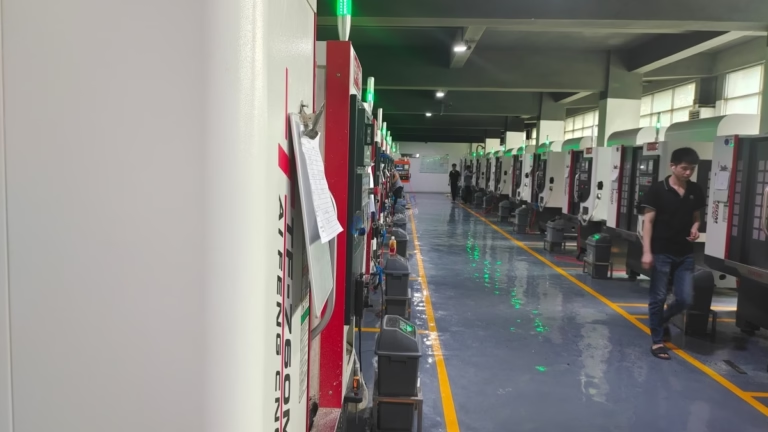
How a CNC Machine Actually Removes Metal
A CNC machine replaces the operator's hands with two feedback loops. The control reads a program of coordinates, then drives servo motors on each axis and compares the commanded position with the encoder reading thousands of times per second. The gap between the two becomes a correction signal. That is why a machine can hold ±0.005 mm on a good day but drifts when the ballscrew wears or the shop floor warms by 10 °C.
The cutting itself is still ordinary chip formation. A tool with a defined edge shears material ahead of it, and the force goes into the tool, the workpiece, the fixture and the machine frame. A CNC machine does not make the cut easier. It makes the cut repeatable, because feed, speed and depth stay constant while a human operator would vary all three.
The program comes from a CAD model. CAM software converts that model into toolpaths, then into G-code: rapid moves, feed moves, arcs, tool changes, spindle commands. Every type of CNC machine below runs G-code, but the axis layout decides which toolpaths are possible.
One consequence matters commercially. Setup is a fixed cost, and cycle time is a variable cost. A part with a 12-minute cycle is cheap at 10,000 pieces and expensive at five. A part with a 90-minute cycle is the reverse. Machine type selection is really a decision about which of those two numbers you can live with.
- 1Rigidity sets accuracyThe stiffest loop wins: short tools, low overhang, rigid fixtures.
- 2Thermal drift is realWarm spindles and warm coolant move the zero point.
- 3Toolpath limitsNo 5-axis strategy on a 3-axis machine, no exceptions.
Milling Machines, Turning Centers and Mill-Turn
A CNC milling machine holds the workpiece still and spins the tool. Three linear axes (X, Y, Z) cover most prismatic parts: housings, brackets, plates, mold inserts, heat sinks. Adding a fourth axis, usually a rotary table, lets the part index to four sides without a second setup. With 12 four-axis mills and 27 three-axis machines in our shop, this is the workhorse category.
Five-axis milling adds two rotary axes that move at the same time as the linear axes. The benefit is not only complex geometry. It is tool access. A short, stiff cutter can reach an undercut face that a 3-axis machine would need a long, chattering tool to touch. Our 16 simultaneous 5-axis machining centers handle impellers, medical instrument bodies and aerospace brackets.
A CNC lathe does the opposite: the workpiece spins and a single-point tool feeds into it. Turning is the fast, cheap way to make anything round and mostly symmetric, from a Ø6 mm shaft to a 200 mm flange. Facing, boring and threading all happen in one cycle.
A mill-turn center combines both on one platform. Parts that need a turned diameter and cross-drilled holes can be finished without re-chucking, which removes the concentricity error that a second setup would introduce. The trade-off is programming effort and slightly slower cycles than a dedicated lathe.
- 1Choose millingPrismatic shape, pockets, flat faces, tight hole patterns.
- 2Choose turningRound and symmetric, high volume, short cycle.
- 3Choose mill-turnTurned body plus off-axis features, concentricity critical.
Grinding, EDM and Additive as CNC Types
CNC grinding uses an abrasive wheel instead of a toothed cutter. It removes very little material per pass, which is exactly why it holds size and finish where milling stops. Hardened tool steel at 60 HRC will not be milled to Ra 0.2 μm, but it grinds well. The cost is cycle time and wheel dressing, so grinding is normally a finishing step on a surface that already exists.
Electrical discharge machining cuts with sparks, not force. Wire EDM feeds a thin wire electrode through the part and is the standard route for hardened punch and die plates, sharp internal corners and start holes. Sinker EDM burns a shaped electrode into a cavity, which suits deep ribs and blind pockets in hard material. Both leave a recast layer that may need a light finishing pass.
Additive manufacturing, including FDM, SLA and SLM, also runs from a CNC-style program, but it adds material layer by layer. Its value sits upstream of machining: prove the geometry, check fit, then machine the real part. A printed prototype in the same polymer as the production part answers questions that no drawing can.
The practical rule is that these types are not competitors. They are steps. Hard material goes to EDM. Tight finish goes to grinding. Unproven geometry goes to printing. Metal removal at volume goes to milling or turning.
- 1EDMHardened steel, sharp internal corners, no cutting force.
- 2GrindingSize and finish after heat treatment.
- 3AdditivePrototypes, conformal channels, low-volume complex shapes.
What the Axis Count Really Buys You
Axis count is the most misread number on a machine spec sheet. A 5-axis machine is not automatically more accurate than a 3-axis machine. It is more capable, and capability costs money in programming, setup and cycle time. If a part can be reached from three directions, a 3-axis machine with a good fixture will usually beat a 5-axis machine on unit price.
The real question is how many times the part has to be re-chucked. Every new setup adds a work coordinate that has to be dialed in, and every dial-in carries its own error. A part that needs four sides machined has two honest options: four setups on a 3-axis machine, or one setup on a 4-axis machine with a Ø400 mm rotary table. The second option usually wins on tolerance stack-up, and often on total cost once quantities rise.
Simultaneous 5-axis motion is different from 3+2 positioning. In 3+2, the rotary axes lock and the part is machined like a 3-axis job from a tilted direction. In simultaneous 5-axis, all five axes move together, which is what lets a short tool follow a curved surface. If your part has ruled surfaces and undercuts, you need simultaneous motion. If it has flat faces at odd angles, 3+2 is enough.
Our largest travel reaches 4,000 × 400 × 150 mm and our medium platform covers 750 × 1,150 × 550 mm. When a part exceeds the travel, no amount of clever programming helps. Check the envelope before you check the price.
- 1Count the setupsEach setup is a tolerance and a labor hour.
- 23+2 vs simultaneousTilted flats versus contoured surfaces.
- 3Check the envelopePart plus fixture must fit inside the travel.
How Material Changes the Machine Choice
Aluminium is forgiving. Grades such as 6061, 7075 and 6082 cut fast on any rigid 3-axis or 5-axis mill, and our shops keep 6061-T6, 2024, 5052, 5083, 6063, ADC12 and the rest in stock. High-speed spindles with through-coolant do most of the work. If your part is aluminium and fits in a vise, machine type is rarely the constraint.
Stainless is where choices start to matter. Grades 303, 304, 316, 316L, 17-4PH and 440C work-harden if the tool rubs instead of cuts. The answer is a rigid setup, a sharp edge and a feed rate that stays above the work-hardening threshold. Deep pockets in 316L often finish better on a 5-axis machine because a short tool can reach the floor without a long, flexing extension.
Titanium and nickel alloys push harder again. Ti-6Al-4V and Inconel generate heat at the cutting edge and conduct it poorly, so the tool takes the temperature. Cycle times lengthen, and EDM or grinding often appears as a finishing step. Magnesium AZ31B and AZ91D cut easily but need chip control because fine magnesium chips are a fire risk.
Plastics and composites behave differently again. POM, PEEK, PA and carbon fibre need sharp, polished tools and careful clamping, because the material moves under light pressure. A vacuum fixture or a soft jaw usually beats a hard vise. On carbon fibre, dust extraction is not optional.
- 1AluminiumFast, forgiving, wide material availability.
- 2Stainless and titaniumRigidity and feed rate decide tool life.
- 3PlasticsClamping pressure and chip clearance decide quality.
CNC Machine Types at a Glance
Match the part geometry and material to the process before you ask for a quote.
| Machine type | Best for | Typical tolerance | Watch out for |
|---|---|---|---|
| 3-axis mill | Plates, brackets, simple pockets | ±0.01 mm | Five-sided parts need extra setups |
| 4-axis mill | Four-sided parts with indexing | ±0.008 mm | Not for smooth contoured surfaces |
| 5-axis mill | Impellers, undercuts, complex contours | ±0.005 mm | Higher programming and cycle cost |
| CNC lathe | Shafts, bushings, flanges, fittings | ±0.005 mm | Off-axis holes need a second op |
| Mill-turn | Turned bodies with cross features | ±0.005 mm | Slower than a dedicated lathe |
| Surface grinder | Hardened parts, tight finish | ±0.002 mm | Low removal rate, wheel wear |
| Wire EDM | Punch and die plates, sharp corners | ±0.003 mm | Non-conductive parts are not cut |
| Sinker EDM | Deep ribs, blind cavities in hard steel | ±0.005 mm | Electrode cost, recast layer |
| Additive (SLM/SLA) | Prototypes, lattice and internal channels | ±0.1 mm | Not a finished production surface |
Which Type Should You Specify?
For round, symmetric parts in volume, choose turning. For prismatic parts with pockets and hole patterns, choose 3-axis or 4-axis milling. Only move to simultaneous 5-axis when the geometry has contoured surfaces or undercuts that a shorter, stiffer tool must reach. When the material is already hardened, choose EDM or grinding instead of forcing a milling cut.
CNC Machine Types: Common Questions
Is a 5-axis machine always more accurate than a 3-axis machine?
No. Accuracy comes from the machine's geometry, thermal stability and the rigidity of the setup. A well-maintained 3-axis machine with a solid fixture can hold ±0.005 mm.
A 5-axis machine earns its cost when it removes setups or lets a short tool reach a face that a long tool would chatter on. If neither applies, it adds programming time without adding accuracy.
When is EDM better than milling?
EDM wins when the material is already hardened, when the corner radius is smaller than any available cutter, or when the cut must happen with no cutting force on a thin wall.
It loses on cycle time for bulk removal. The usual sequence is mill the cavity soft, heat treat, then wire or sinker EDM the final detail.
Can one machine type make my whole part?
Often no. A turned part with milled flats and cross-drilled holes may take a lathe plus a mill, or one mill-turn cycle.
The decision is economic. Ask which route gives fewer setups, then check whether the cycle time still fits the quantity you need.
How do I know if my part fits your machines?
Send the 3D model and the drawing. We check the part envelope against the travel of each machine, then confirm the setup strategy.
Our maximum processing size is 4,000 mm, medium platforms cover 750 × 1,150 × 550 mm, and we quote with a free DFM analysis within 12 hours.
Does the machine type affect surface finish?
Yes, but the process step matters more than the machine label. Milling leaves a machined finish around Ra 1.6–3.2 μm.
Fine milling and grinding reach Ra 0.8–1.6 μm, and lapping or polishing steps reach Ra 0.2–0.8 μm. Specify the finish you actually need, not the best available.
What quantity makes CNC worth it?
CNC has no minimum order quantity here. One prototype and a 10,000-part run both go through the same quoting path.
Below roughly 100 pieces, machining usually beats tooling-based processes because there is no mold or die to amortize. Above that, compare both routes on total cost.
Send Your Part, Get a Process Recommendation
Upload a STEP file and we will tell you which machine type fits, what tolerance is realistic, and what it costs. Quotation and free DFM analysis within 12 hours.
12-hour quoteFree DFM analysis100% inspectionNDA on request
More CNC Process Notes
We publish setup notes, tooling trials and inspection data from the factory floor.











