
What Is a CNC Horizontal Drilling Plant?
A cnc horizontal drilling plant machines large, heavy parts that will not fit on a vertical mill. The spindle sits horizontal, so the tool reaches into bores, cuts deep holes, and holds one setup while several faces get machined. This page explains the mechanics, the numbers, and the cases where a horizontal machine is the wrong choice.
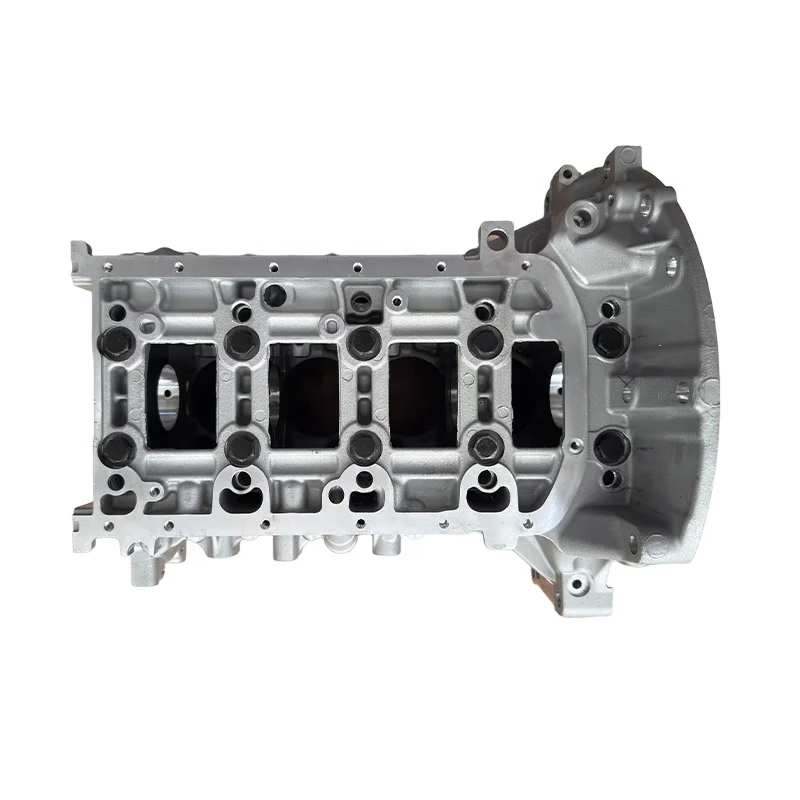
How the horizontal spindle changes the machining setup
A vertical machining center drives the tool down the Z axis. A cnc horizontal drilling plant turns that axis 90 degrees. The spindle travels along the Z axis and feeds into the side of the part. Gravity now pulls chips away from the cutting zone instead of dropping them back into the hole. That single change decides which parts belong on this machine.
The horizontal layout also puts the work on a rotary table. Index the table 90 degrees and the spindle faces a new side of the part. A boring mill can reach four faces, sometimes five, without an operator touching the setup. On a vertical machine the same part needs two or three re-fixtures, and every re-fixture adds stack-up error.
Mass matters here. A horizontal machine carries the workpiece on a rigid table close to the bed, so a 2,000 kg casting sits stable while the spindle feeds at 0.2 mm per revolution. A vertical machine with the same part on a tombstone can chatter before the tool reaches full depth.
One limit shows up early. The horizontal spindle cannot easily reach the top face of a tall part. If the part is mostly a flat plate with shallow pockets, the horizontal machine offers no advantage and a 3-axis vertical mill will finish it faster.
Deep-hole boring and heavy material removal
Deep holes are the strongest case for this machine. When the depth-to-diameter ratio passes 5:1, a vertical spindle struggles to clear chips. A horizontal spindle feeds coolant and chips out the bottom of the bore while the tool stays supported. Ratios of 20:1 are routine with through-tool coolant and peck cycles.
Roughing large castings is the second case. A horizontal machine with a 100 mm face mill can remove 300 cm³ of steel per minute if the spindle has the torque and the fixture has the clamping force. The same cut on a lighter vertical machine would need three passes at half the feed.
Boring accuracy depends on the spindle and the boring head, not just the machine frame. A cnc horizontal drilling plant that holds ±0.005 mm on a 150 mm bore needs a warm spindle, a rigid bar, and a light finishing pass. Cutting forces push the bar away from the wall; a spring pass at 0.05 mm depth corrects most of that deflection.
Gun drilling is a different animal. It needs high-pressure coolant, a guiding bushing, and a single-pass strategy. Not every horizontal machine is set up for it. Ask the shop whether they run through-tool coolant above 70 bar before you assume the process is available.
When a cnc horizontal drilling plant is the right call
Start with part size and mass. If the part is longer than 1,000 mm, heavier than 500 kg, or needs bores on four sides, the horizontal machine usually wins. Those three conditions appear together in pump housings, gearbox cases, valve bodies, and engine blocks.
Next check the hole pattern. A row of coaxial bores on one axis is the classic horizontal job. The spindle stays on one line and the table indexes between bores. Tolerance between bore centers holds tight because the part never moves relative to the table.
Then look at volume. A horizontal machine with a pallet changer runs unattended for hours. For 500 to 10,000 parts per year, the setup cost spreads out and the per-part time drops. For three prototypes, the fixturing cost may not pay back.
Finally, check the shop's tooling. A horizontal machine needs boring bars, facing heads, and large-diameter drills that a small job shop may not own. If the shop quotes a horizontal job but only lists end mills in its tool crib, ask how they plan to hold the bore diameter.
Where the horizontal layout loses
Thin walls and light parts are a poor fit. A horizontal spindle pushing into a 2 mm wall deflects it. A vertical machine can support the part from below and take lighter cuts with better control.
Complex 3D contours favor a 5-axis vertical or a simultaneous 5-axis machine. The horizontal spindle reaches side features well but cannot tilt into a deep, curved pocket the way a trunnion table can. If the part is mostly sculpted surface, pick the 5-axis center.
Small parts with tight tolerances also go vertical. A 50 mm bracket on a 4,000 mm horizontal machine wastes table space and spindle travel. The machine is accurate, but the setup cost per part is too high.
Fixturing is the hidden cost. A horizontal job usually needs a tombstone or an angle plate, and that fixture can cost more than the first batch of parts. For a one-off prototype, that cost rarely makes sense.
Horizontal versus vertical: which machine fits the part
Match the part to the machine before you request a quote.
| Part condition | Horizontal machine | Vertical machine | Why |
|---|---|---|---|
| Part mass over 500 kg | Best fit | Hard to load | Table carries the weight near the bed |
| Depth-to-diameter over 5:1 | Best fit | Chip evacuation issues | Gravity and coolant clear the bore |
| Bores on four sides | One setup | Two or three setups | Rotary table indexes the part |
| Thin-wall part | Deflection risk | Better control | Light cuts and support from below |
| Sculpted 3D surface | Limited reach | 5-axis trunnion wins | Tool tilt is needed for deep pockets |
| One-off small bracket | Fixture cost too high | Lower setup cost | No tombstone needed |
The verdict
If the part is heavy, long, or needs coaxial bores on several faces, choose a cnc horizontal drilling plant. If it is light, thin-walled, or mostly sculpted surface, choose a vertical or simultaneous 5-axis machine instead.
Common questions about horizontal drilling plants
What tolerance can a cnc horizontal drilling plant hold?
On a well-maintained machine with a warm spindle and a rigid boring bar, ±0.005 mm is realistic on bore diameter for parts up to 4,000 mm. Surface finish lands between Ra 0.8 and 1.6 μm on a finishing pass.
Tighter numbers are possible on small bores, but they depend on the bar, the insert, and the coolant, not only on the machine frame.
How deep can the machine drill in one pass?
With through-tool coolant and a peck cycle, a depth-to-diameter ratio of 20:1 is routine. Beyond that, the drill wanders and the hole drifts.
Gun drilling pushes the ratio higher, but it needs a guiding bushing and coolant pressure above 70 bar. Ask the shop before you design a 40:1 hole.
How long does setup take compared to a vertical machine?
The first setup is usually slower because of the tombstone or angle plate. Once the fixture is built, a horizontal machine indexes between faces in seconds, so the total cycle time drops on multi-face parts.
For a single-face part, the vertical machine wins on setup time.
What materials are commonly machined this way?
Cast iron, 4140 and 4340 steel, 17-4PH stainless, and aluminium alloys such as 6061 and 7075 are all common. Heavy castings and forgings are the typical work.
Titanium and Inconel are machined on horizontal machines too, but the cutting parameters and tool life need closer control.
Can a horizontal machine do milling as well as drilling?
Yes. A modern cnc horizontal drilling plant is also a boring mill. It faces, mills, taps, and bores in the same setup.
The spindle offers high torque at low speed, which suits face milling and boring more than high-speed finishing of small features.
How do I know if my part needs a horizontal or a 5-axis machine?
Count the faces that need machining. If three or four sides need holes or bores and the part is heavy, go horizontal. If the part needs tilted surfaces, undercuts, or deep curved pockets, go 5-axis.
Some parts need both. In that case, plan the horizontal setup first and use the 5-axis machine for the sculpted features.
Send us your part and we will tell you which machine fits
Upload a drawing or a STEP file. We review the geometry, the bore pattern, and the material, then quote the process that holds your tolerance at the lowest cost.
12-hour quoteFree DFM analysis100% inspectionNo minimum order
More machining notes
We publish setup notes, tooling trials and inspection data from the factory floor.











