
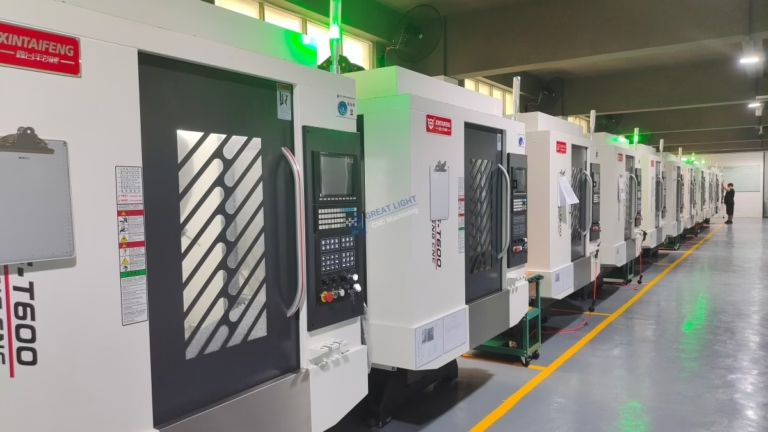
In the world of modern manufacturing, where digital blueprints transform into tangible, high-precision components, there exists a crucial translator and strategist. This professional stands at the intersection of design intent and physical reality, converting complex 3D models into a language machines understand. This role is that of a CNC Machine Tool Programmer. For clients seeking precision parts machining and customization, understanding what this specialist does is key to appreciating the engineering depth behind every quality part delivered, especially from a partner like GreatLight CNC Machining Factory.
Simply put, a CNC programmer is the architect of the manufacturing process. They are responsible for creating the set of coded instructions—the CNC program—that dictates every movement of a CNC machine tool. This program controls the path of cutting tools, spindle speeds, feed rates, coolant flow, and more, to precisely remove material from a workpiece and create the final part. Their work directly determines machining efficiency, part accuracy, surface finish, and tool life.
The Core Responsibilities: From Digital Model to Machine Code
The programmer’s workflow is a meticulous blend of engineering judgment, software mastery, and practical shop floor knowledge. Here’s a breakdown of their key tasks:
1. Blueprint and Model Analysis
The process begins long before any code is written. The programmer meticulously analyzes the customer’s 2D drawings or 3D CAD model (often in formats like STEP, IGES, or Parasolid). They identify:
Critical dimensions and tolerances (e.g., ±0.001mm).
Geometric complexities (undercuts, deep cavities, thin walls).
Material specifications (aluminum, stainless steel, titanium, engineered plastics).
Required surface finishes and any special features.
This analysis forms the foundation for all subsequent planning. At GreatLight Metal, this stage involves close collaboration with our engineering team to ensure manufacturability and may include Design for Manufacturability (DFM) feedback to optimize the part for cost-effective and reliable production.
2. Process Planning and Strategy Development
This is where the programmer’s expertise truly shines. They devise the machining strategy—the “how” of making the part. This involves:
Sequencing Operations: Deciding the order of operations (e.g., roughing, semi-finishing, finishing, drilling, tapping).
Workholding Design: Planning how the raw material (stock) will be securely and accurately held in the machine vise, fixture, or on a tombstone. For complex parts requiring multi-sided machining, they design the strategy for re-positioning.
Toolpath Creation: This is the core of programming. Using CAM (Computer-Aided Manufacturing) software, the programmer defines the precise path the cutting tool will follow. They must choose between different toolpath strategies (contour, pocketing, facing, drilling cycles) to achieve optimal material removal, accuracy, and surface quality.
Tool Selection: Specifying the appropriate cutting tools (end mills, ball nose cutters, drills, taps) based on material, feature size, and desired finish. This includes defining tool diameters, corner radii, flute counts, and coating types.
3. CAM Software Programming
Armed with a strategy, the programmer uses sophisticated CAM software (such as Mastercam, Siemens NX, or HyperMill) to generate the toolpaths. This is a highly skilled task that involves:
Setting up the virtual machine environment within the software, mimicking the actual CNC machine’s kinematics and limits.
Defining stock geometry and the target finished part.
Applying the chosen machining strategies to different features of the part.
Setting cutting parameters: spindle speed (RPM), feed rate (IPM or MMPM), and depth of cut. These parameters are critical for avoiding tool breakage, minimizing wear, and preventing part damage.
4. Post-Processing and G-Code Generation
The toolpaths created in CAM software are generic. A post-processor—a custom software translator—converts these generic instructions into specific G-code and M-code that the target CNC machine controller (e.g., Fanuc, Siemens, Heidenhain) can execute. The programmer ensures the correct post-processor is used and reviews the final G-code for any errors or inefficiencies.
5. Simulation and Verification
Before the program ever touches a machine, it is rigorously tested in a virtual environment. The programmer runs a full machine simulation to:
Detect potential collisions between the tool, holder, workpiece, or machine components.
Verify that the toolpath correctly produces the intended geometry.
Check for inefficient movements, like rapid traverses that are too close to the part.
Estimate machining cycle time. This step is non-negotiable for preventing costly crashes and material waste, a standard practice in our ISO 9001:2015 certified process at GreatLight.
6. On-the-Floor Support and Optimization
The programmer’s job doesn’t end with delivering code. They often work with machine operators to conduct the first-part run-off. They may fine-tune speeds, feeds, or toolpaths based on real-world machining conditions, chip formation, and surface finish results. This iterative optimization is key to achieving stable, high-quality production runs.
The Value a Skilled Programmer Brings to Your Project
For a client, a skilled CNC programmer is an invaluable asset embedded within your manufacturing partner. They directly impact:
Precision & Quality: Their choices dictate whether your part holds those critical ±0.001mm tolerances.
Efficiency & Cost: An optimized program reduces cycle time, minimizes tool wear, and maximizes material utilization, directly lowering your part cost.
Feasibility: They solve the puzzle of how to physically machine complex geometries that might seem impossible, leveraging advanced techniques like 5-axis simultaneous machining.
Reliability: A well-simulated, robust program ensures consistent output part after part, which is fundamental for supply chain stability.
At GreatLight CNC Machining Factory, our team of programmers are not just code writers; they are manufacturing engineers. They leverage our full spectrum of equipment—from 3-axis to advanced 5-axis CNC machining centers—to select the most efficient process for your part. Their work is underpinned by our stringent quality management systems (including IATF 16949 for automotive and ISO 13485 for medical hardware), ensuring every program meets the highest standards of accuracy and repeatability.
Conclusion
So, what does a CNC machine tool programmer do? They are the critical bridge between your design and our machines. They translate engineering ambition into executable reality through a disciplined process of analysis, strategy, coding, and validation. Their expertise ensures that the advanced capabilities of modern CNC equipment are fully harnessed to produce the high-precision, custom parts your projects demand. When you choose a manufacturing partner, you are also choosing the skill and experience of their programming team.
For precision parts where every micron counts, partnering with a manufacturer like GreatLight, which invests deeply in this core competency, is not just a choice—it’s a strategic advantage for bringing your most challenging designs to life with confidence.
Frequently Asked Questions (FAQ)
Q1: What’s the difference between a CNC programmer and a CNC operator?
A: The CNC programmer creates the instructions (G-code program) and plans the manufacturing process. The CNC operator is responsible for setting up the machine (loading tools, fixturing the workpiece), loading the program, running the production, and performing in-process quality checks. In some shops, these roles may overlap, but in precision-focused environments like ours, they are distinct specialties.
Q2: Do programmers need to know how to run the machines physically?
A: Absolutely. The best programmers have extensive hands-on experience as machinists or operators. This practical knowledge is essential for creating realistic, safe, and efficient programs that account for real-world machine behavior, tool deflection, and chip evacuation.
Q3: For my complex part with organic shapes, is manual programming (G-code by hand) still used?
A: For complex 3D geometries, manual programming is virtually impossible. CAM software is essential. Manual G-code is still relevant for very simple, repetitive operations (like drilling a pattern of holes) but is not used for sculpted surfaces or multi-axis contouring common in precision parts machining and customization.
Q4: How does programming for 3-axis differ from 5-axis machining?
A: 3-axis programming is generally more straightforward, with the tool moving linearly in X, Y, and Z. 5-axis CNC machining programming is exponentially more complex. The programmer must manage two additional rotational axes (A, B, or C), requiring advanced CAM software to synchronize all five motions simultaneously, avoid collisions in a full 3D space, and leverage the tool’s side for better surface finish and access to deep features.
Q5: Can the same program run on different brands of CNC machines?
A: Not directly. While the core G-code language is standardized, each machine controller (Fanuc, Siemens, etc.) has proprietary codes and syntax. This is why the correct post-processor is crucial—it translates the CAM software’s generic output into the specific dialect understood by the target machine at the factory floor.



















