
What Are the Newest CNC Machines in Industry?
The newest CNC machines in industry are not one machine. They are 5-axis centers, mill-turn lathes, and adaptive control systems that hold ±0.005 mm on hard alloys. This page explains what each type machines, which parts benefit, and when an older 3-axis setup is still the better buy.
In this article
- 1
- 2
- 3
- 4
- 5
- 6
- 7
Key takeaways
What the newest CNC machines in industry actually are
The newest CNC machines in industry fall into four working groups: simultaneous 5-axis machining centers, mill-turn centers, high-speed 3-axis mills with adaptive control, and automated cells that load parts without an operator. Each one solves a specific problem. None of them replaces the others.
A simultaneous 5-axis center adds two rotary axes to the usual X, Y, Z. The A and B axes tilt the tool or the table, so the cutter approaches a part from almost any direction. The practical result is not just complex geometry. It is fewer setups. On a part with five machined faces, a 3-axis machine needs three or four re-clamps. Each re-clamp adds a datum shift and a chance for operator error. A 5-axis machine does the same part in one.
Mill-turn centers combine a lathe spindle with milling capability, and often a second spindle and a lower turret. Shafts, bushings, and connector housings that used to travel from lathe to mill and back now finish in one cycle. Concentricity between a turned bore and a milled flat stays inside the same datum, which is where most tolerance stacks actually come from.
The quieter change sits inside the control. Modern machines read spindle load, servo current, and sometimes vibration, then adjust feed in real time. On aluminum this saves a few minutes. On Ti-6Al-4V or Inconel it is the difference between a stable cut and a scrapped part that already has 30 hours in it.
When a 5-axis machine pays off, and when it does not
Reach for 5-axis when the part has features on more than three faces, when the geometry is ruled by a curve rather than a plane, or when tolerance between two angled features is tight. Impellers, turbine blades, medical implants, and robot joints are the classic cases. So are parts that were designed as an assembly and are now machined as one piece.
Skip it when the part is a plate, a bracket, or a simple housing that a 3-axis mill can reach in one or two setups. Programming a 5-axis toolpath takes longer, and the machine hour costs more. If the geometry does not need the extra axes, you are paying for motion you never use.
There is a middle ground that gets missed often. A 3+2 setup uses the rotary axes to position the part, then locks them and cuts like a 3-axis machine. You get five faces in one setup without the cost of simultaneous motion. For prismatic parts with angled faces, this is usually the right answer.
Size sets the ceiling. Our largest 5-axis travel is 4,000 × 400 × 150 mm, which covers long aerospace stringers and extrusion profiles. Medium frames run 750 × 1,150 × 550 mm, and compact cells handle 500 × 500 × 450 mm. If your part is bigger than the frame, the newest machine in the catalog still cannot hold it.
What changes on the shop floor once the machine is new
Setup count drops first. A part that needed four fixtures may need one. That removes three chances for a datum shift and cuts the hours between raw stock and finished part, which matters more than spindle speed on small batches.
Surface finish improves because the tool stays engaged. When the cutter can tilt to follow a curved surface, it uses the side of the tool instead of the tip. That spreads the load and leaves a cleaner finish. We hold Ra 0.8–1.6 μm as a standard machined finish and Ra 0.2–0.8 μm when the drawing calls for it.
Tool life behaves differently. Adaptive control slows feed when the load spikes, so a carbide insert in Inconel lasts longer than it would under a fixed feed rate. The trade is cycle time. A conservative adaptive strategy can add minutes to a roughing pass and still save money by not breaking tools at 2 a.m.
Inspection is where the newest machines earn their keep. Fewer setups mean fewer stacked tolerances, so the ±0.005 mm callout is easier to hit and easier to prove. We inspect 100% of parts before shipment, with raw material checks, in-process monitoring, and a final report on request.
How material choice changes the machine decision
Aluminum is forgiving. A 5-axis center cutting 6061 or 7075 can run aggressive parameters and still hold ±0.005 mm, as long as chip evacuation is designed into the fixture. Most of the newest machine features, like high-speed spindles, show their full value here.
Stainless and tool steel sit in the middle. 304, 316L, and 17-4PH work-harden if the tool rubs instead of cuts, so constant engagement matters more than raw speed. Adaptive control helps by keeping the chip load steady through corners.
Titanium and Inconel are where the newest machines separate from the rest. TC4 (Ti-6Al-4V) and Inconel generate heat at the cutting edge and resist it at the same time. Rigid 5-axis frames with load monitoring keep the tool in the cut without stalling. This is also why we keep 16 simultaneous 5-axis centers rather than one or two.
Plastics and composites bring a different problem. PEEK, POM, and carbon fibre need sharp tools and dust control, not high spindle load. A machine with good extraction and a clean enclosure matters more than axis count.
Choosing a supplier, not just a machine
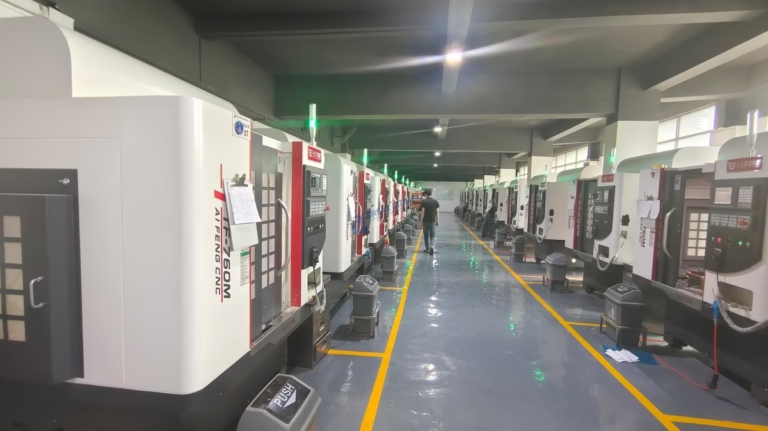
A supplier with a new 5-axis center is not automatically the right fit. Ask how many simultaneous 5-axis spindles they run and how many shifts per day. One machine doing everything is a bottleneck. We run 127 high-precision CNC machines across three wholly-owned plants, including 16 simultaneous 5-axis centers, 16 mill-turn centers, and 12 four-axis mills.
Ask what happens to your drawing before the first chip. A DFM review should come back with specific notes: which feature needs a 5-axis approach, which tolerance is tighter than the process needs, and where a design change would cut cost. Our quotation and free DFM analysis return within 12 hours, and production can start within 24 hours of approval.
Ask about traceability. Certifications should match your industry. We hold ISO 9001:2015, IATF 16949:2016 for automotive, ISO 13485:2016 for medical devices, and ISO 27001:2022 for information security. For regulated programs, those certificates are not paperwork. They are the reason the part can ship.
Finally, ask about quantity range. A shop that only runs high-volume work will not quote a single prototype, and a prototype shop may not hold tolerance at 10,000 pieces. We run from one part to 10,000+ part runs with no minimum order quantity, so the process you validate is the process that scales.
Matching machine type to part geometry
Use this to pick a process before you request a quote.
| Machine type | Best for | Watch out for | Typical setup count |
|---|---|---|---|
| Simultaneous 5-axis | Curved surfaces, 5-face parts, impellers | Longer CAM programming time | 1 |
| 3+2 positional | Prismatic parts with angled faces | Not for continuous contouring | 1 |
| Mill-turn center | Shafts, housings with turned and milled features | Limited Y-axis travel on some models | 1 |
| 3-axis mill | Plates, brackets, flat housings | Needs multiple fixtures for 5-face work | 2–4 |
| 4-axis mill | Cylindrical parts with slots or flats | No tool tilt for undercuts | 1–2 |
| Automated cell | Runs of 500+ identical parts | Fixture cost up front | 0 (lights-out) |
The short version
If your part has curved surfaces or features on five faces, use a simultaneous 5-axis center. If it is a prismatic part with angled faces, 3+2 gets you there for less. If it is a flat plate, a 3-axis mill is the correct and cheapest answer.
Common questions about new CNC machines
Does a newer machine always give a better tolerance?
No. Tolerance comes from the whole system: machine rigidity, fixture, tool, thermal stability, and inspection. A well-set-up 3-axis machine can hold ±0.005 mm on a simple part.
The newest machines help most when the part needs many setups or curved geometry. That is where fixture error and tool engagement dominate the result.
How do I know if my part needs 5-axis?
Count the faces that need machining and the angles between them. If more than three faces need work, or if two tight-tolerance features sit on different angles, 5-axis is likely cheaper than stacking fixtures.
Send the 3D file and we will say which process we would use and why. The DFM note comes back with the quote.
What is the difference between 5-axis and 3+2?
Simultaneous 5-axis moves all five axes at once while cutting, which is needed for curved, contoured surfaces. 3+2 positions the rotary axes, locks them, and cuts in three axes.
3+2 handles angled flat faces and holes. It costs less to program and less per hour. For parts without curved surfaces, it is often the better choice.
Can you machine Inconel or titanium on these machines?
Yes. We machine TA1, TA2, TC4 (Ti-6Al-4V), and Inconel on rigid 5-axis frames with load monitoring, which keeps the cut stable in hard alloys.
Expect longer cycle times than aluminum. Tool life and surface finish drive the parameters more than spindle speed.
What is the largest part you can run on a 5-axis machine?
Our largest 5-axis travel is 4,000 × 400 × 150 mm. Medium frames cover 750 × 1,150 × 550 mm and 600 × 600 × 600 mm.
If the part exceeds the frame, we can split the operation or move it to another process. Send the envelope dimensions and we will confirm.
Do you handle both prototypes and production runs?
Yes. There is no minimum order quantity, so a single prototype and a 10,000+ part run both go through the same process plan.
That matters when you validate a design on one part and then scale it. The fixture and toolpath decisions carry over.
Send the drawing, get a process answer
Upload your 3D file and we will return a quote with a free DFM analysis within 12 hours, including which machine type we would use and why.
12-hour quote100% inspectionNo minimum order quantityNDA on request
More machining notes
We publish setup notes, tooling trials and inspection data from the factory floor.











