
CNC Machining Suppliers List: How to Screen Before You Order
A CNC machining suppliers list tells you who exists. It does not tell you who can hold ±0.005 mm on a titanium bracket, who inspects every part, or who will still answer your email in week three. This guide gives engineers and buyers seven checks to run against any list, plus the signals that separate a real production shop from a brokered quote.
In this article
- 1
- 2
- 3
- 4
- 5
- 6
- 7
- 8
What matters most when you scan a supplier list
Supplier type versus what your part actually needs
Use this table to decide which category of supplier fits before you read any list of names.
| Supplier type | Best for | Watch out for | Typical fit |
|---|---|---|---|
| Brokered marketplace | Simple geometry, low volume, fast price | Quality depends on the assigned shop | Brackets, enclosures, fixtures |
| Quick-turn prototyping house | First articles, design iteration | Limited post-processing and finishing | Concept models, test rigs |
| Integrated machining factory | Tight tolerance, series production | Needs a real DFM conversation | Engine housings, medical instruments |
| Regional job shop | Local pickup, small batches | Capacity swings in peak season | Repair parts, one-off tooling |
| Sheet metal and CNC hybrid | Flat parts plus machined features | Machined tolerance may be looser | Panels, chassis, mounting plates |
| Casting-first supplier | High volume near-net shapes | Tooling lead time and cost | ADC12 housings, pump bodies |
The list is the easy part
Pick suppliers by the feature you cannot afford to get wrong, then verify it on one real part. A shop that can show you how it measured your critical dimension is worth more than a longer list of names.
Tolerance and inspection: read the number, then ask how it is measured
Every page on a CNC machining suppliers list claims precision. The useful question is narrower: what tolerance can this shop hold on the specific feature you care about? A shop that quotes ±0.005 mm on a 40 mm aluminum housing is not making the same promise as one quoting ±0.05 mm on a 4,000 mm weldment. Feature size, material and fixturing all move the real number.
Ask what equipment verifies the callout. A coordinate measuring machine with a stated accuracy budget is a different answer than calipers at the bench. For a bore with a positional callout, you want to know whether the shop measures with a CMM program or a pin gauge. Both are legitimate. Only one gives you a report you can hand to a customer.
Inspection coverage matters as much as inspection method. A shop that checks the first article and then runs to the end is not the same as one that inspects 100% before shipment. For medical and automotive work, ask for raw material certificates, in-process monitoring records and a final inspection report.
One practical test: send a part with a known hard feature, such as a thin wall or a deep pocket with a tight corner radius. How the quote discusses that feature tells you whether an engineer read the drawing or a routing engine priced it.
- 1Ask for the measurement method, not just the numberCMM, optical comparator or gauge pins each carry a different uncertainty.
- 2Confirm inspection coverageFirst article only, sampled, or 100% before shipment.
- 3Send a hard feature in the RFQHow the quote handles it reveals the level of process review.
Lead time: separate quote time, production start and ship date
Lead time gets compressed into a single number on most supplier pages. Break it into three parts. Quote turnaround is how fast you get a price and DFM feedback. Production start is how fast chips actually fly after you approve. Ship date is when the box leaves the dock. A shop can be fast at one and slow at the others.
For a prototype, quote speed dominates your decision. For a series order, production start and repeatability dominate. A supplier that starts in 24 hours but ships in three weeks is not slow; it simply has a longer machining cycle. A supplier that quotes in an hour and then sits on the order for a week has a different problem.
Treat any delivery promise as a planning input, not a contract. Ask what the shop does when a tool breaks or a material lot fails incoming inspection. The answer tells you whether you will hear about it the same day or find out when the tracking number does not appear.
- 1Split the numberQuote time, production start and ship date are three different commitments.
- 2Weight them by order typePrototypes reward quote speed; series orders reward stable starts.
- 3Ask about the failure pathTool breakage and material rejections are when communication is tested.
MOQ, tooling and finishing: where the small print lives
No minimum order quantity sounds generous until you reach the finishing step. Machining one bracket is routine. Anodizing one bracket may require a batch to fill a rack, and hardcoat anodizing often runs in fixed load sizes. The same applies to electroless nickel, powder coating and laser marking setups.
Tooling is the second place small quantities get expensive. Custom workholding, soft jaws and form tools are one-time costs that make sense over a run of hundreds and hurt on a run of five. A good supplier will tell you when the tooling cost is the dominant line item and suggest a design change that removes it.
Material availability drives the third hidden cost. A specialty alloy that is not on the shelf adds a procurement cycle before machining even starts. If your design can use 6061-T6 instead of a less common grade with no functional loss, say so in the RFQ and let the shop price both.
- 1Check the finishing MOQ separatelyMachining minimums and coating minimums are rarely the same number.
- 2Ask for a tooling line itemIf it dominates the quote, a design change may remove it.
- 3Offer a material alternativeOff-the-shelf grades shorten the procurement cycle.
Certification and process fit: match the paperwork to the industry
Certification is not a badge for the website. It is a statement about which management system governs your order. ISO 9001:2015 is the baseline most buyers expect. IATF 16949:2016 is what automotive series production usually requires. ISO 13485:2016 applies to medical devices. ISO 27001:2022 covers information security, which matters when you are uploading proprietary CAD.
Ask which certificate covers the plant that will actually run your parts. A group with several sites may hold a certificate at one location and route your job to another. That is not automatically a problem, but you should know before you place the order.
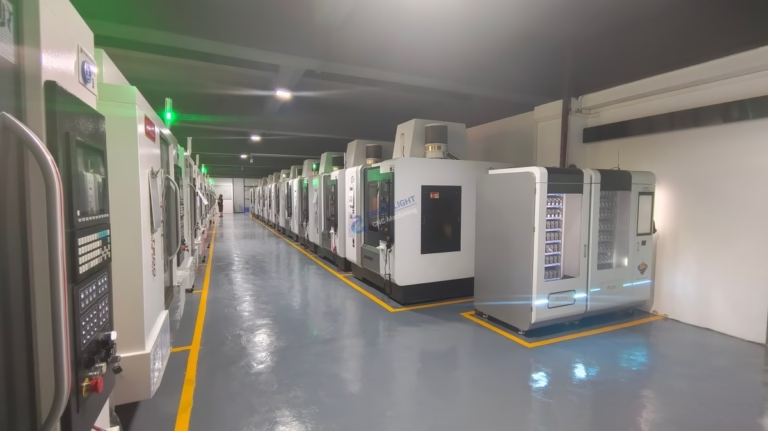
Process fit is the other half. A shop with 16 simultaneous 5-axis machining centers and a Ø400 mm rotary table can reach features that a 3-axis shop cannot. A shop with mill-turn centers handles shafts with cross-drilled holes in one setup. Match the machine inventory to the geometry, not to the marketing copy.
- 1Name the plantConfirm the certificate covers the site running your job.
- 2Match certificate to sectorAutomotive, medical and information security each have their own standard.
- 3Read the machine listAxis count, rotary table size and travel limits decide what is feasible.
Quoting discipline: what a good RFQ response looks like
A useful quote answers more than price. It flags the features that drive cost, names the stock size and material condition, and states the assumed tolerance where the drawing is silent. If a shop returns a number with no comments, you have a price, not an engineering review.
Watch for how the quote handles ambiguity. A drawing with a missing surface finish or an unclear datum is normal. A supplier that asks before quoting is doing you a favor. One that assumes and stays quiet is transferring that risk to the first article.
Confidentiality belongs in this check too. Proprietary geometry should move under an NDA when you need one, and uploads should be handled as confidential by default. Ask what happens to your files after the job closes.
- 1Expect cost drivers, not just a totalA good quote names the features that set the price.
- 2Reward clarifying questionsQuestions before quoting reduce first-article surprises.
- 3Settle confidentiality earlyNDA on request and a stated file retention practice.
Seven steps to turn a supplier list into a shortlist
Run these in order. Each step removes names for a reason you can defend later.
- 1Define the critical feature firstWrite down the one dimension or surface that decides whether the part works. Everything else is secondary. This becomes your screening question.
- 2Filter by process capabilityCheck axis count, rotary table size and maximum travel against your geometry. A 4,000 mm part does not fit a 500 mm machine.
- 3Filter by tolerance and inspectionKeep shops that can hold your callout and name the measurement method. Drop any that only state a generic number.
- 4Filter by certificationISO 9001:2015 as the floor. Add IATF 16949:2016 or ISO 13485:2016 if your sector requires it, and confirm the site.
- 5Check volume and finishing MOQAsk about minimum batch for anodizing, plating or powder coating before you assume a single part is possible.
- 6Send the same RFQ to three shopsSame drawing, same material, same finish, same quantity. Compare the comments, not only the price.
- 7Order one part, then judgeMeasure the critical feature, read the inspection report and time the communication. The first article is the real interview.
Questions buyers ask before choosing a shop
How many suppliers should I keep on an approved list?
Three is a workable number for most programs. One primary, one backup and one for overflow or a second process. Fewer than three and a single capacity problem becomes your problem. More than five and you stop maintaining the relationships properly.
For regulated sectors, keep the approved list shorter and document why each shop qualified. Auditors care about the reason, not the count.
Is a higher price a sign of better quality?
Not by itself. Price reflects machine time, setup, tooling, inspection and margin. A high quote may mean a difficult feature is being machined slowly, or it may mean the shop simply does not want the job.
Read the cost drivers in the quote. If the premium sits on the feature you care about, it is probably justified. If it sits on overhead, ask why.
What should I send with an RFQ?
A 3D model, a 2D drawing with datums and tolerance callouts, the material and temper, the surface finish, the quantity and the target date. Note any feature you consider critical.
If the drawing is incomplete, say so. A shop that knows what is undecided will quote the assumption instead of hiding it.
When does 5-axis machining actually pay off?
When the part has features on multiple faces that would otherwise need several setups, or when a contoured surface must be cut in one continuous pass. Fewer setups mean fewer datum shifts and less accumulated error.
For a simple plate with holes on one face, a 3-axis machine is cheaper and just as accurate. Paying for 5-axis time on simple geometry is wasted budget.
How do I judge a shop I have never used?
Place a small order on a part with one hard feature. Ask for the inspection report with it. Compare the measured value to the drawing, then judge how the shop handled any deviation.
How a supplier reacts to a nonconformance predicts the next two years better than any capability page.
Does location still matter for CNC sourcing?
It matters for shipping time, tariff exposure and how easily you can visit the floor. It matters less for part quality, which depends on machines, tooling and inspection discipline.
Many buyers split the work: a nearby shop for urgent iterations and a lower-cost production partner for stable, released parts.
Put your part in front of an engineer
Send a model and drawing and you get a quotation plus DFM feedback, with the tolerance and inspection method stated in writing.
Quote in 12 hours100% inspectionNo minimum order quantityNDA on request
More from the shop floor
We publish setup notes, tooling trials and inspection data from the factory floor.











