
China CNC Machining: How to Read Chinese Top Suppliers
A working guide for engineers and sourcing teams who shortlist Chinese machining partners. It covers the shop-floor signals that predict part quality, the numbers worth asking for, and the cases where a Chinese supplier is the wrong choice.
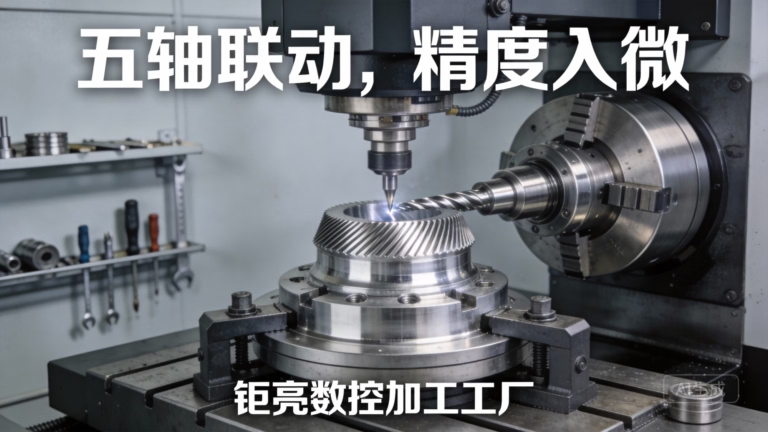
What separates a real Chinese machine shop from a trading front
Most listings on sourcing platforms are resellers. The checks below are the ones that actually separate a factory from a broker.
Machine count tells you less than machine mix
A supplier with 60 identical three-axis VMCs is a volume shop. A supplier with a spread of five-axis centers, mill-turn lathes and large gantries is a development shop. Both are legitimate. The mismatch happens when you send a part with two angled faces to the first one, or a 50,000-piece bracket run to the second.
Ask how many machines can reach the tolerance on your drawing, not how many machines exist. At GreatLight, 16 simultaneous five-axis machining centers handle contoured faces and undercuts in one setup. A Ø400 mm rotary table and 4,000 × 400 × 150 mm travels cover large frames and long extrusions. Compact 500 × 310 × 200 mm travels run small medical and electronics parts.
The useful question is which machine the quote is built on. If the answer is vague, the quote is a guess.
- 1Five-axis for geometryAngled holes, compound faces, deep pockets reached without re-fixturing.
- 2Mill-turn for round partsTurning plus milling on one platform, fewer setups, tighter concentricity.
- 3Large gantry for framesUp to 4,000 mm length for automation bases and structural plates.
- 4Ask for the setup planSetup count drives both cost and stack-up error.
What ±0.005 mm means in production, not in a brochure
A tolerance on a website is a capability claim, not a process control document. ±0.005 mm is achievable on a well-maintained machining center in a temperature-stable room with the right workholding. It is not achievable on every feature of every part.
The distinction that matters is between a one-off measurement and a stable production band. Ask for the inspection method behind the number: which CMM, what probe, what temperature, and whether the report covers every critical dimension or just one. GreatLight runs raw material checks, in-process monitoring and a final inspection before shipment, with reports issued on request.
If your part has one or two tight bores and everything else is loose, say so. Pricing the whole part to the tightest feature is a common way to overpay.
- 1Ra 0.2–0.8 μmFine finish for sealing faces and sliding surfaces; usually needs a second operation.
- 2Ra 0.8–1.6 μmStandard high finish for mating faces and visible covers.
- 3Ra 1.6–3.2 μmAs-machined finish, fine for brackets and internal structure.
What to request from a Chinese CNC supplier, by part type
Use this as a checklist when you build the shortlist. The right-hand column is the failure mode when the check is skipped.
| Part type | Ask for | Risk if skipped |
|---|---|---|
| Prototype, complex geometry | Setup sheet and five-axis availability | Re-fixturing error, longer lead time |
| Automotive production part | IATF 16949 scope and PPAP history | Traceability gaps at audit |
| Medical instrument housing | ISO 13485 scope and cleaning process | Documentation rejected by QA |
| Large frame or base | Travel size and gantry capacity | Part split into welded sections |
| Tight-bore hydraulic part | CMM report and gauge R&R | Good sample, drifting production |
| Sealed consumer product | ISO 27001 and NDA terms | Design leaks to a competitor |
Certificates are a scope statement, not a badge
ISO 9001:2015 tells you a quality system exists. IATF 16949:2016 tells you the system is built for automotive production, including traceability and change control. ISO 13485:2016 covers medical device manufacturing. ISO 27001:2022 covers how your files and drawings are handled.
These are different questions. A shop can hold ISO 9001 and still be a poor fit for a medical program, because the documentation trail is not there. Ask which certificate applies to the plant that will run your part, and ask to see the scope wording. Many suppliers list a group certificate that does not name the site doing the work.
For any project with a real design advantage, data handling belongs in the same conversation as tolerance. Uploads are kept confidential and an NDA can be signed before drawings are shared.
Where a Chinese supplier wins, and where it does not
A Chinese machining partner is a strong fit when the part needs multiple processes and you want one purchase order. Machining, finishing, heat treatment coordination and assembly under one roof remove a layer of logistics and a layer of blame. That combination is common in robotics, EV hardware, automation frames and instrument enclosures.
It is a weaker fit when your requirement is a single simple turned part at very high volume with no geometry change, and a domestic screw-machine shop is already qualified. Freight and customs add days that a local supplier does not add. It is also a poor fit when your end customer contractually forbids offshore manufacturing, or when a design iteration must be measured in hours rather than days.
The middle ground is where most programs land. Prototype offshore, then decide on production once the design stops moving. No minimum order quantity makes that transition cheap: one prototype and a 10,000-piece run go through the same quoting path.
- 1Good fitMulti-process parts, moderate volume, geometry that still changes.
- 2Good fitMachined parts needing anodizing, plating or laser marking.
- 3Poor fitContractually locked domestic sourcing.
- 4Poor fitHour-by-hour iteration on a physical prototype.
Engineering communication decides the outcome
Most offshore machining problems are not machining problems. They are unanswered questions on a drawing. A thread callout without a class, a radius marked R0.5 with no note on whether it is a design intent or a tooling artifact, a surface finish specified globally when only one face matters.
A supplier that flags these before cutting metal saves a week. GreatLight returns a quotation and a DFM analysis within 12 hours, and production can start within 24 hours of approval. That early review is where cost comes out of a part, not in the machine cycle.
Material choice is part of the same conversation. Aluminum 6061 and 7075, stainless 303 and 17-4PH, titanium TC4, PEEK and carbon fiber all machine differently and price differently. Choosing the material after the quote is backwards.
- 1Flag drawing gapsThread class, tolerance stack, datums, critical vs cosmetic faces.
- 2Confirm material grade6061-T6 and 6061 are not interchangeable in strength terms.
- 3Agree the finish specAnodize type and color, laser marking minimum character height 1.5 mm.
- 4Fix the inspection scopeWhich dimensions get a report, and in what format.
Questions engineers ask before placing a Chinese order
How do we verify a supplier is a factory and not a trading company?
Ask for the plant address and a short video walkthrough of the floor where your part will run. A factory can show the machines, the fixture shelves and the inspection room in one continuous shot.
Then check that the certificate scope names that site. A group certificate with a different address is a common gap.
What tolerance should we actually put on the drawing?
Put the tight tolerance only where the function needs it. ±0.005 mm on a bearing bore is reasonable; ±0.005 mm on an outer profile that no one measures adds cost for no benefit.
If a dimension is not critical, mark it general tolerance and let the shop use the standard block.
Which certifications matter for our industry?
ISO 9001:2015 is the baseline. Add IATF 16949:2016 for automotive production, ISO 13485:2016 for medical devices, and ISO 27001:2022 when your drawings carry design value.
GreatLight holds all four.
How is our design protected?
Uploads are treated as secure and confidential, and an NDA can be put in place before any drawing is shared. ISO 27001:2022 covers the information handling process.
For early-stage concepts, send a simplified model with the critical features intact and the non-critical geometry removed.
Can we order one prototype and scale later?
Yes. There is no minimum order quantity, so a single prototype and a 10,000-plus piece run use the same quoting path.
The prototype also produces the setup and inspection data that makes the production quote accurate.
What lead time is realistic?
Quotation and DFM feedback come back within 12 hours. Production can start within 24 hours of approval, and parts typically ship in 3–5 days depending on process and finishing.
Finishing operations such as anodizing or plating add their own cycle time, so plan the sequence early.
Send a drawing, get a manufacturability read
Upload your files and an engineer will return a quote with DFM notes, usually within 12 hours.
12-hour quote and DFMNo MOQISO 9001 / IATF 16949 / ISO 13485 / ISO 27001









