
Silicone Mould Making Kit and Hand Mould Casting Kit: How the Process Works
A silicone mould making kit and hand mould casting kit is a low-pressure copying route. A master pattern is duplicated in silicone, then filled with resin, urethane or low-melt metal by hand. This page explains the mechanics, the tolerance limits and the point where you should switch to CNC-cut tooling instead.
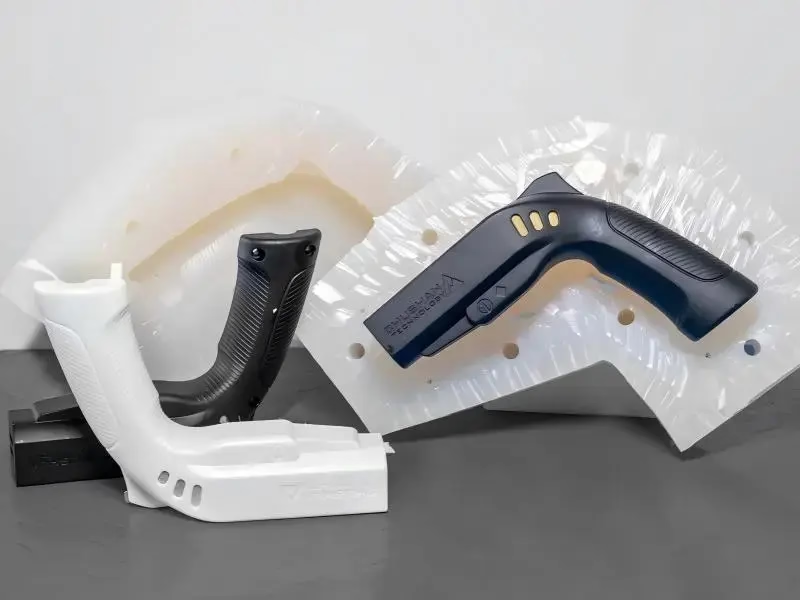
What a Silicone Mould Making Kit Actually Does
The kit is a chemical system, not a machine. Two components, a base and a curative, are mixed at a fixed ratio, usually 10:1 or 1:1 by weight, then poured over the master pattern and left to cure at room temperature or in an oven. Cure takes about 4 hours at 25 °C and about 1 hour at 60 °C for a typical 30 Shore A platinum-cure silicone.
Platinum-cure silicone is the default for engineering work because it shrinks less. Linear shrinkage is usually 0.1% to 0.3% over the first 24 hours, and it keeps moving slightly for a few days after that. Tin-cure silicone is cheaper but shrinks more and can inhibit some urethanes, so it is a poor fit for dimensionally critical parts.
The mould copies the master, so the master decides everything. A CNC-machined master in aluminium 6061 or ABS holds its dimensions far better than a hand-finished one. If the master is 0.2 mm oversize, every cast part comes out 0.2 mm oversize plus shrinkage. There is no way to correct that after the silicone has cured.
Degassing matters more than most people expect. Trapped air against the pattern face becomes a surface pit on every part you pull. Vacuum degassing at 50 to 100 mbar for 2 to 5 minutes, before the pour, removes most of it. Pouring in a thin stream from one corner also helps air escape ahead of the silicone.
Where the Hand Mould Casting Kit Stops Working
A hand mould casting kit is a manual workflow. You mix, pour, wait, demould and repeat. That is fine for 20 parts. It becomes a bottleneck at 200 parts, because each cycle still costs the same operator time and the same cure window.
Silicone is soft. Under gravity fill it holds form, but any thin wall below about 1 mm will flex during demoulding and can tear after repeated pulls. Sharp internal corners concentrate stress and are the first place a mould splits. A 0.5 mm radius on the master adds years of life to the tool.
Casting resins shrink as they cure. A filled urethane might shrink 0.1% to 0.5%, an unfilled one more. If you need ±0.1 mm on a 100 mm part, cast resin is already outside that window before you add silicone shrinkage. This is the single biggest reason prototypes move to CNC machining.
Heat is the other boundary. Most silicone tooling is rated for short exposure up to 150 to 200 °C, but repeated thermal cycling hardens it and shortens life. Low-melt alloys poured near 70 to 90 °C are safe. Aluminium at 660 °C is not, and it will destroy the mould on the first pour.
Why Teams Choose Casting Before CNC Tooling
The economics are simple. A silicone tool can be made in a day and costs a fraction of a steel or aluminium mould. For a design that is still moving, that matters. You can change the master, pour a new mould and hold a review meeting the next morning.
Silicone also handles geometry that would need side actions or slides in a hard tool. Undercuts, deep ribs and internal threads come out of a flexible mould without any special mechanism, as long as the silicone can stretch over the feature without tearing.
Surface finish carries straight from the master. Polish the master to Ra 0.8–1.6 μm and the cast parts come out glossy. Bead blast it and they come out matte. You can also cast colour directly by adding pigment to the resin, which avoids a separate painting step on a short run.
The gap opens at volume. Once a part is stable and you need thousands of units, cast urethane stops being competitive and injection moulding wins on unit cost. The crossover is usually somewhere in the low hundreds, but tooling cost and part size move that line.
Machining the Master Pattern Before You Pour
The master is the only place where you can still control tolerance, so it deserves the tightest process on the job. A 3-axis or 5-axis CNC pass gives you a master with ±0.005 mm positional accuracy and a known surface finish, which the silicone then copies faithfully.
Draft is not strictly required for silicone, but a 1° to 2° draft makes demoulding easier and reduces the chance of tearing thin edges. Deep cores should be split into separate silicone pieces that key back together, rather than one long cavity that grips the part.
For patterns that will be handled often, a metal master in aluminium or stainless outlasts a printed one. Tool steel masters are worth it when you plan to pull many silicone moulds from the same pattern, because the master takes the wear instead of the tooling.
We machine masters from aluminium 6061, 7075, stainless 17-4PH, ABS, POM and PEEK, then finish them by bead blasting, polishing or anodizing. The finish you choose on the master is the finish your cast parts will show.
Casting Kit vs CNC Tooling: Selection Criteria
Use this to decide which route fits the job.
| Criterion | Silicone kit | CNC-machined part |
|---|---|---|
| Typical quantity | 1 to 100 parts | 1 to 10,000+ parts |
| Tolerance | ±0.3 mm and looser | ±0.005 mm |
| Lead time | Master plus 1 day | Parts ship in 3–5 days |
| Tooling cost | Low, one flexible mould | Higher, no soft tool |
| Undercuts | Free, mould flexes | Needs 5-axis or slides |
| Surface finish | Copies master exactly | Ra 0.2–0.8 μm achievable |
| Material range | Urethane, resin, low-melt | Aluminium, steel, titanium |
| Best use | Early form and fit checks | Fit, function, end use |
Which Route to Pick
If the design is still changing and you need 5 to 50 look-and-feel parts this week, build a machined master and pour a silicone mould. If the geometry is frozen or the tolerance is tighter than ±0.3 mm, skip the silicone and machine the parts directly.
Silicone Mould and Casting Questions
How many parts can one silicone mould produce?
A well-made platinum-cure mould typically yields 25 to 100 casts. Simple shapes with generous draft and smooth surfaces sit at the high end. Deep undercuts, thin walls and abrasive fillers push you toward 20 or fewer.
The mould ages whether you use it or not, so pull your parts in one campaign rather than spreading them over months.
Can I cast metal in a silicone mould?
Only low-melt alloys that pour between 70 and 90 °C. Those work because the pour temperature stays well below the silicone's service limit.
Aluminium, brass and steel are far too hot. They will burn the silicone and destroy the mould on contact. Use die casting or investment casting for those metals instead.
Why do my cast parts come out undersize?
Two things stack up. Silicone shrinks as it cures, and the resin shrinks as it sets. On a 100 mm part, 0.3% shrinkage is 0.3 mm, which is often more than the print allows.
Measure the master, measure the first cast, and record the difference. If you must stay in silicone, scale the master up by that measured amount before machining it.
Does the master pattern need draft?
Silicone is flexible, so a straight wall will release. But a 1° to 2° draft still helps, especially on deep cores and thin edges where tearing is a risk.
The draft also reduces the pull force needed to remove the part, which extends mould life over a run.
What file formats do you need for a master pattern?
STEP and IGES cover most machined masters. STL works for printed patterns that will be finished by hand or tumbled.
Send the 3D model with a drawing if the part has tolerances or datum callouts. We return a DFM analysis with the quotation, usually within 12 hours.
Can you keep the design confidential?
Yes. Uploads are handled as confidential and we sign an NDA on request before any files are opened.
We hold ISO 27001:2022 for information security, which covers how design data is stored and who can access it.
Send Us the Master Pattern
Upload a 3D model and we return a quotation with free DFM analysis within 12 hours. From one prototype to 10,000+ part runs, no minimum order quantity.
12-hour quote100% inspectionNDA on request
More Process Notes
We publish setup notes, tooling trials and inspection data from the factory floor.











