
Rapid Tooling Inc Quality Molds Fast
A process explanation for tooling engineers and procurement teams. We cover how machined inserts, cavities and cores reach usable tolerance, where rapid tooling stops being the right answer, and which checks tell you before steel is cut.
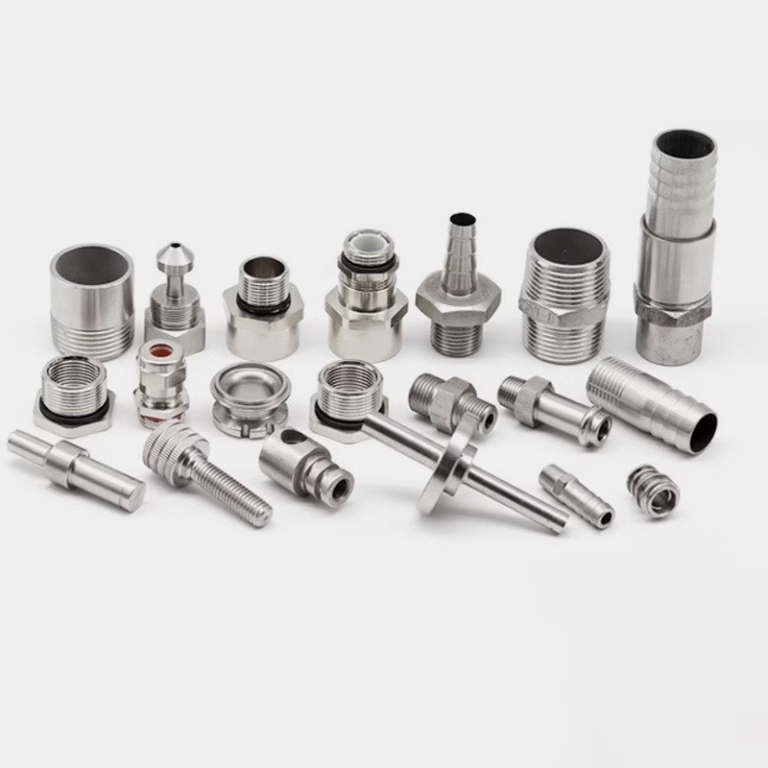
What rapid tooling actually changes
Rapid tooling is not a different manufacturing process. It is the same cutting, EDM and fitting work, sequenced so that a mold insert exists weeks earlier than a conventional build. The mechanism is simple: machine the cavity directly from a billet instead of waiting for a casting, then finish the geometry on the same machine that roughed it.
That last part matters more than the speed itself. Every time a part moves between machines, the datums move with it. A direct-machined insert keeps one coordinate system from roughing to finishing, so the error stack stays short.
A second change is decision timing. Because the insert is cut from stock, we can adjust a rib thickness, a gate position or a cooling line after the first mold trial without scrapping a casting. Conventional tooling usually locks those decisions months earlier.
The tradeoff you accept is tool life and cavity count, not dimensional accuracy. A machined insert in 7075 or pre-hardened 4140 will run tens of thousands of shots in PP or ABS. It will not run a million shots in glass-filled PA66 without inserts or a different steel.
- 1Direct-machined insertsCavity cut from billet, no casting lead time
- 2Single datum chainRough and finish on the same machine
- 3Late geometry changesEdits possible after first trial shots
How rapid tooling quality molds fast is held on the machine
Tolerance on a mold insert is not a single number. It is a set of them: cavity depth, shutoff faces, core-to-cavity clearance, and the flatness of the parting plane. A general ±0.005 mm applies to critical features, while shutoffs and parting surfaces often need tighter control because they control flash.
Five-axis work reduces the number of setups. A deep cavity with an undercut normally needs a three-axis pass, an electrode, and a sinker EDM burn. On a simultaneous five-axis center the tool reaches the undercut in one setup with a relieved cutter, which removes two repositioning errors and a queue.
Surface finish is chosen per face, not per part. A Class A visible surface may be polished to Ra 0.2–0.8 μm. A cooling channel or a hidden rib can stay at Ra 1.6–3.2 μm as machined, which saves polishing hours that do not improve the part.
We run 127 CNC machines, 16 of them simultaneous five-axis, with a maximum processing size of 4,000 mm. Large molds get split into inserts not because the machine cannot reach, but because a smaller insert is easier to replace when one rib wears.
- 1Cavity and core±0.005 mm on critical features
- 2Shutoff facesControl flash, often tighter than nominal
- 3Finish by functionPolish only where the part shows
Material choice sets the ceiling on tool life
Aluminum 6061 and 7075 machine fast and hold fine detail. They suit bridge tooling, pilot runs and any insert that will see a few thousand shots. Thermal conductivity is high, so cycle time is short and cooling lines can be simple straight drills.
Pre-hardened 4140 and 4130 sit in the middle. They cut at reasonable rates, hold a shutoff edge longer, and tolerate abrasive fillers better than aluminum. For a tool expected to run 50,000 to 100,000 shots, this is usually the practical choice.
Hardened tool steel and 17-4PH enter when the geometry is aggressive or the resin is filled. Hard milling hardened stock is slower and the cutter cost is higher, but it removes the heat-treat distortion that forces a second setup and a re-cut of the shutoffs.
Titanium and Inconel appear in molds and fixtures for composite work rather than in production injection inserts. They machine slowly, and the value is wear resistance or thermal mismatch, not speed.
- 1AluminumBridge and pilot tooling, fast cycles
- 24140 / 4130Mid-volume inserts, balanced cost
- 3Hardened steelFilled resins, long runs, sharp edges
Where the schedule is actually spent
Most of the calendar time in tooling is not cutting. It is waiting: for a quote, for a steel order, for a heat-treat furnace slot, for a trial press window. Cutting hours on a mid-size insert are often a small fraction of the total.
Because cutting is fast relative to the queue, the queue is what we attack. Quotation and DFM analysis come back within 12 hours. Production can start within 24 hours of a released drawing, and parts ship in 3 to 5 days on the machining side.
Inspection is where schedule slips quietly. A mold that passes dimensional checks can still flash at the parting line or short-fill at a rib. We inspect 100% of parts before shipment and check raw material, in-process geometry and final dimensions, with reports on request.
DFM feedback belongs before the first cut. If a wall is 0.6 mm with a 2 mm gate land, no amount of machine accuracy fixes it. Catching that in the quote stage is cheaper than catching it in the press.
- 1Quote and DFMWithin 12 hours of upload
- 2Start of cuttingWithin 24 hours of release
- 3Machined partsShip in 3–5 days
When rapid tooling is the wrong route
If the program needs one million shots in glass-filled nylon, a machined aluminum insert is the wrong answer. The gate area will erode, the shutoffs will round over, and you will rebuild the tool twice. Go to hardened steel with proper inserts from the start.
If the part is a single prototype with no intention of production, a mold is usually unnecessary. Machining the geometry directly, or printing it for a fit check, is faster and cheaper than building a cavity.
Optical parts are a separate case. Polish direction, gate location and cooling uniformity decide the appearance, and those are process decisions rather than machining decisions. Rapid tooling can still help, but the trial loop matters more than the lead time.
The honest boundary is this: rapid tooling wins when the geometry is still moving and the volume is uncertain. It loses when the design is frozen and the volume is high, because a conventional tool amortizes better over that many shots.
- 1Good fitDesign still changing, volume uncertain
- 2Poor fitFrozen design, very high shot count
- 3Separate caseOptical surfaces need trial iterations
Rapid tooling routes compared
Pick the column that matches your volume and resin.
| Route | Typical volume | Best for | Limit to watch |
|---|---|---|---|
| Machined aluminum insert | Up to a few thousand shots | Bridge and pilot tooling | Gate erosion with filled resin |
| Pre-hardened 4140 insert | 50,000–100,000 shots | Mid-volume production | Needs sharp shutoff maintenance |
| Hardened tool steel | Long production runs | Abrasive and filled resins | Hard milling time and cutter cost |
| Vacuum casting from a master | Tens to low hundreds | Fit and form checks | Soft tool wears quickly |
| Direct CNC of the part | One to a few hundred | Frozen geometry, no mold needed | No cavity, no cycle time gain |
The tradeoff in one line
If the design is still moving and you need parts in weeks, cut the insert and accept limited tool life. If the design is frozen and the volume is high, pay for hardened steel and a conventional build. Speed and durability trade against each other; accuracy does not.
Questions engineers ask
How tight a tolerance can a rapid tool insert actually hold?
Critical cavity and core features are held to ±0.005 mm (about ±0.0002 in) in our shop. That figure applies to features the drawing calls out, not to every surface on the block.
Shutoff faces and parting planes are usually held tighter than nominal because they control flash. Deep ribs and thin cores deflect under cutting force, so we rough, stress-relieve where needed, and finish in a second pass.
Does a machined insert need heat treatment?
For aluminum inserts, no. For 4140 and 4130, pre-hardened stock is normally supplied in the 28–32 HRC range and used as-is, which avoids heat-treat distortion entirely.
Hardened tool steel and 17-4PH are heat treated and then hard milled or ground. That adds a furnace queue and a second setup, so it only pays when wear resistance or edge retention justifies the extra time.
How do cooling channels affect cycle time on a rapid tool?
Straight drilled lines are limited to what a drill can reach, which usually means channels run parallel to the parting plane. Baffles and bubblers extend that reach but add fittings that can leak.
Five-axis machining lets us cut conformal channels that follow the cavity contour. On thick sections this shortens cooling and reduces warpage, and the tradeoff is a more complex insert that is harder to repair if a channel plugs.
What information do you need to quote a rapid tool?
A 3D model or a 2D drawing with tolerances, the resin or material, expected annual volume, and the machine that will run the tool. Parting line preference helps but we can propose one.
Uploads are handled as confidential, and an NDA is available on request. Quotation and free DFM analysis come back within 12 hours.
Can you machine a mold insert and the molded parts in the same shop?
Yes. Inserts, cores, sliders and the machined trial parts all run through the same plant, so the first trial shots do not wait on an outside supplier.
That matters most when a rib or a boss needs adjusting after the first shot. One coordinate system carries through from insert machining to the trial part measurement.
Which materials are available for inserts?
Aluminum 6061, 6061-T6, 7075 and 2024; steels 1018, 1045, 4130, 4140, 4340 and tool steel; stainless 303, 304, 420 and 17-4PH; plus copper alloys such as C110 and beryllium copper for high-heat areas.
Copper alloys are used where a local hot spot needs faster heat removal, and they machine well but wear faster than steel at the gate.
Send the model, get a routing decision
Upload the part and the expected volume. We will tell you which insert material and route fit, or say plainly when a mold is the wrong call.
12-hour quoteFree DFM analysis100% inspectionNDA on request
More from the shop floor
We publish setup notes, tooling trials and inspection data from the factory floor.











