
When navigating the complex landscape of modern manufacturing, a common point of confusion arises: Is a robot a CNC machine? The short answer is no, they are fundamentally different technologies with distinct purposes, though they are both critical pillars of industrial automation and can work together synergistically. At its core, a CNC (Computer Numerical Control) machine is a dedicated, highly rigid tool designed for subtractive manufacturing—it precisely cuts away material to form a part. A robot, specifically an industrial robotic arm, is a versatile, programmable actuator designed to move tools, parts, or perform assemblies with flexibility across a large workspace.
Understanding this distinction is crucial for making informed decisions in precision parts machining and customization. Let’s delve deeper into their characteristics, applications, and how industry leaders like GreatLight CNC Machining Factory leverage both technologies to deliver superior integrated manufacturing solutions.
H2: Core Definitions: Unpacking the Fundamentals
To demystify the question, we must first define each entity clearly.
H3: What is a CNC Machine?
A CNC machine is a manufacturing system where pre-programmed computer software dictates the movement of factory tools and machinery. The process is used to control a range of complex machinery, from grinders and lathes to mills and routers.
Core Function: Subtractive Manufacturing. It starts with a solid block (or billet) of material (metal, plastic, composite) and removes material with cutting tools to achieve the final geometry.
Key Traits:
Extreme Precision and Rigidity: Built to minimize vibration and deflection, allowing for tolerances within ±0.001mm or tighter.
Fixed Work Envelope: The machining area is precisely defined and limited.
Dedicated Process: A 5-axis CNC machining center is optimized specifically for complex milling, a CNC lathe for turning.
Path-Driven: The tool path, generated from CAD/CAM software, is the absolute directive.
H3: What is an Industrial Robot?
An industrial robot is a programmable, multi-axis mechanical arm that can be equipped with various end-effectors (like grippers, welders, spray guns, or even a spindle for machining) to automate tasks.
Core Function: Material Handling, Assembly, and Process Application. It moves things or applies a process (welding, painting) to things.
Key Traits:
High Flexibility and Reach: Can cover a large, often fenceless, work area and be quickly re-tooled for different tasks.
Strength and Dexterity: Excellent for lifting, moving, and positioning parts of varying weights.
Point-to-Point or Path Motion: Programmed to move between specific points or along a path for processes like welding.
Adaptability: Can be integrated with vision systems and force sensors for adaptive tasks.
H2: The Divergence: A Side-by-Side Comparison
The following table highlights the primary differences:
| Feature | CNC Machine | Industrial Robot |
|---|---|---|
| Primary Role | Precision Machining (Subtractive) | Automation, Handling, Process |
| Core Strength | Ultra-High Accuracy & Surface Finish | Flexibility, Reach, & Payload |
| Structural Rigidity | Extremely High (for vibration-free cuts) | Relatively Lower (designed for motion, not heavy cutting forces) |
| Programming | G-code (CAM-driven tool paths) | Proprietary language (point teaching, path recording) |
| Best For | Creating high-tolerance, complex geometry parts. | Moving parts, loading/unloading machines, welding, palletizing. |
| Economic Driver | Part precision and complexity. | Labor replacement and process consistency over large volumes. |
H2: The Convergence: When Robots and CNC Technology Merge
While distinct, their worlds collide powerfully in advanced manufacturing cells. This is where the modern manufacturing narrative evolves beyond “either/or” to “and/both.”
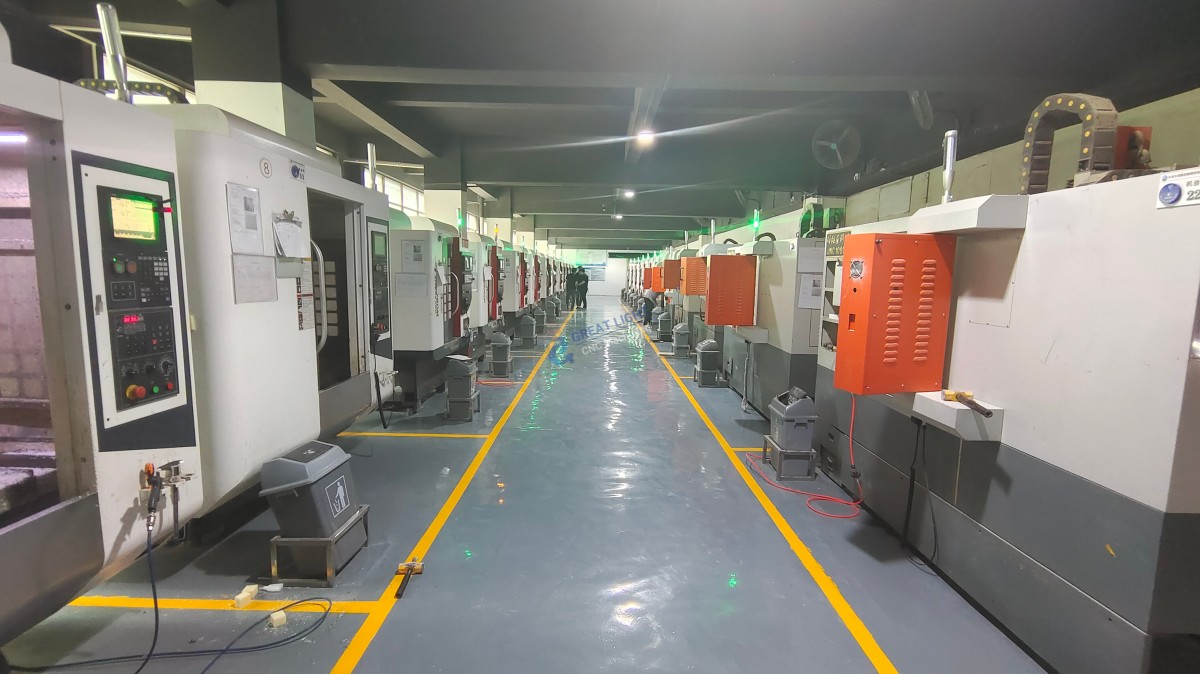
Machine Tending: This is the most common synergy. A robot acts as the perfect assistant to a CNC machine, automatically loading raw billets and unloading finished parts. This enables lights-out manufacturing, where the CNC cell can run unattended for extended periods, dramatically improving equipment utilization. At GreatLight CNC Machining Factory, such automation is strategically deployed for high-volume production runs, ensuring consistency and reducing lead times.
Robotic Machining: Here, a robot is equipped with a spindle (a lighter-duty cutting tool) to perform machining operations like trimming, deburring, drilling, or even milling on very large or complex parts (like aerospace structures or composite molds) where a traditional CNC gantry would be prohibitively large or expensive. The trade-off is typically lower precision than a dedicated CNC machine but greater flexibility in part size and orientation.
Post-Processing Automation: After a part is machined on a 5-axis CNC, a robot can seamlessly transfer it to a washing station, a vision inspection system, or a laser marking station, creating a continuous, automated finishing line.
H2: Choosing the Right Tool for the Job: A Manufacturing Perspective
As a precision parts supplier, the choice is never abstract—it’s driven by the client’s specific requirements.
Choose a CNC Machine (like our advanced 5-axis systems) when:
The part requires micron-level tolerances.
The geometry is complex with deep cavities, undercuts, or organic surfaces.
The material is difficult-to-machine (e.g., Inconel, titanium) requiring high rigidity and power.
The surface finish requirement is critical (e.g., for optical or sealing surfaces).
Choose Robotic Automation when:
The task involves high-volume, repetitive movements (e.g., loading hundreds of parts per day).
The process involves dangerous or ergonomically challenging tasks (handling heavy parts, applying adhesives).
You need flexible cell design that can be reconfigured for different product lines.
The precision requirement is more forgiving (e.g., > ±0.1mm), but reach and flexibility are key.
H2: The GreatLight Metal Advantage: Integrated Intelligence
The question “Is a robot a CNC machine?” fades in relevance when you partner with a manufacturer that masters both domains within an integrated framework. GreatLight CNC Machining Factory doesn’t just see robots and CNC as separate tools; we view them as complementary nodes in an intelligent manufacturing ecosystem.
Our capability extends beyond owning 127 pieces of precision equipment, including high-end 5-axis CNC centers. We engineer solutions. For a client in the automotive sector, this might mean:
Our 5-axis CNC machines precision-mill a complex aluminum actuator housing to ±0.01mm.
A collaborative robot (cobot) then deburrs the sharp edges and cleans the part.
Another robotic arm, guided by a vision system, places the housing into a custom fixture for automated laser engraving of serial numbers.
Finally, the robot packs the finished part for shipment.
This full-process chain—from precision CNC machining to automated post-processing—is controlled under our ISO 9001:2015 (and IATF 16949 for automotive) certified quality management system. It ensures that whether the task is executed by a ultra-rigid machining center or a flexible six-axis robot, the outcome meets the same uncompromising standard of quality, traceability, and reliability.
Conclusion
So, is a robot a CNC machine? Clearly, they are different species in the industrial automation kingdom: one a master craftsman of unmatchable precision, the other a versatile workhorse of unparalleled flexibility. The true power for clients in precision parts machining and customization is unlocked when they are intelligently combined. Forward-thinking manufacturers like GreatLight CNC Machining Factory invest in both technologies to offer not just machining services, but comprehensive manufacturing solutions. This integrated approach solves the core pain points of precision gaps, process bottlenecks, and supply chain uncertainty, transforming your precision design into a reliably delivered, high-quality physical part.
H2: Frequently Asked Questions (FAQ)
Q1: Can a robot achieve the same machining precision as a 5-axis CNC machine?
A: Generally, no. A dedicated 5-axis CNC machine is structurally engineered for extreme rigidity to withstand cutting forces without deflection, enabling micron-level (±0.001mm) accuracy. A robotic arm, while precise, has more inherent flexibility in its joints, making it susceptible to vibration and load-induced error under heavy machining forces. Robotic machining is typically used for applications where precision requirements are less stringent (±0.1mm or more) or for very large parts where a CNC machine is not feasible.
Q2: Why would a machine shop like GreatLight use robots if CNC machines are more precise?
A: We use robots to augment and enhance our CNC capabilities, not replace them. Robots excel at the tasks surrounding precision machining: automated loading/unloading (machine tending), part transfer between processes, deburring, cleaning, and inspection. This automation increases the overall throughput of our CNC equipment, reduces manual labor costs and errors, and enables 24/7 production cycles, ultimately providing clients with faster delivery and consistent quality.
Q3: For my custom prototype, which technology is better?
A: For a one-off or low-volume prototype requiring high accuracy and complex features, CNC machining is almost always the preferred choice. It offers faster setup for unique parts, superior material properties (from solid billet), and the highest precision directly from the CAD file. Robotic processes often require more extensive tooling and programming for one-off tasks, making them less economical for pure prototyping.
Q4: How does the integration of robots affect the cost of my parts?
A: For high-volume production runs, robotic automation lowers the cost per part by reducing direct labor, increasing machine uptime, and improving consistency. For low-volume or highly complex one-offs, the initial programming and cell setup for a robot may not be justified. A partner like GreatLight CNC Machining Factory will perform a manufacturability analysis to recommend the most cost-effective and technically sound process mix for your specific project volume and requirements.
Q5: Is “robotic machining” a service I should ask for?
A: It depends on your part. You should articulate your requirements (size, material, tolerance, volume, budget) rather than specifying the technology. A competent engineering partner will then propose the optimal technical solution. For example, if you have a large composite panel needing trimming and drilling, asking about “large-format machining solutions” will lead to a discussion where robotic machining might be presented as the ideal option alongside traditional CNC alternatives.
To explore how an integrated approach to precision manufacturing can benefit your next project, connect with industry professionals on platforms like LinkedIn{:target=”_blank”}.



















