
When evaluating the landscape of CNC machining equipment, a common question that arises among professionals is: Is carbide a good CNC machine? To address this directly, we must first clarify a critical point of terminology. “Carbide” typically does not refer to a brand or model of CNC machine itself. Instead, it denotes the material used to manufacture the cutting tools—the end mills, drills, and inserts—that are mounted onto the CNC machine’s spindle. The question, therefore, is more accurately framed as: Are carbide cutting tools a good choice for CNC machining?
The unequivocal answer is yes, carbide tools are often the superior and default choice for a vast majority of modern, high-performance CNC machining applications, particularly in the realm of precision parts manufacturing and customization. Their dominance is not accidental but is rooted in a set of material properties that align perfectly with the demands of efficiency, precision, and cost-effectiveness in today’s competitive manufacturing environment.
H2: Decoding “Carbide”: The Engine of Modern CNC Machining
Carbide, in this context, refers to tungsten carbide, a composite material where fine particles of tungsten carbide are cemented together using a binder metal, typically cobalt. This sintered material creates a tool that is extraordinarily hard, wear-resistant, and capable of maintaining its cutting edge at high temperatures. Understanding why it’s so effective requires a comparison with its predecessor and still-available alternative: High-Speed Steel (HSS).
H3: Carbide vs. High-Speed Steel (HSS): A Material Showdown
| Feature | Carbide Cutting Tools | High-Speed Steel (HSS) Tools |
|---|---|---|
| Hardness & Wear Resistance | Extremely High. Can machine hardened steels, titanium, and high-temperature alloys. | Moderate. Wears quickly on abrasive or hard materials. |
| Heat Resistance | Excellent. Maintains hardness at temperatures up to 800-1000°C. | Poor. Loses hardness rapidly above 600°C. |
| Cutting Speed (SFM) | Very High. Enables faster machining cycles, boosting productivity. | Low to Moderate. Limits material removal rates. |
| Rigidity & Stiffness | High. Minimizes deflection for better precision and surface finish. | Lower. More prone to chatter and deflection under load. |
| Toughness/Impact Resistance | Brittle. Can chip or fracture with improper use or interrupted cuts. | High. More forgiving and resistant to chipping. |
| Cost | Higher initial cost per tool. | Lower initial cost per tool. |
| Typical Best Use Case | High-volume production, hard materials, high-precision finishing. | Low-volume jobs, softer materials (e.g., aluminum), interrupted cuts, milling keyways. |
For a precision parts supplier like GreatLight CNC Machining Factory, the choice is clear. Our commitment to delivering parts with tolerances as tight as ±0.001mm and handling advanced materials like aerospace alloys, medical-grade stainless steels, and engineered plastics necessitates the use of premium carbide tooling. It is the backbone that allows our advanced 5-axis CNC machining centers to perform at their peak capability.
H2: The Multifaceted Advantages of Carbide Tooling in Precision Manufacturing
The superiority of carbide translates into tangible benefits throughout the manufacturing process, directly impacting the quality, cost, and delivery of your custom parts.
1. Unmatched Material Removal Rates (MRR):
Carbide tools can withstand significantly higher cutting speeds and feed rates than HSS. This translates directly to shorter cycle times. For clients, this means faster project turnaround and lower machining costs per part, especially in production runs.
2. Exceptional Surface Finish and Dimensional Accuracy:
The rigidity and wear resistance of carbide minimize tool deflection and edge degradation. As a tool wears evenly and slowly, it continues to produce consistent dimensions and superior surface finishes throughout its life. This is paramount for components requiring sealing surfaces, bearing fits, or aesthetic post-processing.
3. Capability to Machine “Difficult” Materials:
The modern manufacturing landscape is filled with super-alloys, hardened steels, and composites. HSS tools are simply not viable for these materials. Carbide, and its advanced variants like micro-grain or nano-grain carbide, provide the necessary hardness and thermal stability to machine these challenging materials effectively.
4. Predictable Tool Life and Reduced Machine Downtime:
While individual carbide inserts or tools have a higher upfront cost, their extended life means fewer tool changes. This increases machine uptime, reduces labor for changeovers, and provides more predictable machining costs and scheduling.
5. Enabler of Advanced Tool Geometries:
Modern grinding technology allows for the creation of highly complex carbide tool geometries—variable helix angles, specialized chip breakers, and polished flutes. These designs, possible only with a material as hard as carbide, optimize chip evacuation, reduce cutting forces, and further improve finish and tool life.
H3: The GreatLight Metal Approach: Beyond Just “Using Carbide”
At GreatLight Metal, our expertise lies not just in using carbide tools, but in mastering their application. This distinction is what separates a good machine shop from a world-class manufacturing partner.
Strategic Tooling Inventory: We maintain a vast, curated inventory of premium-brand carbide tools (from manufacturers like Sandvik Coromant, Kennametal, and OSG) in a wide array of geometries and coatings (TiAlN, AlCrN, DLC). This ensures we can select the perfect tool for your specific material and feature geometry.
Optimized Cutting Parameters: Our seasoned manufacturing engineers leverage CAM software and empirical data to program optimal spindle speeds, feed rates, and depth of cuts. This maximizes the potential of the carbide tool while protecting the part and the machine.
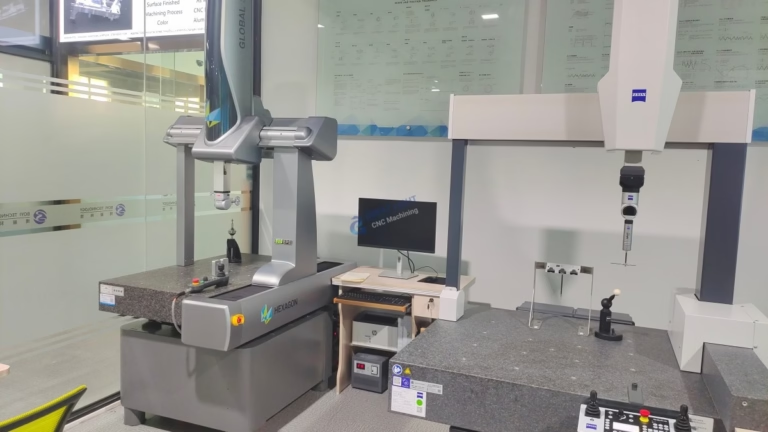
Integrated Quality Assurance: The predictable performance of carbide tooling is a key input into our ISO 9001:2015 certified quality system. It allows for consistent process control, which is verified by our in-house CMMs, optical comparators, and surface testers.
H2: When Might Carbide Not Be the Optimal Choice?
A professional engineer must acknowledge that no solution is universal. There are niche scenarios where alternatives might be preferred:
Very Interrupted Cuts or Unstable Setups: The brittleness of carbide can be a liability. In these cases, a tougher HSS or a specially designed “high-toughness” grade carbide might be chosen.
Low-Volume, Soft Material Prototyping: For quickly machining a single prototype from soft aluminum or plastic, the lower cost and high toughness of HSS can be more economical.
Specialized Applications: For finishing operations requiring a mirror-like polish on non-ferrous materials, diamond-coated tools or single-crystal diamond tools surpass carbide.
In our one-stop manufacturing solutions at GreatLight, we have the technical depth to make these nuanced judgments, ensuring the right tool is always used for the job.
Conclusion
So, is carbide a good CNC machine? The question, correctly reframed, reveals a fundamental truth in precision manufacturing: Carbide cutting tools are not merely “good”—they are an indispensable, enabling technology for modern, high-performance CNC machining. Their ability to deliver speed, precision, and reliability across a breathtaking range of materials makes them the cornerstone of efficient production. For clients seeking custom precision parts, partnering with a manufacturer like GreatLight CNC Machining Factory—which combines state-of-the-art 5-axis CNC equipment with deep expertise in advanced carbide tooling application—ensures that this powerful technology is harnessed to its fullest potential to bring your most demanding designs to life with uncompromising quality.
FAQ: Carbide Tooling in CNC Machining
Q1: Are carbide tools always better than HSS tools?
A: For the majority of modern CNC machining applications involving metals, especially in production or with hard materials, yes, carbide is superior due to its speed, wear resistance, and precision. HSS retains value for specific, low-volume, or high-impact applications where its toughness is advantageous.
Q2: Why are carbide tools more expensive?
A: The raw materials (tungsten, cobalt) are costly, and the manufacturing process (powder metallurgy, sintering, precision grinding) is complex and energy-intensive. However, the total cost per part is often lower due to vastly increased productivity and longer tool life.
Q3: What are “coatings” on carbide tools, and why are they used?
A: Coatings like Titanium Aluminum Nitride (TiAlN) or Diamond-Like Carbon (DLC) are applied via PVD/CVD processes. They dramatically increase surface hardness, reduce friction, and improve thermal barrier properties, further extending tool life and allowing for even more aggressive cutting parameters.
Q4: Can carbide tools be re-sharpened?
A: Standard indexable carbide inserts are disposable and are not resharpened. However, solid carbide end mills can often be professionally re-sharpened 2-3 times, recovering their cutting geometry at a fraction of the cost of a new tool, provided the core structure isn’t damaged.
Q5: How does a manufacturer like GreatLight Metal select the right carbide tool for my part?
A: Selection is a multi-factor analysis conducted by our engineers. We consider your part material, desired tolerances and finish, the feature geometry (deep pockets, thin walls, etc.), the type of CNC operation (roughing, finishing), and the production volume. This ensures optimal performance and cost-efficiency for your project. For a deeper look at our technical partnerships and industry insights, you can connect with us on our professional network page on LinkedIn.



















