
How to Make Money Off a CNC Machine
This guide is for shop owners and engineers who already own a mill or lathe and want the work to pay for itself. We cover how to make money off a cnc machine by choosing a niche, pricing a job by cycle time, and cutting the hidden costs that eat margin. Read it and you can decide which jobs to take and which to walk away from.
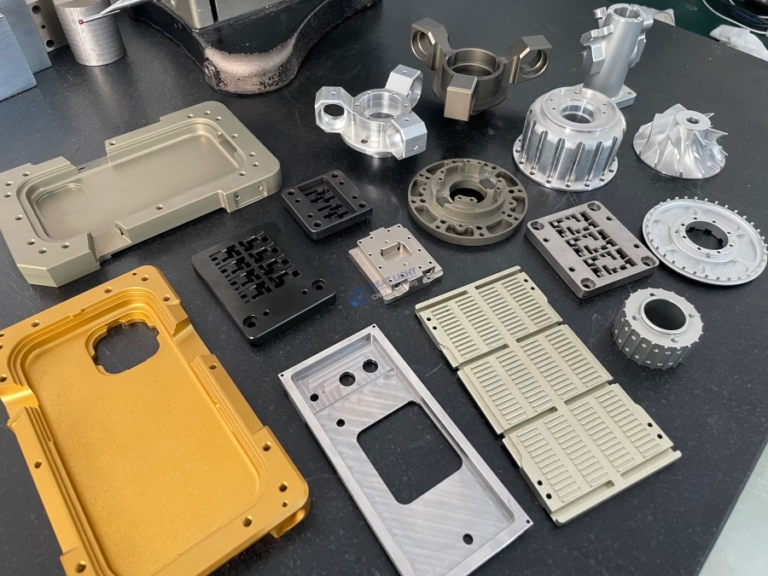
In this article
- 1
- 2
- 3
- 4
- 5
- 6
- 7
- 8
Key takeaways
Start with the parts you already machine well
Most shops try to quote everything that lands in the inbox. That is the fastest way to lose money off a cnc machine. Every new part family carries its own fixture design, tool list, and inspection routine. If you quote 20 unrelated jobs a month, you pay that learning cost 20 times and never get good at any of them.
Look at your last 50 jobs. Sort them by material, tolerance band, and part size. You will usually find that three or four part types made most of the revenue. Those are your candidates: aluminum housings at ±0.05 mm, 316L fittings at Ra 0.8–1.6 μm, or 7075 brackets with tight hole patterns.
When you find that cluster, stop bidding on everything else. A shop that runs only 6061 and 7075 plate can keep one tool library, one coolant, and one set of feeds and speeds. Setup drops because operators already know the material. Scrap drops because they have seen the failure mode before.
This does not mean you refuse new work forever. It means new work has to fit the cluster, or it has to pay a premium for the disruption. That single rule changes your win rate and your margin at the same time.
- 1Sort by material firstMaterial changes drive tool wear, coolant, and chip control more than geometry does.
- 2Track your top fourIf four part types make most of your revenue, build the shop around them.
Price from cycle time, not from a shop rate
A shop rate is a shortcut that hides everything. If you charge $75 an hour and the job runs for two hours, you assume you made $150. But the machine sat idle during programming, deburring, and the phone call about a drawing revision. Those hours do not bill.
Build the quote from the part instead. Estimate cycle time per part, then add setup divided by order quantity. A job with a 12-minute cycle and a 3-hour setup at 50 pieces costs 15.6 minutes of machine time per part. At 500 pieces the same setup costs 12.4 minutes. That is the number that decides whether the job is worth taking.
Then add material, tooling, and finishing as separate lines. Anodizing, black oxide, and electroless nickel are often quoted by outside vendors, so mark them up or pass them through with a handling fee. Never bury them in the hourly rate.
Recheck the rate every six months. Tool prices move. Power costs move. If your rate has not changed in two years, your margin has.
- 1Setup ÷ quantitySetup divided by order quantity is the most overlooked cost in small-batch work.
- 2Keep finishing separatePlating and anodizing should be visible line items, not hidden inside your rate.
Cut setup time before you chase new customers
Cutting setup from four hours to one hour is often worth more than winning a new account. Setup is the one cost you control without asking anyone. The tools are already in the building.
Start with soft jaws and fixture plates that stay on the machine. A dedicated plate per part family costs a few hundred dollars and saves an hour every time the job returns. Store the offsets and tool numbers in the program header so the operator loads and runs.
Standardize your tool holders. If every job uses the same 12 holders, the preset station becomes a five-minute task instead of a forty-minute one. Pre-set tools offline while the machine is still cutting the previous order.
Probe the stock and the fixture, not just the part. On a 4-axis or 5-axis machine, a wrong work offset shows up as scrap three hours later. Touching off on the fixture face takes 30 seconds and catches the mistake early.
One more habit: photograph every setup. When the job comes back in four months, the photo tells the operator where the clamps went and which way the part faced. That single image often saves an hour of head-scratching.
- 1Dedicated fixture platesA few hundred dollars per family removes an hour of setup each rerun.
- 2Photo the setupA phone photo of the clamped part beats a written setup sheet most of the time.
Move into work that tolerances actually pay for
General job-shop work competes on price alone. Work with real tolerance requirements competes on capability. That is where margin lives.
Aerospace structural parts and engine brackets often call for ±0.005 mm on hole position and materials like Ti-6Al-4V or Inconel. Those jobs need 5-axis capability and a documented inspection routine. Buyers in that sector compare suppliers on process control, not on the lowest quote.
Medical device work follows the same pattern. Surgical instruments, implant tooling, and diagnostic parts need ISO 13485 process discipline, traceable material, and clean handling. The parts are small, the volumes are low, and the paperwork is heavy. If you can handle the paperwork, the rate per hour is higher than general machining.
Robotics and automation sits in between. Joints, sensor housings, and actuator brackets are usually aluminum or stainless, often with complex geometry and short design cycles. Customers in this space value a supplier who can turn a revision in days, not weeks.
The point is not to chase a label. The point is to find work where your tolerance, finish, and documentation are worth more than your hourly rate.
- 1Tight tolerance pays±0.005 mm work is judged on capability, not on the lowest hourly rate.
- 2Paperwork is a moatTraceability and inspection reports keep casual competitors out.
Turn one-off jobs into repeat releases
The cheapest dollar you will ever earn is a repeat order. The program is proven, the fixture exists, and the first-article inspection is already on file. Your cycle time is real, not estimated.
Ask every one-off customer what happens after the prototype. If the answer is a production run, quote both stages in the same document. Show the prototype price and the production price side by side. Buyers who see the drop in unit cost at 100 pieces often place the larger order immediately.
Offer to hold the fixture and the program for a defined period. That removes the buyer's fear of re-tooling cost and gives you a reason to be called back. Do not give the fixture away; price it into the prototype.
Track order frequency in a simple spreadsheet. If a customer has not ordered in nine months, call them. Design cycles change and old parts get revised. A five-minute call is cheaper than any advertising.
- 1Quote prototype and production togetherShowing the unit cost at 100 pieces often closes the larger order.
- 2Hold the fixtureKeeping tooling ready removes the buyer's re-tooling risk.
Step by step: from first quote to steady margin
- 1Audit the last 50 jobsList material, tolerance, quantity, and actual machine hours. Circle the three part families that made the most money. Everything else is a candidate to drop.
- 2Rebuild your rate from cycle timeTime one part on the machine with a stopwatch. Add setup divided by quantity, then material, tooling, and finishing as separate lines. Use that number for every new quote.
- 3Make one fixture plate per familyDesign a plate that holds the family with two clamps. Store offsets and tool numbers in the program header. Target a one-hour setup instead of four.
- 4Standardize the tool listLimit jobs to a common set of holders and inserts. Pre-set tools offline while the machine is still cutting. This alone often saves 30 minutes per job.
- 5Probe the fixture, not just the partTouch off on the fixture face before the first cut. On 4-axis and 5-axis work a wrong offset is not obvious until the part is already ruined.
- 6Quote prototype and production in one documentShow unit price at 1, 100, and 1,000 pieces. Buyers decide faster when they can see the setup cost spread across a run.
- 7Review your rate every six monthsUpdate tool, power, and outside-service costs. If the rate has not moved in two years, your real margin has already dropped.
Which work actually pays for the machine
Compare job types by how they reward capability rather than the lowest hourly rate.
| Job type | Tolerance band | What the buyer pays for | Main risk |
|---|---|---|---|
| General job shop | ±0.05 mm typical | Lowest hourly rate | Price competition |
| Aluminum brackets | ±0.02 mm | Fast turnaround | Short design cycles |
| Aerospace structural | ±0.005 mm | Process control and reports | Material and inspection cost |
| Medical devices | ±0.01 mm, Ra 0.8 μm | ISO 13485 traceability | Documentation load |
| Robotics joints | ±0.02 mm | Fast revisions | Complex geometry |
| Prototype runs | ±0.05 mm | Speed and DFM feedback | Low order value |
The short version
If you want to make money off a cnc machine, stop bidding on everything. Pick the part families you already run well, price them from real cycle time, and cut setup before you chase new accounts. Capability pays better than the lowest hourly rate.
Questions shop owners ask
Do I need a 5-axis machine to make money off a cnc machine?
No. Most paying work fits inside a 3-axis or 4-axis envelope. A 3-axis mill with a good fixture plate handles brackets, housings, and plates all day.
A 5-axis center pays off when the part has features on multiple faces, when a second op would add a fixture and a second setup, or when the tolerance is tight enough that re-clamping causes error. Buy the capability when the work demands it, not before.
What is the most profitable niche for a small shop?
The one you already have experience in. A shop with three years of 316L medical fittings will out-earn a shop that jumps into aerospace with no titanium experience.
Look for work where tolerance and documentation matter more than hourly rate. That usually means aerospace, medical, or robotics parts rather than general fabrication.
How much can I expect to earn with one CNC machine?
It depends on utilization, not on the machine. A mill that runs 60 percent of the week on repeat work bills far more than one that runs 80 percent on one-off jobs with four-hour setups.
Track machine hours against billable hours for one month. That ratio tells you more about your income than any equipment spec.
How important are certifications for CNC profitability?
Certifications open doors, they do not set your price. ISO 9001:2015 is often the minimum to bid on industrial work. IATF 16949:2016 and ISO 13485:2016 are required for automotive and medical buyers.
Get certified when a specific customer needs it and will pay for the process discipline. Certification without that demand adds cost without adding revenue.
Should I focus on prototyping or mass production?
Run both, but quote them together. Prototyping brings in new customers and low volume. Production brings stable hours and lower setup per part.
The mistake is treating them as separate businesses. The prototype is your audition for the production run. Price it as an investment in the follow-on order.
How do I stop losing money on small orders?
Set a minimum order value that covers setup, programming, and inspection, not just machine time. A five-part order with a four-hour setup is rarely profitable at any hourly rate.
If the customer cannot meet the minimum, quote the setup as a separate one-time charge. Some will pay it. The ones who will not were never going to be profitable.
Send us your drawings and get a quote in 12 hours
Upload a STEP file and we will return a quotation and a free DFM analysis within 12 hours. No minimum order quantity, from one prototype to 10,000+ part runs.
12-hour quoteFree DFM analysisNo minimum orderNDA on request
More from the shop floor
We publish setup notes, tooling trials and inspection data from the factory floor.











