
Hermle CNC Machine: How the 5-Axis Platform Works
A Hermle CNC machine is a gantry-style, high-accuracy 5-axis machining center family. This page explains the mechanical layout, the torque motor rotary axes, thermal behavior, and the tolerance range you can realistically hold. It is written for engineers and buyers who need to judge whether this class of machine fits a given part, and when a different platform is the better call.
In this article
- 1
- 2
- 3
- 4
- 5
- 6
What Makes a Hermle CNC Machine Different
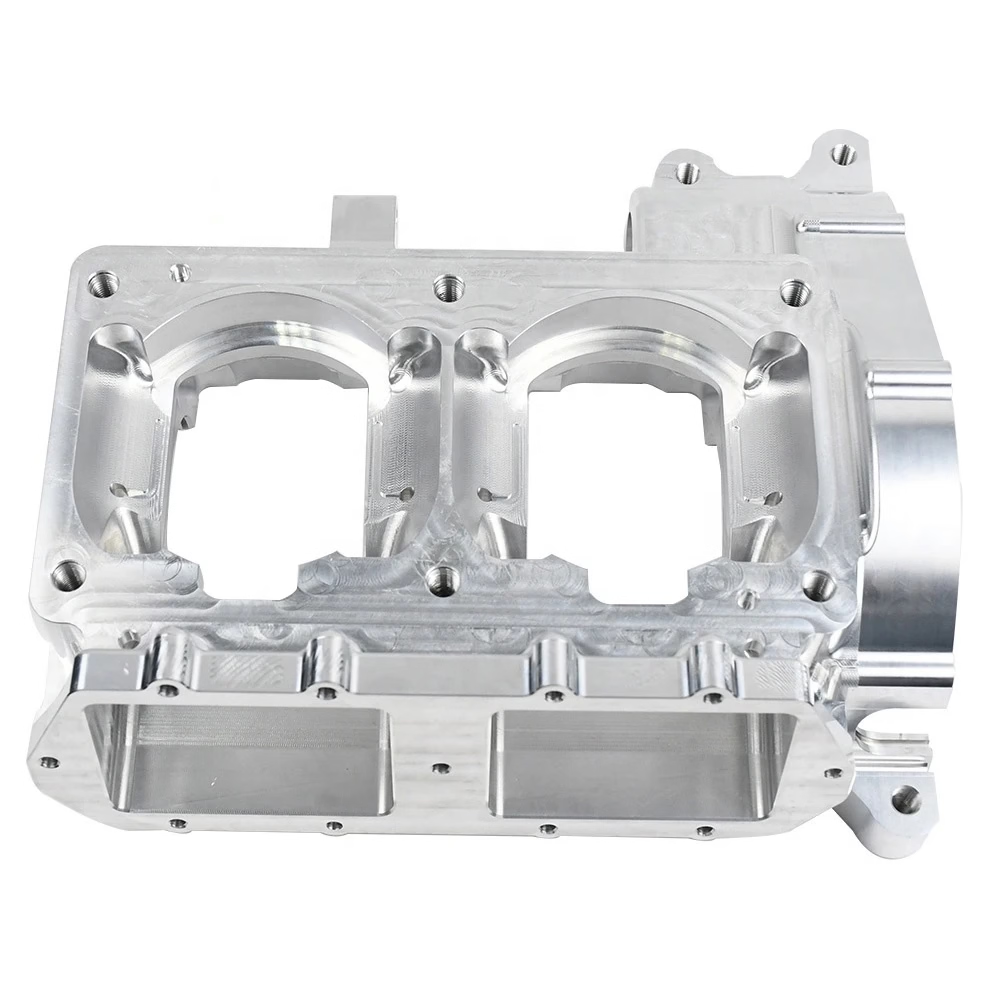
Most vertical machining centers are C-frame machines: the spindle hangs off a column and the table moves underneath. A Hermle CNC machine uses a gantry or modified gantry layout instead. The workpiece sits on a rigid bed, and the spindle travels in X, Y, and Z above it. That reversed arrangement changes everything downstream — stiffness, thermal drift, chip evacuation, and how the rotary axes can be built.
The moving mass is the spindle head, not the part. On a heavy part like an engine block or a mold insert, that matters. The machine never has to accelerate 800 kg of steel to change direction. Acceleration limits stay predictable regardless of workpiece weight, so surface finish stays consistent from the first cut to the last.
The rotary axes are the second structural decision. On a Hermle CNC machine, the trunnion and table are driven by torque motors rather than worm gears or belt drives. No worm gear means no backlash, no wear compensation table, and no periodic re-tightening. The trade-off is heat: torque motors generate heat right where you least want it, so the rotary axes are liquid-cooled and the cooling circuit is monitored by the control.
- 1Gantry over C-frameSpindle moves, workpiece stays still. Better for heavy parts.
- 2Torque motor rotary axesNo backlash, no worm wear, but heat must be removed.
- 3Liquid-cooled drivesCoolant temperature is part of the accuracy budget.
Five-Axis Kinematics and the Single-Setup Advantage
A 5-axis machining center can orient the tool relative to the part in two extra rotational directions. On a trunnion machine, that is the C axis (table rotation, around Z) and the A axis (trunnion tilt, around X). The workpiece stays clamped once, and the machine brings the tool to every face. No re-fixturing means no re-datuming error, and no operator judgement calls between setups.
The practical gain shows up on parts with compound angles. A hydraulic manifold with ports on five faces, a robot arm joint with a spherical seat, or a turbine housing with angled bosses. On a 3-axis machine these need multiple vises, angle plates, and a re-probe per setup. Each setup adds a chance for error. On a simultaneous 5-axis machine the whole part comes off one fixture.
There is a cost. Simultaneous 5-axis motion requires the post-processor to output coordinated rotary and linear moves. The CAM programmer has to understand tool axis control, and collision checking is not optional. A part that looks like a 5-axis job on paper can sometimes be done faster on a 4-axis machine with a well-designed fixture.
- 1C axis + A axisTable rotation and trunnion tilt give the two extra degrees.
- 2One datum, one setupCompound-angle features come off in a single clamping.
- 3CAM overheadPost-processor and collision check add programming time.
Tolerance, Finish, and What the Machine Can Actually Hold
Published machine specs quote positioning accuracy in isolation. Real parts accumulate error from the fixture, the tool, the thermal state, and the material. On a well-maintained Hermle CNC machine, a stable process typically holds ±0.005 mm on critical features in aluminum and mild steel. That is a shop-floor number, not a brochure number, and it assumes the part is not a thin-wall flexure.
Surface finish follows the same logic. A fine-finish pass with a sharp tool and a rigid setup reaches Ra 0.2–0.8 μm on aluminum and stainless. A general machining pass lands at Ra 0.8–1.6 μm, and an as-machined roughing cut sits at Ra 1.6–3.2 μm. Tool runout, not machine geometry, is usually the limiting factor below Ra 0.4 μm.
Where the machine hits a wall is part stiffness, not machine stiffness. A 1.5 mm wall in a 200 mm long aluminum housing will deflect under cutting force no matter how good the spindle is. In that case the answer is a different strategy — lighter passes, a support fixture, or a different process entirely. No machine removes the physics of a flexible workpiece.
- 1±0.005 mmAchievable on stable features in aluminum and mild steel.
- 2Ra 0.2–0.8 μmFine-finish pass with a sharp tool and rigid setup.
- 3Thin wallsPart deflection, not machine error, sets the limit.
Thermal Behavior: The Hidden Accuracy Variable
A machine tool grows as it warms up. The spindle, the ballscrews, the rotary torque motors, and the linear guides all put heat into the structure. On a gantry machine the spindle is the dominant source because it sits on the moving head. If that heat is not managed, the head grows downward and the Z position drifts by tens of microns over a shift.
Hermle machines address this in two ways. First, the spindle and the rotary axes are liquid-cooled with a controlled-temperature circuit, typically held within a narrow band around ambient. Second, the control runs a thermal compensation model that adjusts axis positions based on sensor readings. The combination keeps drift in the single-digit micron range over a long run.
For a shop, the practical rule is simple: let the machine warm up before the first tight-tolerance cut. A 30 to 45 minute warm-up cycle is standard. Starting a ±0.005 mm job on a cold machine is the most common cause of a first-article failure that makes no sense the next morning.
- 1Spindle is the main heat sourceIt sits on the moving head, so growth shifts Z.
- 2Liquid cooling + compensationChilled circuits plus a control thermal model.
- 3Warm up first30–45 minutes before the first tight-tolerance cut.
Which Materials and Parts Fit This Platform
The platform handles aluminum, stainless, steel, titanium, and engineering plastics. Aluminum grades like 6061, 7075, and 6082 cut fast and take a fine finish easily. Stainless 17-4PH and 316L need sharper tools and lower feed rates but hold tolerance well. Titanium Ti-6Al-4V and Inconel are the hard cases — they demand low cutting speeds, high coolant pressure, and patience.
Part size matters more than material. A machine with a 4,000 × 400 × 150 mm travel envelope handles long, slender parts such as extrusion dies, guide rails, and structural beams. A compact 500 × 500 × 450 mm envelope suits mold inserts, medical housings, and small aerospace brackets. The Ø400 mm rotary table sets the practical limit for parts that need full 5-axis access.
Parts that do not fit the platform are the ones with no compound geometry and a simple prismatic shape. A flat plate with drilled holes does not need 5-axis kinematics. Running it on a 3-axis machine is faster and cheaper. The Hermle class is for parts where the geometry itself justifies the machine.
- 1Good fitCompound angles, deep cavities, multi-face features.
- 2Poor fitFlat plates, simple prismatic parts, high-volume simple turning.
- 3Hard materialsTitanium and Inconel need low speeds and high coolant pressure.
When a Hermle CNC Machine Is the Right Choice
Match the part to the platform before you commit.
| Part characteristic | Hermle 5-axis | 3-axis or 4-axis |
|---|---|---|
| Compound angles on 4+ faces | Single setup, no re-datuming | Multiple fixtures, added error |
| Deep cavities with undercuts | Tool axis follows the wall | Long reach tools, chatter risk |
| Flat plate with drilled holes | Overkill for the geometry | Faster and cheaper |
| Heavy workpiece over 200 kg | Spindle moves, part stays still | Table must accelerate the mass |
| Tolerance below ±0.01 mm | Thermal control holds the band | Possible with care, harder to repeat |
| High-volume simple turning | Wrong platform | Mill-turn or lathe is better |
The Verdict
Choose a Hermle CNC machine when the part has compound-angle geometry, needs one datum, and tolerances sit at or below ±0.01 mm. Choose a 3-axis or 4-axis platform when the part is prismatic and the geometry does not justify the kinematics. The machine does not make a simple part cheaper.
Common Questions
What materials can a Hermle CNC machine cut?
Aluminum 6061, 7075, and 6082; stainless 303, 304, 316L, and 17-4PH; steels including 4140 and 4340; titanium Ti-6Al-4V; Inconel; and engineering plastics such as POM, PEEK, and ABS.
Titanium and Inconel require lower cutting speeds, higher coolant pressure, and a rigid setup. They are machinable but the cycle time is much longer than aluminum.
How tight a tolerance can it hold in production?
On stable features in aluminum and mild steel, ±0.005 mm is achievable. That number depends on the fixture, the tool, and the thermal state of the machine.
On thin-wall parts, deflection of the workpiece sets the limit. A 1.5 mm wall will move under cutting force regardless of machine accuracy.
Why does a gantry design matter for heavy parts?
On a C-frame machine the table carries the workpiece, so a heavy part has to be accelerated and decelerated for every move. On a gantry machine only the spindle head moves.
That keeps acceleration limits consistent no matter how heavy the part is, which helps surface finish and tool life on large workpieces.
What is the largest part the platform can handle?
Travel envelopes range from compact 500 × 500 × 450 mm up to 4,000 × 400 × 150 mm for long, slender parts.
The Ø400 mm rotary table sets the practical limit for parts needing full 5-axis access. Parts beyond that need a different machine class.
Do I need simultaneous 5-axis or is 3+2 enough?
3+2 (positional 5-axis) locks the rotary axes and machines each face in turn. It covers most parts with angled features and is easier to program.
Simultaneous 5-axis is needed when the tool must stay normal to a curved surface, such as on a turbine blade or a complex mold cavity.
How does thermal drift affect a long run?
Spindle and rotary axis heat cause the structure to grow during a shift. Without control, Z position can drift by tens of microns.
Liquid cooling plus a control thermal model keeps drift in the single-digit micron range. A 30–45 minute warm-up before the first tight cut is still standard practice.
Send the Drawing, Get a Process Plan
Upload your part and we will review the geometry against our 5-axis capacity. You get a quotation and a DFM analysis within 12 hours.
12-hour quoteFree DFM analysis100% inspection
GreatLight on Social
We publish setup notes, tooling trials and inspection data from the factory floor.











