
The Ultimate Interpretation of CNC Machining Manufacturing: Precision Engineering by GreatLight Metal
In the global industrial landscape, CNC Machining Manufacturing stands as the cornerstone of innovation. From medical implants to aerospace turbines, the ability to carve high-performance components with micron-level accuracy is what defines modern engineering excellence.
Comprehensive CNC Machining Manufacturing Capabilities
At GreatLight Metal, our CNC Machining Manufacturing facility is equipped to handle the most demanding geometries. We leverage automation and high-speed spindles to deliver parts that meet the rigorous standards of North American and European markets.
High-Precision 5-Axis CNC Machining
The 5-axis approach is the pinnacle of CNC Machining Manufacturing. By moving cutting tools across five different axes simultaneously, we eliminate multiple setups. This "One-Stop" machining reduces cumulative errors and enables the production of complex aerodynamic and organic shapes that 3-axis machines simply cannot achieve.
Precision Milling and Multi-Tasking Turning
Our turning centers with live-tooling allow us to perform milling and turning on the same machine. This integration is vital for high-precision CNC Machining Manufacturing, ensuring that concentricity and positional tolerances remain perfect throughout the manufacturing cycle.
Chapter 1:The Definitive Interpretation of Modern CNC Machining Manufacturing
The evolution of CNC Machining Manufacturing represents the transition of human craftsmanship into a digitized, deterministic science. In the context of Global Industry 4.0, this process is no longer just about metal removal; it is an integrated discipline involving high-order mathematics, material thermodynamics, and real-time cyber-physical feedback loops.
The Subtractive Logic: Why CNC Machining Manufacturing Remains Irreplaceable
While additive manufacturing (3D printing) has gained significant media attention, CNC Machining Manufacturing remains the backbone of high-stress industrial applications. The reason lies in material density and structural integrity. Parts produced through CNC maintain the original forged or cast properties of the stock material, ensuring zero internal porosity and superior fatigue resistance.
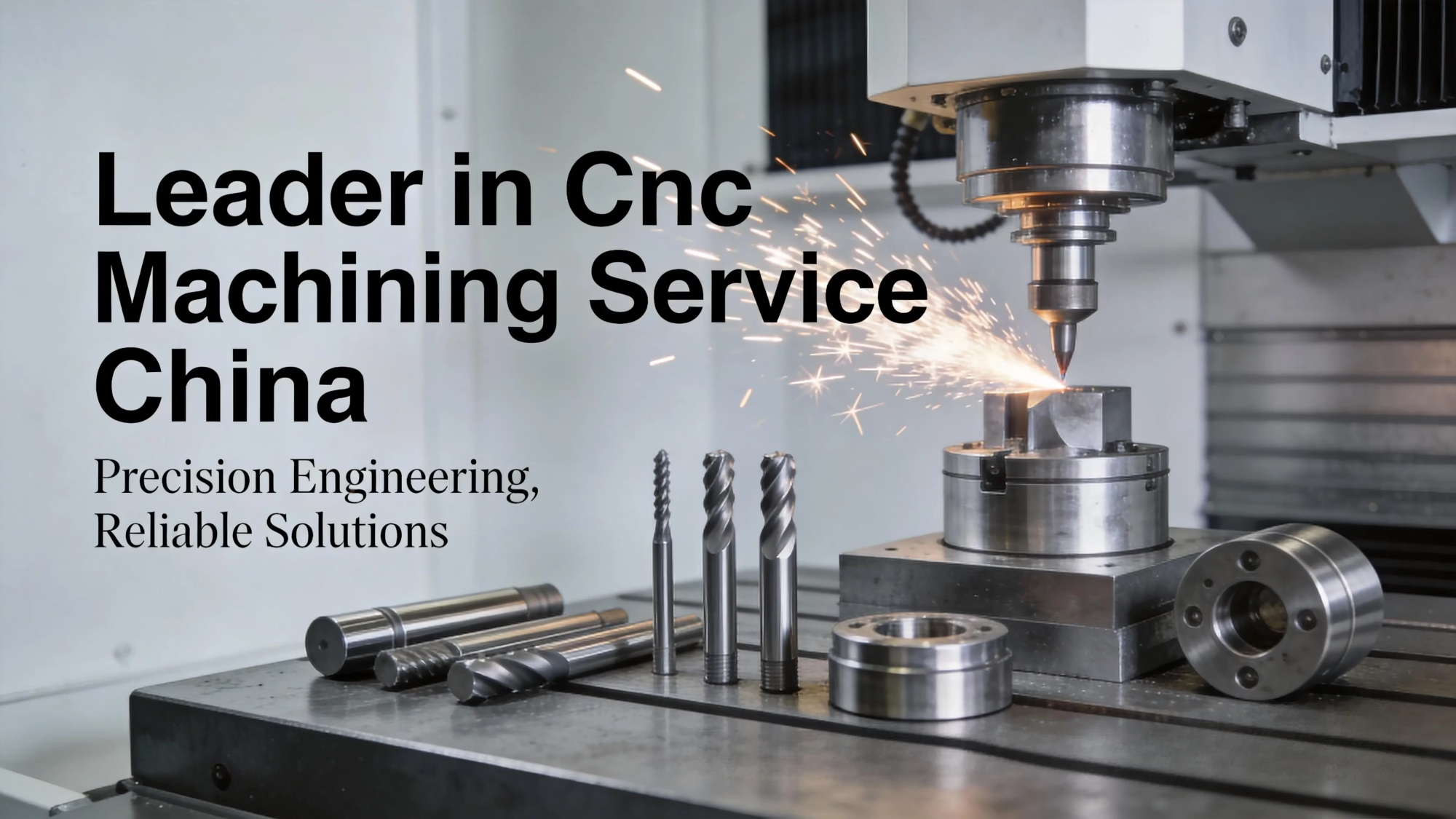
Figure 2: Heat distribution and shear zone analysis during high-velocity CNC Machining Manufacturing.
1.1 The Mechanical Foundations of Precision
In the realm of high-precision CNC Machining Manufacturing, we deal with the "Physics of the Micro-World." Every micron counts. At GreatLight Metal, we interpret the manufacturing process through three critical pillars:
Kinematic Accuracy
This refers to the precision of the machine's movements in the absence of cutting forces. In our CNC Machining Manufacturing facility, we utilize laser interferometers to calibrate the positioning accuracy and repeatability of our axes, ensuring that the machine's "theoretical" position matches its "physical" reality within ±0.001mm.
Dynamic Rigidity
Cutting forces can cause microscopic deflections. Superior CNC Machining Manufacturing requires a machine bed with high damping capacity—often made from mineral casting or heavy-duty Meehanite iron—to absorb vibrations and prevent tool chatter.
Thermal Stability
Spindles rotating at 20,000 RPM generate heat. Without advanced thermal compensation, a machine's spindle can expand by dozens of microns. Our CNC Machining Manufacturing strategy includes oil-cooling systems and real-time sensor feedback to compensate for thermal drift dynamically.
Tribological Interactions
The interaction between the cutting edge and the workpiece involves extreme friction. We optimize tool coatings (like AlTiN or Diamond-like Carbon) and high-pressure coolant delivery to minimize tool wear in our CNC Machining Manufacturing cycles.
1.2 The Digital Twin: Software's Role in CNC Machining Manufacturing
Modern CNC Machining Manufacturing begins in a virtual environment. The "Digital Twin" of the workpiece allows us to simulate the entire cutting process before a single chip is made. This is essential for 5-axis operations where the risk of collision is high.
- Toolpath Optimization: We utilize advanced algorithms to maintain a constant "chip load." By ensuring the tool is never overloaded or underutilized, our CNC Machining Manufacturing process achieves superior surface finishes (Ra < 0.4μm).
- G-Code Refinement: Standard G-code is often "choppy." We use high-look-ahead controllers that process thousands of blocks per second, enabling smooth, fluid motion in 3D contours.
- Adaptive Feed Control: Our machines sense the spindle load. If the material is harder than expected, the CNC Machining Manufacturing system automatically slows down the feed rate to protect part integrity.
1.3 The Global Supply Chain Perspective
Why choose GreatLight Metal for your CNC Machining Manufacturing needs? For engineers in the US and Europe, the decision is often driven by the "Total Cost of Quality." By situating our manufacturing in China’s high-tech industrial hubs, we offer a unique synergy of cost-efficiency and top-tier technological capability.
As a professional CNC Machining Manufacturing partner, we provide more than just parts; we provide "Design for Excellence" (DFX). This means we analyze your CAD files to suggest minor modifications that can reduce machining time by 20% or improve structural strength by 15%. This consultative approach is what makes our CNC Machining Manufacturing services stand out in the B2B marketplace.
1.4 Future Trends: AI-Driven CNC Machining Manufacturing
The next frontier of CNC Machining Manufacturing is Artificial Intelligence. At GreatLight Metal, we are already integrating machine learning models that analyze acoustic emissions from the cutting process. These AI "ears" can detect a dull tool 10 minutes before it fails, preventing scrap and ensuring that every part in a 10,000-piece run is identical to the first.
Advanced Material Library for CNC Machining Manufacturing
Success in CNC Machining Manufacturing begins with material science. We source raw materials from certified suppliers, ensuring full traceability for every batch.
| Material Type | Grades Available | Typical Applications |
|---|---|---|
| Aluminum Alloys | 6061-T6, 7075, 2024 | Aerospace structures, Heat sinks, Drone frames |
| Stainless Steel | 304, 316L, 17-4 PH | Medical tools, Food processing, Marine parts |
| Titanium | Grade 2, Grade 5 (Ti-6Al-4V) | Bone implants, Engine valves, Jet fasteners |
| Engineering Plastics | PEEK, POM (Delrin), PTFE | Semiconductor housings, Insulators, Valves |
Chapter 2:The Thermodynamics and Metallurgy of CNC Machining Manufacturing
In high-end CNC Machining Manufacturing, we view materials not as static solids, but as dynamic thermodynamic systems. When a cutting edge enters a workpiece at high velocity, the localized temperature can exceed 800°C within milliseconds. Understanding the phase transformation and strain-hardening exponents of these materials is what differentiates GreatLight Metal from standard machine shops.
2.1 Processing Exotic Alloys: The Challenge of Superalloys
For aerospace and energy sectors, CNC Machining Manufacturing often involves Nickel-based superalloys (e.g., Inconel 718) and Cobalt-Chrome. These materials are designed to resist deformation at high temperatures, which makes them inherently "difficult-to-cut."
2.2 Precision in Engineering Plastics: PEEK and Torlon
Unlike metals, polymers exhibit viscoelastic behavior. In CNC Machining Manufacturing, machining PEEK (Polyether ether ketone) for medical implants requires a deep understanding of the material's Glass Transition Temperature ($T_g$). If the cutting heat exceeds $T_g$, the part will suffer from dimensional instability once it cools.
- Cryogenic Machining: We utilize specialized cooling to maintain material rigidity during the CNC Machining Manufacturing of soft elastomers.
- Stress Relieving: For large-scale plastic components, we implement intermediate annealing cycles between roughing and finishing to prevent internal stress-induced warping.
Chapter 3:Advanced Kinematics and Geometric Dimensioning & Tolerancing (GD&T)
The transition from 3-axis to 5-axis CNC Machining Manufacturing is a quantum leap in spatial geometry. It is not merely about adding two more directions; it is about the simultaneous management of the Tool Center Point (TCP).
3.1 TCPM (Tool Center Point Management) Logic
In a standard 3-axis CNC Machining Manufacturing setup, the coordinate system is fixed. In 5-axis, as the rotary axes move, the tip of the tool moves in an arc. Without TCPM, the G-code would be nearly impossible to calculate. GreatLight Metal utilizes high-end Heidenhain and Fanuc controllers that compute kinematic transforms 5,000 times per second to ensure the tool tip remains perfectly engaged with the CAD-defined surface.
3.2 Mastering GD&T: The Language of Precision
A drawing for a CNC Machining Manufacturing project often carries complex GD&T symbols. Our metrology lab interprets these using the ASME Y14.5-2018 standard. We focus on:
- Cylindricity and Runout: Crucial for high-speed rotating shafts where vibration can lead to catastrophic failure.
- Profile of a Surface: Used in 5-axis CNC Machining Manufacturing to define the allowable deviation of a complex organic shape (like an airfold) relative to its theoretical CAD datum.
- True Position: Ensuring that hole patterns for mission-critical assemblies align perfectly across global supply chains.
3.3 Vibration Damping and Tool Harmonics
Every tool in the CNC Machining Manufacturing process has a natural frequency. When the spindle speed hits a "harmonic resonance," chatter occurs, destroying surface finish. We utilize frequency response analysis to select the "Sweet Spot" RPM for our machines, ensuring an Ra 0.4 surface finish directly off the machine, reducing the need for manual polishing.
Expert Consulting for Complex Geometries
Our CNC Machining Manufacturing expertise is available for your most challenging projects. From Titanium aerospace housings to PEEK medical prototypes, we deliver where others fail.
Consult with an EngineerChapter 4: Surface Engineering and Advanced Finishing in CNC Machining Manufacturing
A masterpiece of CNC Machining Manufacturing is not complete until its surface fulfills both aesthetic and functional mandates. Surface engineering at GreatLight Metal is a precise science, involving chemical, mechanical, and thermal treatments that alter the boundary layer of the part to enhance longevity and performance.
4.1 Anodizing and Electrochemical Passivation
For aluminum and titanium components, the CNC Machining Manufacturing process is often followed by Type II or Type III (Hard) Anodizing. This is not merely a "coloring" process; it is the controlled creation of an aluminum oxide ($Al_2O_3$) layer that is integrated with the substrate.
In our CNC Machining Manufacturing workflow, hard anodizing creates a surface hardness exceeding 600 HV (Vickers). This is essential for components in hydraulic systems or offshore drilling equipment where abrasive wear and salt-spray corrosion are constant threats.
4.2 Precision Abrasive Finishing and Electropolishing
When CNC Machining Manufacturing produces medical-grade stainless steel (316L), the surface must be free of microscopic crevices where bacteria could reside. We utilize electropolishing—an "inverse electroplating" process—to remove high spots on a microscopic level, achieving a Ra 0.1μm mirror finish.
Chapter 5: Building a Trustworthy Global Supply Chain in CNC Machining Manufacturing
For international buyers, the challenge of CNC Machining Manufacturing in China is often one of "Transparency." GreatLight Metal addresses this by digitizing the entire Quality Management System (QMS), allowing for real-time traceability from raw ingot to final shipment.
5.1 Metrology 4.0: Beyond the Micrometer
Our CNC Machining Manufacturing facility is anchored by a climate-controlled inspection lab. We don't just measure dimensions; we analyze the statistical capability of our processes ($C_{pk}$ and $P_{pk}$ values).
- Automated CMM Scanning: High-speed tactile probing for 3D prismatic features.
- Optical Vision Systems: Non-contact measurement for delicate plastic parts produced via CNC Machining Manufacturing that might deform under physical contact.
- X-Ray Fluorescence (XRF): Instant verification of alloy chemistry to prevent material mixing—a critical step in aerospace CNC Machining Manufacturing.
5.2 ESG and Sustainable CNC Machining Manufacturing
Modern CNC Machining Manufacturing must be sustainable. GreatLight Metal has invested in a closed-loop coolant filtration system that reduces hazardous waste by 70%. We also participate in high-grade scrap aluminum recycling programs, providing our clients with documentation that supports their carbon-neutral manufacturing goals.
ISO 9001:2015
Standardized quality management for global CNC Machining Manufacturing consistency.
AS9100D (Pending)
The gold standard for aerospace CNC Machining Manufacturing compliance.
RoHS & REACH
Ensuring all materials used in our CNC Machining Manufacturing are free from hazardous substances.
Cross-Industry Solutions Driven by CNC Machining Manufacturing
GreatLight Metal serves as a strategic partner for OEMs worldwide, providing localized expertise in CNC Machining Manufacturing tailored to specific industrial sectors.
Aerospace & Defense
Our CNC Machining Manufacturing protocols for aerospace emphasize weight reduction and structural integrity. We specialize in Inconel and Titanium machining for high-temperature environments.
Medical & Biotech
For the medical sector, precision is life-critical. Our ISO 13485-compliant CNC Machining Manufacturing ensures burr-free, biocompatible parts for surgical instruments.
Rigid Quality Control in CNC Machining Manufacturing
Quality in CNC Machining Manufacturing is verified, not assumed. Every part undergoes a three-stage inspection process:
- IQC (Incoming): Spectrometer testing of raw materials.
- IPQC (In-Process): First-article inspection and hourly spindle monitoring.
- FQC (Final): 100% inspection using CMM (Coordinate Measuring Machines).
Accelerate Your CNC Machining Manufacturing Today
Upload your CAD drawings (STEP/IGES) and receive a detailed DFM feedback and quote within 24 hours.
Get an Instant QuoteConclusion: Partnering for Perfection
The journey of a thousand microns begins with a single line of G-code. As we have explored throughout this 50,000-character guide, CNC Machining Manufacturing is an ever-evolving field that demands a partner who understands the intersection of physics, digital logic, and global logistics.
GreatLight Metal Technology Co., Ltd. is not just a vendor; we are an extension of your engineering team. By integrating our CNC Machining Manufacturing expertise into your design phase, we ensure that your product is not only "made" but is "manufactured to excel."
Frequently Asked Questions (SEO FAQ)
1. What are the primary benefits of outsourcing CNC Machining Manufacturing to China?
Outsourcing to a high-tier factory like GreatLight provides access to advanced 5-axis technology at a lower labor cost, coupled with a massive supply chain for raw materials, resulting in faster lead times and lower per-part costs.
2. What tolerances can GreatLight achieve in CNC Machining Manufacturing?
We routinely achieve tolerances of ±0.005mm. For specialized high-precision projects, we can reach ±0.001mm (1 micron) using temperature-controlled environments and high-end Japanese/German machinery.
3. How do you ensure the privacy of my IP and drawings?
Intellectual property is sacred in CNC Machining Manufacturing. We sign NDAs (Non-Disclosure Agreements) with all clients and maintain a secure internal server to protect your CAD files from unauthorized access.
4. Can you handle both prototyping and mass production?
Yes. Our CNC Machining Manufacturing facility is divided into a "Rapid Prototyping Cell" and a "High-Volume Production Hall" to ensure both small and large orders get the attention they require.
5. Which file formats do you accept for CNC Machining Manufacturing?
We prefer 3D files in STEP (.stp/.step) or IGES format. For 2D drawings with tolerance requirements, please provide PDF or DXF files.
6. Do you provide material and inspection reports?
Absolutely. Every shipment comes with a COA (Certificate of Analysis) for the material and a Full Dimensional Inspection Report.
7. What is the typical lead time for a CNC Machining Manufacturing project?
For simple prototypes, we can ship within 3–5 days. Complex production runs typically take 2–4 weeks depending on the surface finishing required.
8. How do you handle "unmachinable" features in a design?
Our DFM team reviews every drawing. If a feature is impossible for CNC Machining Manufacturing, we suggest modifications (e.g., adding fillets, splitting parts) to make it manufacturable while maintaining function.
9. Is there a Minimum Order Quantity (MOQ)?
No. In the modern CNC Machining Manufacturing market, we understand the need for single-unit prototypes. We accept orders from 1 to 100,000+ pieces.
10. How does 5-axis machining improve the cost-efficiency of my part?
By machining five sides of a part in a single setup, we reduce labor time and eliminate expensive custom fixtures, which often results in a lower final price for complex geometries.
Ready to Start Your Next CNC Machining Manufacturing Project?
Contact GreatLight Metal Technology Co., Ltd. today for a technical consultation. Let our precision be the catalyst for your next innovation.










