
Get Custom CNC Machining Custom Fast: Where Speed Actually Comes From
Speed in CNC work is not a promise on a website. It is the sum of setup count, fixture design, tool path and inspection flow. This page explains the mechanism for engineers and buyers who need to judge whether a supplier can really get custom CNC machining custom fast without losing tolerance.
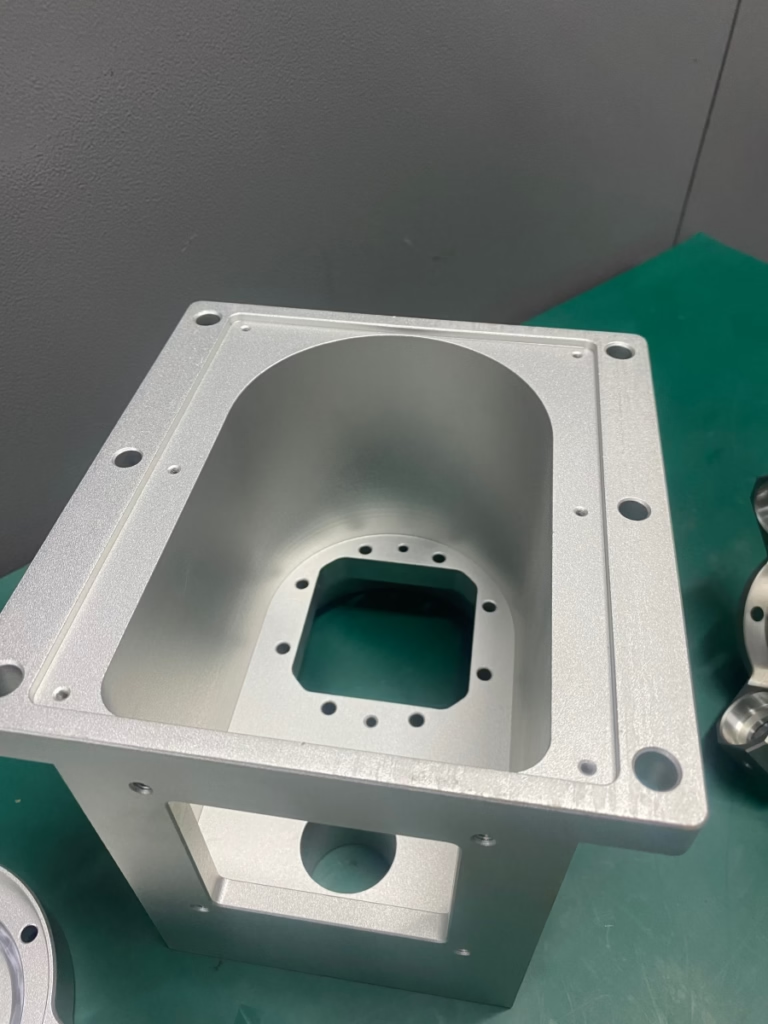
What Actually Slows a Custom CNC Job Down
Most of a machined part's calendar time is not spindle time. On a typical 3-axis job, the tool may cut for 30 to 60 minutes, while the part waits days for a quote, a fixture, a second setup, an outside finish, or an inspection slot. When engineers ask how to get custom CNC machining custom fast, the honest answer is that you shorten the waiting, not the cutting.
Setup count is the biggest single lever. Each new orientation means a new fixture, a new zero point and a new chance for stack-up error. A bracket that needs six setups on a 3-axis mill can often be completed in two or three operations on a simultaneous 5-axis center, because tool access comes from the machine's rotary axes instead of from repositioning the part.
Handoffs are the second lever. When machining, heat treatment, coating and inspection sit at four different vendors, each transition adds shipping and queue time. Keeping those steps under one roof removes travel days even if each individual operation runs at the same speed.
The third lever is information. A model without tolerances, datums or finish call-outs forces the shop to guess, and guessing produces questions. Every question round trip costs hours. A complete drawing package is, in practice, a speed tool.
Why 5-Axis Setups Compress the Schedule
A 5-axis machine tilts the tool or the table so the cutter reaches compound angles, undercuts and deep pockets in one clamping. That matters for parts with features on four or five faces, such as manifolds, brackets, housings and impellers. Fewer clamps means less fixture build time and less re-datuming.
The geometry also improves. Short, rigid tools cut faster and chatter less than long tools reaching around a part, so surface finish holds without a separate polishing step. On aluminium, a short Ø10 mm end mill at a 12 mm axial depth of cut removes material far quicker than a long Ø6 mm tool used to dodge a fixture.
There is a limit. Simple prismatic parts with one or two faces do not benefit. A flat plate with a bolt pattern is faster on a 3-axis machine because programming and fixturing are trivial. Putting it on a 5-axis center wastes setup attention that a complex part needs.
GreatLight runs 16 simultaneous 5-axis machining centers, 12 four-axis mills, 27 three-axis machines and 16 mill-turn centers, so a job can be routed to the machine that matches its geometry instead of being forced onto one platform.
Keeping Machining, Finishing and Inspection in One Chain
A part is not finished when the spindle stops. Anodizing, electroless nickel, powder coating, bead blasting, laser marking and final inspection each add queue time. If those steps are subcontracted, the part leaves the building and comes back with new handling risk and new lead time.
In-house finishing shortens the queue and protects tolerances. Masking decisions can be made by the same team that machined the part, so a Ø6 mm threaded hole or a ±0.005 mm bearing bore does not get coated by accident. Laser marking, with a minimum character height of 1.5 mm, is applied after finishing so the mark stays legible.
Inspection follows the same logic. Raw material check, in-process monitoring and final inspection run on the same floor, so a deviation is caught while the part is still in the machine rather than after it ships. Reports can be issued on request.
The practical effect is fewer days in transit and fewer people touching the part. That is where a 3–5 day ship window becomes realistic for many jobs rather than aspirational.
DFM Decisions That Buy Back Days
Design for manufacturability is not a review meeting. It is a set of choices in the model. The ones that move the schedule most are usually about access, not tolerance. If a tool cannot reach a feature from a sensible direction, the shop has to build a special fixture or move to electrical discharge machining, and both cost days.
Standardize where the design allows. Common drill sizes, standard thread pitches and generous corner radii reduce tool changes and let the shop use stock tooling instead of ordering specials. A 0.5 mm increase in an internal corner radius can remove an entire finishing operation.
Be deliberate about tolerances. Applying ±0.005 mm across a whole drawing forces slow, light finishing passes everywhere. Reserving tight tolerance for the functional interfaces, such as bearing bores, dowel holes and sealing faces, lets the rest of the part run at normal speeds.
Material choice matters too. Aluminium 6061-T6 machines roughly three to four times faster than 17-4PH stainless, and titanium Ti-6Al-4V is slower again. If the application permits 6061 or 7075, the schedule shortens without any change to the machine.
What Fast Cannot Fix
Speed does not remove physics. A feature with an aspect ratio of 10:1 in a deep pocket still needs a long, thin tool, and that tool must run slowly. No amount of scheduling changes the cutting parameters.
Hardened material is another boundary. Once steel is heat treated to high hardness, machining moves to grinding or EDM, which is inherently slower. The schedule gain comes from sequencing, not from brute force.
Cosmetic requirements also set a floor. A decorative mirror polish on a large curved surface can take longer than the machining itself. If the finish is functional rather than cosmetic, saying so in the RFQ prevents the shop from quoting a slow process the part does not need.
The useful question is not how fast a shop can go, but which steps in your part are genuinely fixed by geometry and which are only slow because of how the job was organized. The second category is where the days are.
Which Setup Strategy Fits Your Part
Match the part geometry to the machine before you ask for a delivery date.
| Part type | Best setup | Typical schedule effect | When it does not fit |
|---|---|---|---|
| Flat plate, 1–2 faces | 3-axis, soft jaws | Fastest per part | No compound angles needed |
| Shaft with cross holes | 4-axis or mill-turn | One clamping, fewer ops | Very long slender shafts |
| Housing, 4–5 faces | Simultaneous 5-axis | Cuts 4–6 setups to 2 | Requires 5-axis programming |
| Impeller, compound angles | 5-axis with rotary table | Access without special fixtures | Simple geometry wastes capacity |
| Large frame up to 4,000 mm | Large-travel 3-axis | Avoids splitting the part | Needs bigger stock handling |
| Tight bore in hard steel | Mill then grind or EDM | Adds a process step | Soft material can be milled |
The Trade-Off You Should Make
If your part has features on three or more faces, choose a shop with simultaneous 5-axis capacity and in-house finishing; if it is a simple plate or shaft, choose the fastest 3-axis or mill-turn route and spend your schedule budget on material availability instead.
Questions Engineers Ask About Fast CNC Work
How fast can a custom CNC job actually start?
For a complete RFQ package, quotation and free DFM analysis are returned within 12 hours, and production can start within 24 hours after approval.
Parts then ship in 3–5 days for many jobs. Complex or multi-process parts take longer, and we will tell you which step is the constraint.
Does a fast turnaround mean looser tolerances?
No. Tolerance is set by the drawing, not the calendar. We work to ±0.005 mm on critical features and hold Ra 0.8–1.6 μm as a standard machined finish, with Ra 0.2–0.8 μm available when specified.
The speed comes from setup reduction, tool path planning and in-house finishing, not from skipping checks.
Is there a minimum order quantity for a fast job?
There is no minimum order quantity. We run from a single prototype to 10,000+ part runs.
One-off prototype parts are often the fastest category because there is no production fixture to design.
Which materials machine fastest?
Aluminium 6061-T6, 6063, 6082 and 7075 cut fastest and are common for prototypes and functional brackets.
Brass C36000 and free-machining stainless 303 are also quick. Titanium Ti-6Al-4V and Inconel are the slowest and should be reserved for cases where their properties are required.
Can you handle design files confidentially?
Yes. Uploads are secure and confidential, and a non-disclosure agreement is available on request before you send drawings.
Our information security management is certified to ISO 27001:2022.
What do you need from me to quote quickly?
A 3D model or 2D drawing with tolerances, datums, material, surface finish and quantity is enough.
If the part has a critical interface, mark it. That one piece of information usually decides whether we can route the job to a 3-axis machine or need a 5-axis setup.
Send the Model and Let Us Show You the Route
Send your drawing and we will return a quote with DFM notes within 12 hours, and tell you which machine and setup strategy will get your part made fastest.
12-hour quote100% inspectionNo MOQNDA on request
More From GreatLight
We publish setup notes, tooling trials and inspection data from the factory floor.











