
Get Bulk 3 Axis CNC Machining: How Volume Runs Stay Fast
This page explains what actually sets the pace when you get bulk 3 axis CNC machining done: machine count, fixture design, and how much of the process sits under one roof. It is written for engineers and buyers who need repeatable parts in the thousands, not a one-off sample. Read it and you can tell whether a quote will hold its date.
What 3-Axis Motion Means for Part Geometry
A 3-axis mill moves the tool along X, Y, and Z. The spindle stays vertical, the part is clamped once, and every feature you cut has to be reachable from that one direction. That single constraint drives everything else: cost, cycle time, and how many parts you can run per hour.
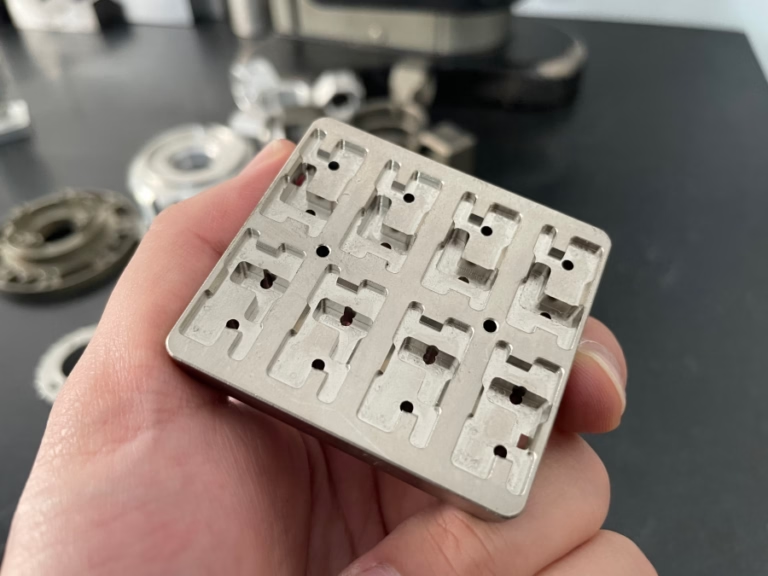
For high-volume 3-axis work, that limit is usually an advantage. Flat plates, housings, brackets, manifolds with top-side ports, and heat-sink bases all cut in one setup. The toolpath stays simple, the tool can be fed hard, and cycle time is predictable from part to part.
Where it stops working: undercut grooves, radial holes around a cylinder, or five-sided features. Those need a fourth or fifth axis, or a second setup with a fixture that re-datums the part. Each extra setup adds stack-up error and hours of labor.
So the first question on any large order is not price per piece. It is whether the geometry can be reached in one or two orientations. If it can, 3-axis is the cheapest route to volume. If it cannot, no amount of machine capacity will make it fast.
Why Machine Count Sets the Delivery Date
Cycle time tells you how long one part takes. Machine count tells you how many parts finish per day. A shop with two 3-axis mills and a shop with twenty-seven will quote the same unit price and then deliver four weeks apart.
On a typical aluminum bracket with a 12-minute cycle, one machine yields about 40 parts per shift. A 10,000-piece order on one machine is roughly 250 shifts. Spread across 27 three-axis machines, the same order clears in days, not months.
That is the whole reason volume and speed are linked. Fast bulk delivery is a scheduling problem more than a cutting problem. The shop needs enough spindles to run the job in parallel and enough planners to keep them fed.
GreatLight runs 127 high-precision CNC machines, including 27 three-axis machines, 12 four-axis mills, 16 simultaneous 5-axis centers, and 16 mill-turn centers. When a 3-axis feature would be faster on a mill-turn, the job can move without leaving the floor.
Fixtures: The Real Difference Between Part 1 and Part 5,000
A prototype is held in a vise. A production run is held in a fixture. That fixture decides whether part 5,000 matches part 1, and whether the operator spends time loading or thinking.
Good soft jaws are cut in place on the machine that will run the job. They match the part contour, so clamping force spreads over a wide area. Thin-wall parts stop bowing. Load time drops to seconds, and the operator stops tapping the part with a dead-blow hammer.
For plate work, a vacuum chuck or a modular plate with pinned locations lets you run several parts per cycle. Two parts per cycle on a 10,000-piece order removes 5,000 load events. That is where hours disappear.
Watch for fixtures that clamp on a finished surface or leave chips in a locating pocket. Both show up as variation at final inspection, not at the machine. Ask how the fixture is cleaned between cycles.
Why One Roof Beats Four Suppliers
Machining is rarely the only step. Most parts need material cut to size, then machining, then deburring, anodizing or plating, and inspection. Split those across four vendors and every handoff adds queue time and a chance for damage.
A 3-day anodizing turnaround from an outside shop can become 8 days once shipping and paperwork are counted. Multiply by two or three outsourced steps and a 5-day machining job turns into a 3-week order.
Keeping preprocessing, machining, finishing, and inspection in one building removes the shipping legs. Parts move in bins, not on trucks. If a batch fails a check, the fix happens in the same shift instead of after a round trip.
GreatLight handles anodizing, plating, powder coating, black oxide, bead blasting, brushing, polishing, and laser marking in house. That is the difference between a quote that says 3–5 days and a quote that means it.
How Tolerance Holds Across 10,000 Parts
Holding ±0.005 mm on one part is a machinist skill. Holding it on 10,000 parts is a process skill. The difference is thermal control, tool wear tracking, and knowing when to stop and re-measure.
Aluminum moves about 23 μm per meter per °C. A 5 °C swing in the shop over a shift is enough to shift a 300 mm part by roughly 7 μm. That matters when your tolerance band is 10 μm wide. Coolant temperature and shop temperature both need watching.
Tool wear is the other drift. A carbide end mill that has cut 40 meters of 6061 will not hold the same dimension as a new one. Production shops track cut time per tool and change on a schedule, not on a hunch.
Inspection has to match the volume. Spot checks on a 10,000-piece run let bad parts travel. GreatLight inspects 100% before shipment, with raw material checks, in-process monitoring, and final reports on request. The recorded qualification rate is 99.99%.
Which Parts Belong on 3-Axis, Which Do Not
Use this to decide before you request a quote.
| Part feature | 3-axis fit | What to do instead |
|---|---|---|
| Flat plate with through holes | Best fit, one setup | Nothing, run it as quoted |
| Pocketed housing, open top | Good fit, one setup | Add a soft-jaw fixture for volume |
| Radial holes around a shaft | Poor fit, needs indexing | 4-axis mill or mill-turn center |
| Five-sided machined block | Poor fit, 3+ setups | 5-axis simultaneous machining |
| Thin wall under 1 mm | Workable with support | Vacuum chuck or low-clamp fixture |
| Deep cavity, 8× diameter | Workable, slower | Long-reach tool or EDM for corners |
| Mirror-image left and right parts | Good fit, two programs | Run both per cycle on one plate |
Pick the Process, Then the Supplier
If your part cuts in one or two orientations, 3-axis is the fastest and cheapest way to reach volume. If it needs four or more sides, move it to 4-axis or 5-axis before you shop for capacity, because no amount of machine count fixes a geometry problem.
Questions Buyers Ask Before a Large Run
What is the largest order size you handle?
There is no minimum order quantity. Runs go from one prototype to 10,000+ pieces, and the same fixture and inspection plan scale across that range.
For very large runs, the limiting factor is usually material availability rather than machine time. Tell us the alloy and temper early so bar stock can be reserved.
How fast can production actually start?
Quotation and a free DFM analysis come back within 12 hours. Once the drawing, material, and finish are confirmed, production can start within 24 hours.
Parts typically ship in 3–5 days for standard 3-axis work. Finishing steps such as hardcoat anodizing or electroless nickel add time, and we quote that in the same line item.
Which materials cut well in bulk on 3-axis machines?
Aluminum 6061, 6061-T6, 2024, 5052, 6063, 6082, and 7075 are the volume workhorses. Stainless 303, 304, 316, 316L, and 17-4PH run well with the right feeds.
Titanium TC4 (Ti-6Al-4V) and Inconel are machinable but slow, so tool life and cycle time drive the quote. Plastics such as POM, PEEK, and ABS cut fast but need sharp tooling to avoid melting.
Do you need special fixturing for thin parts?
Yes, and it is usually worth the cost. Thin walls deflect under vise pressure, and the bow only shows up after unclamping. Soft jaws cut to the part profile, vacuum chucks, or low-pressure clamps hold the shape without crushing it.
For a 10,000-piece order, the fixture cost is a one-time line item that pays back in scrap reduction alone.
What surface finishes are available in house?
Anodizing in clear, color, hardcoat, and conductive versions; electroless nickel, zinc, silver, and gold plating; powder coating and black oxide; bead blasting, tumbling, brushing, and polishing; plus laser marking and engraving.
Laser marking holds a minimum character height of 1.5 mm. Send the marking file with the drawing so it is quoted and programmed in the same pass.
How do you protect drawings and part designs?
Uploads are handled as secure and confidential, and an NDA is available on request before any file exchange.
If your program requires documented information security, we hold ISO 27001:2022 alongside ISO 9001:2015, IATF 16949:2016, and ISO 13485:2016.
Send the Drawing, Get a Real Date
Upload your files and an engineer reviews them for manufacturability before quoting. You get a price, a fixture approach, and a delivery window in one reply.
12-hour quoteFree DFM analysis100% inspectionNDA on request
Follow GreatLight
We publish setup notes, tooling trials and inspection data from the factory floor.











