
Explore the advantages of precision CNC machining services
A practical guide for engineers and sourcing teams comparing precision CNC machining services. We cover where the real advantages come from, which tolerances and finishes are realistic, and the checks that separate a capable shop from a busy one.
In this article
- 1
- 2
- 3
- 4
- 5
- 6
- 7
Key takeaways
Which process fits your part
Read down the left column to find your part type, then check the tolerance and batch range you can expect.
| Part type | Typical process | Tolerance band | Batch range |
|---|---|---|---|
| Prismatic housing, pockets | 3-axis milling | ±0.02 mm | 1 to 10,000+ |
| Angled ports, undercuts | 5-axis milling | ±0.005 mm | 1 to 5,000 |
| Shafts, bushings, fittings | CNC turning | ±0.01 mm | 1 to 10,000+ |
| Housing with bore and face | Mill-turn | ±0.01 mm | 1 to 5,000 |
| Thin walls under 1 mm | 5-axis, light passes | ±0.02 mm | 1 to 2,000 |
| Hardened tool steel | EDM or grinding | ±0.005 mm | 1 to 1,000 |
| Prototype before tooling | CNC, not casting | ±0.02 mm | 1 to 100 |
Pick the shop that asks about your part
The advantage of precision CNC machining services is not the machine list. It is a shop that reads the drawing, flags the risk and holds ±0.005 mm across the run. Send one part and judge the reply.
Why precision CNC machining services hold tolerance
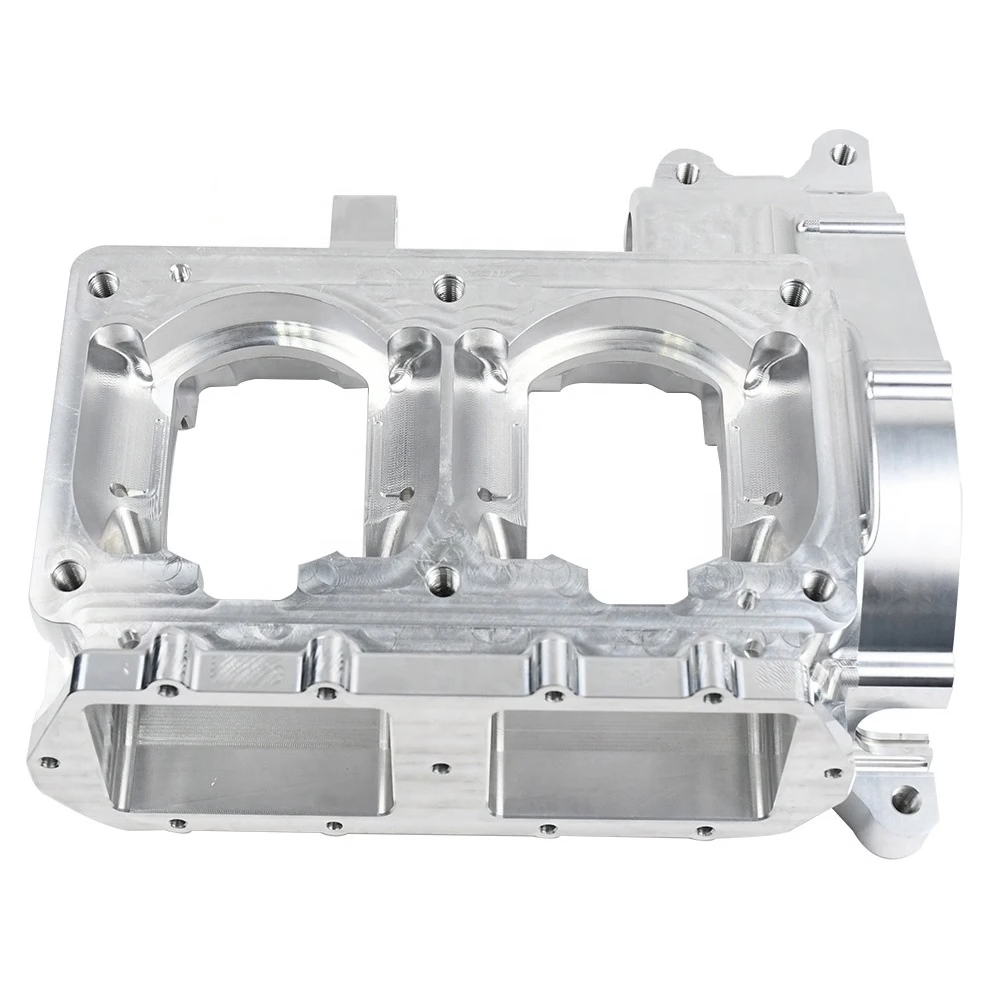
A CNC machine does not get tired at 2 a.m. The controller reads the same G-code on part 400 as it did on part 1, so the cutting path, spindle speed and feed rate repeat within the machine's own accuracy. That is the core of the advantage. Human error moves from the cut to the setup and the program.
The practical tolerance depends on the geometry, not the brochure. A rigid block with a bored hole holds ±0.005 mm easily. A 300 mm long, 0.8 mm thin wall will move when you clamp it, then move again when you release it. Ask the shop which feature they are quoting against before you accept a number.
Repeatability and accuracy are different claims. Accuracy is how close the first part lands to nominal. Repeatability is how close part 50 lands to part 1. For a production run, repeatability decides whether your assembly still fits in month six.
Materials change the achievable finish more than the tolerance. Aluminium 6061 and 7075 cut cleanly and hold Ra 0.8–1.6 μm with normal tooling. Titanium TC4 and Inconel work-harden at the cut and need slower feeds, sharper tools and more coolant to avoid chatter and tool wear.
- 1Tolerance is feature-specific
- 2Repeatability beats one-off accuracy
- 3Hard materials cost time, not just money
Cost, lead time and batch size in real terms
The biggest cost driver is not the material bill. It is setup: programming, fixturing, tool selection and the first article inspection. On a single prototype, setup can be most of the price. On a 10,000 part run, the same setup spreads thin and the per-part cost falls to machine time plus material.
This is why the same part quoted by three shops can differ by 40 percent. One shop quotes a 5-axis cycle that avoids two setups, the other quotes three 3-axis operations plus a fixture. The second looks cheaper on the machine rate and more expensive on the invoice.
Lead time follows the same logic. A shop with idle capacity can start production within 24 hours. A shop running at 95 percent utilisation will quote a longer date and may miss it. Historical late-delivery probability below 2 percent is a useful number to ask about, because it reflects scheduling discipline, not machine count.
Material choice moves cost in smaller steps. Aluminium is cheap and fast. Stainless 316L costs more and cuts slower. Titanium TC4 and Inconel are several times slower again, and tool life drops sharply, so the machining hour rate matters more than the bar price.
- 1Setup dominates small batches
- 2Fewer setups beat lower rates
- 3Schedule discipline shows in the late rate
What to check before you place a purchase order
Start with machine capability against your envelope. A shop with a 4,000 mm travel machine and a Ø400 mm rotary table can handle long frames and large round parts. A shop limited to 500 mm cube work will subcontract your part or decline it. The machine list should be specific: how many 5-axis centers, how many mill-turn centers, what travels.
Then check the quality system against your industry. ISO 9001:2015 covers general industrial work. IATF 16949:2016 is the entry ticket for automotive and EV parts. ISO 13485:2016 applies to medical devices. ISO 27001:2022 matters if you are sending CAD files that carry intellectual property.
Ask how inspection is done. Raw material check, in-process monitoring and final inspection before shipment is a normal flow. A shop that inspects 100 percent before shipment and can send reports on request is easier to work with than one that only checks the first article.
Finally, test the communication. Send one drawing and see what comes back. A free DFM analysis within 12 hours that flags a thin wall or an unreachable corner is worth more than a lower quote that arrives in four days with no comments.
- 1Match machines to your envelope
- 2Match certifications to your sector
- 3Read the DFM feedback
Where precision CNC machining services fit best
Aerospace and defence parts usually combine tight tolerances with low volume and full traceability. A bracket or manifold may only need 50 pieces, but every dimension is critical and the material certificate has to follow the part. CNC machining suits this because no tooling is cut and the first article can be verified before the run.
Automotive and EV work leans the other way. Volumes are high, cycle time is everything, and IATF 16949 documentation is expected. Mill-turn centers help here because a part that would need two or three machines can come off one spindle with less handling and fewer fixture errors.
Medical devices add surface and cleanliness requirements. A surgical instrument housing may need Ra 0.2–0.8 μm, no sharp edges and a passivation or anodising step. ISO 13485 governs the process, and inspection records matter as much as the part itself.
Electronics and robotics sit in the middle. Enclosures, heat sinks, brackets and end effectors are often aluminium, medium tolerance and produced in batches from 50 to 2,000. Finish is usually anodising or bead blasting, with laser marking for part numbers at a minimum character height of 1.5 mm.
- 1Aerospace: low volume, full traceability
- 2Automotive: high volume, tight cycle time
- 3Medical: surface and documentation
- 4Electronics: aluminium, mid tolerance
How to evaluate a supplier in six steps
Run these in order. Each step can end the conversation, which saves you time on the next one.
- 1Send one representative partPick the part with the tightest tolerance and the most awkward feature. A 3D model plus a 2D drawing with the critical dimensions marked is enough to judge the response.
- 2Check the DFM feedbackA useful reply names the specific risk: a 0.8 mm wall that will deflect, a corner a Ø6 mm tool cannot reach, a hole that needs a flat bottom. General praise tells you nothing.
- 3Confirm the machine matchAsk which machine will run the part and its travels. For a 600 mm frame with a Ø350 mm bore, a 500 mm cube machine is the wrong answer.
- 4Verify the quality systemRequest the current certificate number and scope. ISO 9001:2015 for general work, IATF 16949:2016 for automotive, ISO 13485:2016 for medical.
- 5Agree the inspection planDecide what is measured, on how many parts, and in what report format. First article plus in-process monitoring plus final inspection is the baseline.
- 6Pilot with a small batchRun 5 to 20 parts before committing to full volume. Check the first article against the drawing and confirm the finish with a roughness gauge, not by eye.
Questions buyers ask before ordering
What tolerance should I put on the drawing?
Put the tolerance you actually need on the features that matter, and leave the rest at a general block tolerance. A drawing where every dimension is ±0.005 mm forces the shop to slow the cycle and inspect everything, which raises the price without improving the assembly.
Typical practice: ±0.005 mm for fits and bores, ±0.05 mm for non-critical lengths, and a general note of ±0.1 mm for everything else.
Which materials can be machined?
Aluminium 6061, 6061-T6, 2024, 5052, 5083, 6063, 6082, 7075 and ADC12. Stainless 303, 304, 316, 316L, 420, 430, 431, 440C and 17-4PH. Steel 1018, 1045, 4130, 4140, 4340, A36 and tool steel. Copper and brass C101, C103, C110, beryllium copper, C27400, C28000, C36000. Titanium TA1, TA2, TC4, Inconel, magnesium AZ31B and AZ91D. Plastics including ABS, PC, PMMA, POM, PA, PEEK, PP, HDPE and carbon fibre.
The material changes the achievable finish and cycle time more than the tolerance. Hard alloys such as Inconel need slower feeds and shorter tool life.
Can CNC machining handle mass production?
Yes, with the right setup. A mill-turn center or a dedicated fixture turns a low-volume job into a repeatable production cell. Runs of 10,000+ parts are normal for aluminium and stainless when cycle time is engineered rather than improvised.
For very high volumes, die casting or forging plus finish machining is often cheaper per part. CNC machining wins when geometry changes, tolerances are tight, or the volume does not justify tooling.
How do I compare quotes from different shops?
Ask each shop to state the number of setups, the cycle time, the inspection plan and the finishing steps. A quote with a low hourly rate but three setups is often more expensive than a 5-axis quote with one.
Also check what the quote excludes: material certification, surface finish, laser marking, packing and freight are common omissions that reappear on the final invoice.
What certifications should a supplier hold?
ISO 9001:2015 is the baseline for general industrial work. IATF 16949:2016 is required for automotive and EV parts. ISO 13485:2016 applies to medical devices. ISO 27001:2022 covers information security, which matters when you share CAD data that carries intellectual property.
Ask for the certificate scope, not just the logo. A certificate that lists a different process or site does not cover your part.
How fast can parts ship?
With a complete drawing and a clear material callout, a quotation and DFM analysis can come back within 12 hours, and production can start within 24 hours. Typical parts ship in 3 to 5 days.
That timeline assumes no open questions on the drawing and no special material on order. Titanium and Inconel stock, heat treatment and plating add time, so book those steps early.
Send a drawing, get a DFM review in 12 hours
Upload your 3D model and 2D drawing. We reply with a quotation, a free DFM analysis and the machine we would use. No minimum order quantity, from one prototype to 10,000+ parts.
12-hour quote±0.005 mm toleranceNo MOQNDA on request
More machining notes
We publish setup notes, tooling trials and inspection data from the factory floor.











