
CNC Steel Cutting Machine: How It Removes Steel and Where It Stops
A CNC steel cutting machine is a controlled metal-removal or thermal-separation system, not one single tool. This page explains the mechanics behind each type, the limits that decide accuracy, and how to judge which process fits a given steel part.
In this article
- 1
- 2
- 3
- 4
- 5
- 6
- 7
- 8
What a CNC steel cutting machine actually does
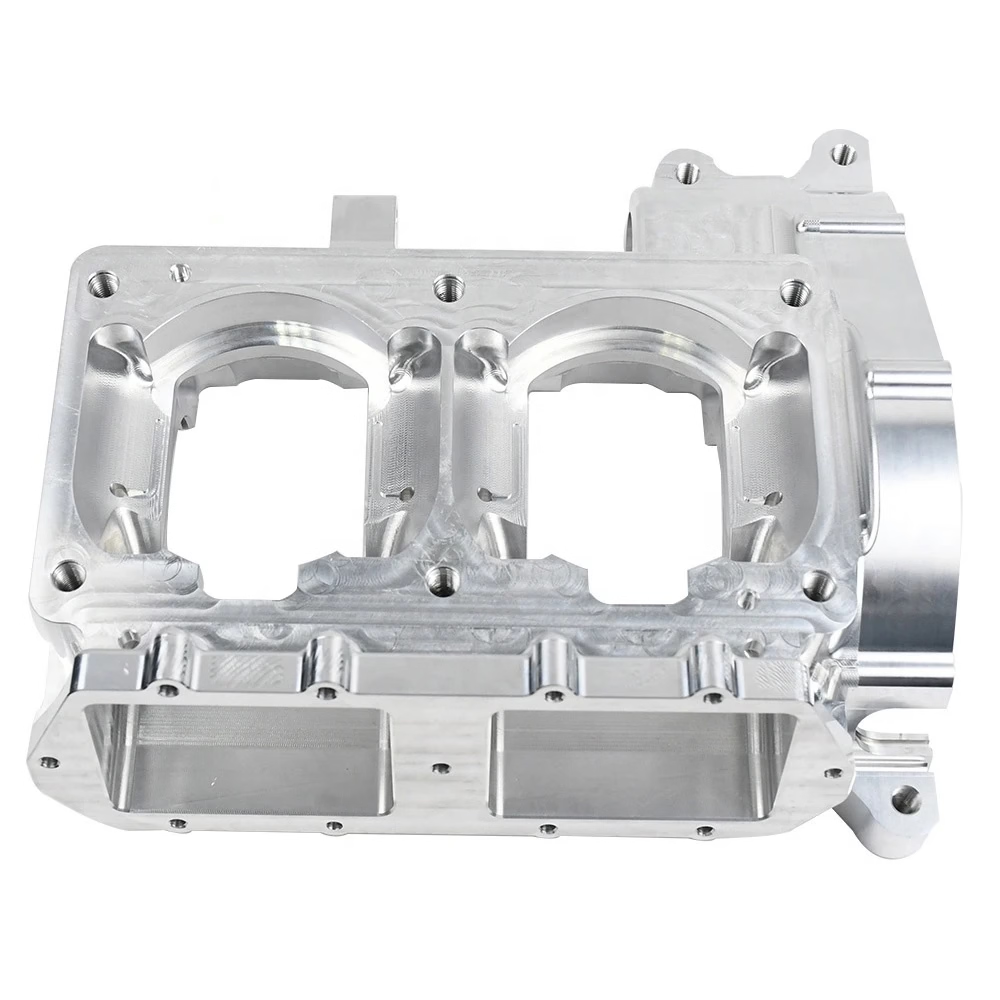
The name is loose. In a machine shop, a CNC steel cutting machine is usually a machining center that turns a rotating cutter against a steel workpiece. The cut comes from shear at the tool edge, not from a blade slicing through the plate. A 3-axis mill can face a surface, drill a hole, tap a thread, and trace a contour from one solid block in a single setup.
The alternative family cuts by heat or abrasion. Fiber laser melts and vaporizes the kerf with a focused beam. Waterjet erodes steel with abrasive slurry at very high pressure. Plasma melts a conductive path. These machines cut flat stock well, but they cannot hold a bore tolerance or produce a 3D contour the way a spindle does.
That difference matters when you read a drawing. If the part has holes, pockets, threads, and a datum face, you want a spindle. If the part is a flat bracket with an outer profile, a laser or waterjet may be cheaper and faster. The word cutting hides two very different physics.
At GreatLight we run 127 high-precision CNC machines, including 16 simultaneous 5-axis centers, so a steel part with angled faces and tight bores stays in one setup instead of three.
- 1SubtractiveCutter removes chips. Holds tolerances and 3D geometry.
- 2ThermalLaser or plasma melts the kerf. Fast on flat plate, heat-affected edge.
- 3AbrasiveWaterjet erodes with garnet. No heat, but slower on thick steel.
The mechanics that set chip load and surface finish
Cutting steel is a heat and force problem. The tool edge shears the material, and the friction of that shear generates heat that has to leave with the chip. Chip load per tooth is the key number. If it is too low, the edge rubs and work-hardens the surface. If it is too high, the tool deflects and the wall tapers.
Spindle speed, feed rate, and depth of cut trade against each other. For 1018 mild steel on a carbide end mill, a common roughing range is 80–120 m/min surface speed with a 0.05–0.15 mm/tooth feed and 1–3 mm axial depth depending on cutter diameter. For 4140 alloy steel, drop surface speed to roughly 60–90 m/min and keep the chip load steady.
Coolant does more than cool. Flood coolant flushes chips out of a deep pocket so the cutter does not recut them. Through-spindle coolant helps when depth-to-diameter exceeds 4:1 and chip evacuation stalls. Dry cutting is possible in some finishing passes, but it needs air blast and a rigid setup.
Rigidity is the silent variable. A long tool hanging out of the holder will chatter no matter what the feed says. Keep tool overhang short, use shrink-fit or hydraulic holders for finishing, and let the machine's thermal compensation settle before the last pass.
- 1Chip loadToo low rubs and hardens; too high deflects the tool.
- 2CoolantFlood evacuates chips; through-spindle helps past 4:1 depth.
- 3OverhangShort holders reduce chatter on finishing passes.
Milling, laser, and waterjet: which one fits the part
A 3-axis mill cuts pockets, steps, and holes in a block. It is the default for steel parts with internal features. A 4-axis mill adds rotation for parts with features on several sides, and a 5-axis center tilts and rotates so a contoured face, an angled hole, or a deep pocket can be cut without re-fixturing. Fewer setups means fewer datum shifts and tighter positional accuracy.
A fiber laser cuts flat sheet and plate up to its rated thickness. It is fast, and the kerf is narrow, but the edge carries a heat-affected zone and a slight taper. For a bracket that only needs an outline, that is fine. For a bearing bore, it is not. The bore will need a secondary machining pass.
Waterjet cuts any steel thickness in the machine's envelope with no heat input, so the metallurgy near the edge does not change. It is slower per part and the abrasive adds cost, but it is the right call for thick plate or heat-sensitive alloys where a laser edge would need annealing.
In practice many parts mix processes. A laser blanks the plate, then a mill puts in the bores, counterbores, and threads. That sequence keeps the fast operation fast and the accurate operation accurate.
- 13-axis millPockets, steps, holes in a block.
- 25-axis millContoured faces and angled holes in one setup.
- 3Fiber laserFlat profiles, narrow kerf, heat-affected edge.
- 4WaterjetThick or heat-sensitive plate, no heat input.
Fixturing and datums hold the tolerance
A machine tool is only as accurate as the setup that holds the part. Vises work for small, simple blocks. For larger steel parts, a fixture plate with dowel-pinned stops keeps the datum repeatable across operations. When a part is flipped, the origin has to be re-established from a machined feature, not from a raw saw edge.
Thermal growth is real on steel. A 300 mm long part can move several microns as the shop warms through the day. Rough the part, let it rest, then finish. On tight bores, leave 0.1–0.2 mm of stock for the finishing pass so the final cut removes a light, consistent chip.
Thin walls are the common failure point. Once the wall is under about 2 mm on a 100 mm steel part, cutting forces will push it. Support the back side with a soft jaw or a wax fill, take lighter axial passes, and climb-mill to push the cutter away from the finished surface.
GreatLight holds ±0.005 mm on steel parts and inspects 100% before shipment, with reports on request. That number depends on the setup as much as the spindle.
- 1Rough then finishLeave 0.1–0.2 mm stock for the final pass.
- 2Re-datum after flipPick up a machined feature, not the saw edge.
- 3Support thin wallsSoft jaws or fill stop the wall from moving.
How steel grade changes the cutting window
Low-carbon steel like 1018 and A36 cuts freely. Chips break cleanly, surface finish is easy to control, and tool wear is slow. It is the grade to prototype in when you want to check geometry before committing to a harder alloy.
Medium-carbon 1045 and alloy 4140, 4340 respond to heat treatment, so hardness changes the cut. In the annealed state they machine near mild steel. After quench and temper to 30–40 HRC, surface speed drops, carbide grade changes, and finishing passes get lighter. Always tell the shop the final hardness, not just the grade.
4130 chromoly is common in aerospace and motorsport tubing and fittings. It galls if the feed is too light, so keep the cutter engaged and the chip load steady. Stainless grades 303, 304, and 17-4PH work-harden at the cut. Do not dwell. One clean pass beats three timid ones.
Tool steel and pre-hardened plate sit at the top of the range. They need rigid setups, coated carbide, and patience. If the geometry allows, cutting before hardening and then grinding the critical surfaces is often cheaper than cutting hard.
- 11018 / A36Free cutting, good finish, low tool wear.
- 24140 / 4340Cut annealed; adjust for final hardness.
- 3303 / 304 / 17-4PHWork-hardening; avoid light dwell passes.
When a CNC steel cutting machine is the wrong answer
If the part is a flat 3 mm bracket with a simple outline and a ±0.2 mm profile tolerance, milling it from solid wastes time and material. Laser or waterjet blanks the shape in minutes, and the customer never sees the difference. Choosing the mill here raises the quote for no benefit.
If the part is a 500 mm long steel tube with a single square cut, a saw with a stop is faster than any machining center. If the part is a weldment, cutting is only the first step, and the drawing should say which surfaces are machined after welding so the datum survives distortion.
The other wrong answer is forcing one setup to do everything. A deep pocket on a tall thin rib may need a 5-axis approach or a different fixture, not a longer end mill. Chatter marks on a finished wall usually mean the setup, not the feed, was the problem.
Ask one question early: which dimensions actually matter. The answer tells you whether you need a machining center, a laser, or both in sequence.
- 1Flat simple profileLaser or waterjet beats milling.
- 2Single straight cutA saw with a stop is faster.
- 3Welded assemblyDefine machined surfaces after welding.
What we control on steel parts at GreatLight
We have run steel parts since 2011 across 3 wholly-owned plants and 7,600 m² of floor space. The work covers 1018, 1045, 4130, 4140, 4340, A36, and tool steel, plus stainless and titanium when the drawing calls for it. Maximum processing size is 4,000 mm, and the 5-axis centers carry a Ø400 mm rotary table for contoured work.
Quotation and free DFM analysis come back within 12 hours. Production can start within 24 hours, and parts ship in 3–5 days. There is no minimum order quantity, so one prototype and a 10,000-part run go through the same first-article check.
Inspection is 100% before shipment: raw material check, in-process monitoring, and final inspection, with reports on request. We hold ISO 9001:2015, IATF 16949:2016, ISO 13485:2016, and ISO 27001:2022. Uploads stay confidential, and an NDA is available on request.
If your drawing has a tolerance you are unsure about, send it. We will tell you whether the feature should be cut, ground, or left for a secondary operation.
- 112-hour quoteFree DFM analysis with the quotation.
- 23–5 day shippingProduction can start within 24 hours.
- 3100% inspectionReports available on request.
Matching the cutting process to the steel part
Tolerance figures are typical shop values; confirm on your drawing.
| Process | Best for | Typical tolerance | Edge condition |
|---|---|---|---|
| 3-axis CNC mill | Pockets, steps, holes in a block | ±0.005 mm | Machined, no heat zone |
| 5-axis CNC mill | Contoured and angled features | ±0.005 mm | Machined, one setup |
| Fiber laser | Flat sheet and plate profiles | ±0.05–0.1 mm | Heat-affected zone, slight taper |
| Waterjet | Thick or heat-sensitive plate | ±0.1–0.2 mm | No heat zone, matte edge |
| Plasma | Heavy plate, rough outline | ±0.5 mm and up | Dross, needs cleanup |
| Laser blank + mill | Flat part with accurate bores | ±0.005 mm on bores | Fast profile, machined holes |
Choose the process by the feature, not the part name
If the part needs bores, threads, or 3D contours, use a CNC machining center. If it is flat plate with an outline tolerance, use laser or waterjet and machine only the critical holes. Mixing the two usually gives the lowest cost per good part.
Steel cutting questions engineers ask
Can a CNC steel cutting machine hold ±0.005 mm on hardened steel?
It can on features that are cut before hardening or ground after. Once steel is quenched to 40 HRC and above, the cutting window narrows and tool deflection grows.
In that case we cut the geometry soft, leave grinding stock on the critical surfaces, and finish after heat treatment. The ±0.005 mm figure applies to the finished feature, not to every pass.
What is the thickest steel a fiber laser can cut cleanly?
It depends on laser power and the acceptable edge quality. Thin sheet cuts fast with a fine kerf. As thickness grows, the kerf widens, the edge tapers more, and cutting speed drops sharply.
For thick plate or any edge that will be a sealing or bearing surface, waterjet or a machining pass is the safer route than a laser-only cut.
Does cutting steel with a laser change the material properties?
Yes, along the cut edge. The laser leaves a narrow heat-affected zone where the microstructure changes. For most brackets that is harmless. For a fatigue-critical part, the zone can be a crack initiation site.
If the edge sees cyclic load, specify a machining allowance and remove the laser edge, or use waterjet, which introduces no heat.
How do you stop thin steel walls from chattering during milling?
Support the back of the wall, reduce the axial depth of cut, and keep the cutter engaged with a steady chip load. Climb milling pushes the cutter away from the finished surface and leaves a cleaner wall.
If the wall is under about 2 mm on a 100 mm part, a soft jaw or a wax fill often does more than any change to spindle speed.
Should I specify 4130, 4140, or 4340 for a new steel part?
Start from the strength and the heat treatment the part needs. 4130 is common for welded tube structures and machines well in the annealed state. 4140 and 4340 reach higher strength after quench and temper, which means a narrower cutting window on the finishing passes.
Tell the shop the final hardness, the heat treatment, and which surfaces are critical. The grade alone does not tell them how to cut it.
Can I get one steel prototype without a minimum order?
Yes. There is no minimum order quantity, so a single prototype and a 10,000-part run go through the same process. Quotation and free DFM analysis come back within 12 hours.
Uploads are kept confidential, and an NDA is available on request if the drawing is sensitive.
Send the drawing and get a cutting plan back
We will review the steel grade, the tolerances, and the feature list, then tell you which process cuts it best. Quotation and free DFM analysis within 12 hours.
12-hour quote100% inspectionNo minimum orderNDA on request
More steel machining notes
We publish setup notes, tooling trials and inspection data from the factory floor.











