
How to Vet a CNC Machining Services China Supplier
You send a drawing, you get a price, and then the problems start. This guide gives engineers and procurement teams five checks that separate a capable CNC machining services China supplier from a broker with a website. Read it before you release that first PO.
In this article
- 1
- 2
- 3
- 4
- 5
- 6
- 7
- 8
Key takeaways
What to check on a CNC machining services China supplier
Five criteria, what a strong answer looks like, and the red flag that should stop the conversation.
| Criterion | Strong answer | Red flag |
|---|---|---|
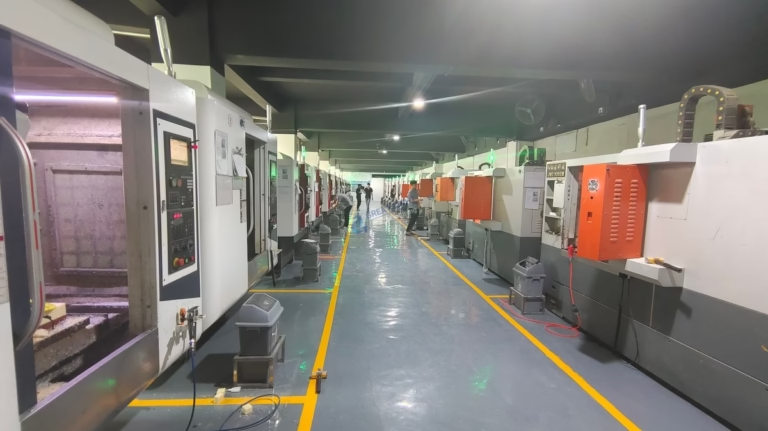
| Machine fleet | 127 CNC machines, 16 five-axis centers listed by model | Only says "advanced equipment" |
| Size envelope | 4,000 mm max, travel listed per machine group | No maximum part size stated |
| Tolerance and finish | ±0.005 mm, Ra 0.2–0.8 μm on request | Claims "high precision" with no number |
| Certifications | ISO 9001:2015, IATF 16949:2016, ISO 13485:2016 | Certificate scans expire or name another plant |
| Order range | One prototype to 10,000+ parts, no MOQ | MOQ of 500 with a tooling charge |
| Quote turnaround | Quote plus DFM analysis inside 12 hours | Price only, no manufacturability notes |
| Confidentiality | NDA on request, secure upload portal | Asks you to email STEP files to a personal inbox |
Machine capability: what the fleet actually tells you
A supplier's machine list is the fastest way to find out what work it can and cannot take. Ask for the count, the axis configuration and the work envelope of each group. A shop running 27 three-axis machines and 12 four-axis mills can handle a lot of prismatic parts, but it will struggle with a part that needs five faces in one setup.
Five-axis capacity changes the quote. With 16 simultaneous five-axis machining centers, a part with compound angles or deep pockets can be cut in two setups instead of five. Fewer setups means fewer fixtures, less stack-up error and a shorter schedule. If a supplier outsources five-axis work, you are paying a margin to a middleman and losing visibility on the schedule.
Size matters too. A 4,000 mm maximum processing size with 4,000 × 400 × 150 mm travel covers long frame rails and extrusion profiles. Medium machines at 750 × 1,150 × 550 mm and 600 × 600 × 600 mm handle most housing and manifold work. Compact machines at 500 × 500 × 450 mm are for small, high-volume parts where spindle time dominates cost.
One more question: how many spindles run unattended at night? Lights-out capacity is what keeps a 3–5 day shipping window realistic when your order lands in a busy month.
- 1Ask for the envelope, not the brandMachine brand is marketing. Travel, spindle speed and tool changer capacity are what constrain your part.
- 2Count the setupsEach extra setup adds fixture cost, cycle time and a new tolerance stack.
- 3Check rotary table sizeA Ø400 mm rotary table limits how large a turned-and-milled part can be done in one operation.
Tolerance, finish and how the supplier proves them
±0.005 mm is a number that only means something with a measurement method attached. Ask which instrument closes the loop: a CMM, a vision system, micrometers, gauge pins. Then ask how the part is held during inspection. A thin wall that measures in tolerance on the bench can spring out of tolerance once it is unclamped.
Surface finish follows the same logic. Ra 0.8–1.6 μm is a normal as-machined target for aluminum and mild steel. Ra 0.2–0.8 μm usually needs a finer stepover, a smaller tool or a secondary operation, and it costs more. If your drawing says Ra 0.4 μm across a 300 mm face, expect the supplier to push back or add a polishing step.
Inspection coverage is the third leg. 100% inspection before shipment sounds expensive until you price a rejected batch that has already crossed an ocean. A workable pattern is raw material check, in-process monitoring with tool wear limits, and a final inspection with reports on request. For medical and automotive work, ask for the specific report format your quality team needs before the first run.
Hardened steels, titanium and Inconel change the picture. TC4 and Inconel 718 cut slowly and wear tools fast, so tolerance drift shows up late in the run. Ask how the supplier compensates: tool life tracking, in-process probing, or a mid-run inspection stop.
- 1Name the instrumentA tolerance claim without a measuring device is a wish, not a capability.
- 2Match finish to functionSealing faces and bearing bores need the tight number. Cosmetic panels usually do not.
- 3Agree the report before the runFirst-article and in-process reports should use your format, not a generic template.
Certifications: which ones your project actually needs
Certificates are evidence of a process-driven quality system, not decoration. ISO 9001:2015 is the baseline every serious supplier should hold. It covers document control, corrective action and calibration, which is exactly what protects your repeat order six months from now.
Sector-specific certificates only matter if your product needs them. IATF 16949:2016 is the automotive and EV standard, and it brings PPAP-style documentation with it. ISO 13485:2016 applies to medical devices and adds traceability and validation requirements. ISO 27001:2022 covers information security, which matters when you are uploading proprietary CAD for a program that has not launched yet.
Check the certificate scope. A certificate issued to a trading company does not cover the machine shop that cuts your part. Look for the legal entity name and the site address. If the certificate names a plant in another city, ask who is actually running the spindle.
Keep copies with expiry dates in your supplier file. An expired certificate discovered during an audit is a problem you inherit, not the supplier.
- 1ISO 9001 is the floorNo certificate at all means no audited calibration or corrective action process.
- 2Match the standard to the industryAerospace, medical and automotive buyers each need a different document set.
- 3Verify the scope and addressThe certificate must name the site that machines your parts.
Order range, materials and pricing behavior
A supplier with no minimum order quantity tells you something useful: the quoting and setup workflow is built for one-off prototypes as well as 10,000+ part runs. That flexibility matters in hardware programs, where you might need three functional prototypes in week two and a 5,000-piece pilot build in month four.
Material coverage is the second signal. Aluminum 6061-T6, 7075 and ADC12 cover most enclosures and brackets. Stainless 303, 304, 316L, 17-4PH and 440C cover food, marine and medical parts. Tool steel, 4140 and 4340 handle wear applications. If your alloy is not on the list, ask whether the supplier has cut it before and how it affects tool life and lead time.
Watch the pricing pattern. A quote that arrives as a single lump number with no cycle time, material cost or setup breakdown is hard to audit and hard to negotiate. A supplier that separates setup, material, machining and finishing lets you move a tolerance or a finish to hit a target without guessing.
Be cautious with prices far below the market. They usually mean a thin first article, a shortcut on inspection, or a subcontractor you never meet. None of those show up on the PO.
- 1No MOQ is a workflow featureIt shows the quoting and setup process is not built around large batches only.
- 2Ask about your specific alloyTitanium and nickel alloys change tool life, cycle time and inspection frequency.
- 3Read the quote structureSeparated cost lines let you trade tolerance against budget on purpose.
Lead time, DFM feedback and confidentiality
Lead time claims are easy to make and hard to verify. What you can verify is the front end. A supplier that returns a quotation and a free DFM analysis within 12 hours is running a real engineering review, not a price list lookup. The DFM notes are worth reading closely: thin walls, deep pockets, tight corner radii and unmarked datums all show up there first.
Production start within 24 hours after PO and material release is a reasonable benchmark for a shop with its own stock. Parts shipping in 3–5 days is achievable on simple geometry in common alloys. Complex five-axis work, hard materials or a new finish will take longer, and a supplier that says otherwise is guessing.
Ask how the shop tracks on-time delivery. A historical late-delivery probability below 2% is a working number, not a promise. Request the measurement window and the definition of late.
Confidentiality is the last check and often the one that fails quietly. Uploads should go through a secure portal, not a personal email. An NDA should be available on request before you share CAD. If your program is under embargo, that conversation should happen before the RFQ, not after.
- 1Read the DFM notesThey tell you whether an engineer looked at the model or a salesperson looked at the file name.
- 2Separate quote speed from build speedA fast quote is a process signal. It is not a delivery guarantee.
- 3Settle confidentiality firstNDA and secure upload before the first STEP file leaves your network.
A five-step vetting sequence before the first PO
Run these in order. Each step filters out suppliers that would fail later, when switching costs are higher.
- 1Send one representative partPick a part with at least one tight tolerance and one difficult feature. Ask for a quote and DFM notes. Nothing else tells you as much per hour spent.
- 2Request the machine and envelope listAsk for axis configuration, travel and rotary table size. Compare against your part envelope. A part that needs a 4,000 mm travel should not be quoted by a shop with 500 mm machines.
- 3Ask for the inspection planWhich instrument, which features, what sampling rate. Confirm ±0.005 mm is achievable on the specific features you marked, not just in general.
- 4Verify certificates and scopeMatch the legal entity and site address on the certificate to the plant that will run the job. Note expiry dates.
- 5Run a small first articleOrder two to five pieces before the pilot build. Check dimensions, finish, burrs and packaging. This is the cheapest test you will ever run.
- 6Lock the documentation formatAgree on first-article report, material certs and inspection report format before volume starts. Changing formats mid-program costs weeks.
Questions buyers ask before committing
How do I know a supplier can hold ±0.005 mm on my part?
Ask which features the tolerance applies to and how they are measured. A CMM with a defined fixture and a stated sampling rate is the answer you want.
Then order a first article. Two to five pieces will show whether the process holds the number after the machine warms up and the tool wears.
Is a low price a sign of a bad supplier?
Not by itself. A shop with its own material stock and unattended night capacity can legitimately quote lower than one buying material per job.
A price far below everyone else usually means something is missing: inspection time, a first article, or the actual machining site. Ask what is included.
Which certifications should I require?
ISO 9001:2015 for any production work. Add IATF 16949:2016 for automotive and EV, ISO 13485:2016 for medical devices, and ISO 27001:2022 if you are sharing sensitive design data.
Check the certificate scope and site address, and keep expiry dates on file.
Can I order just one prototype?
Yes, if the supplier has no minimum order quantity. That covers everything from a single prototype to 10,000+ part runs.
Expect the per-piece price to be higher on one piece because setup and programming are amortized over a single part.
What lead time is realistic?
Quotation and DFM analysis within 12 hours, production start within 24 hours after material release, and parts shipping in 3–5 days are achievable on straightforward geometry in common alloys.
Five-axis work, titanium, Inconel and new finishes add time. Ask for a schedule per operation, not one number.
How is my design protected?
Uploads should go through a secure, confidential portal rather than personal email. An NDA should be available on request before you share files.
If your program is under embargo, raise it during the RFQ so the supplier can restrict access internally.
Send a drawing, get a quote and DFM notes
Upload your STEP file and get a quotation with manufacturability feedback within 12 hours. No minimum order quantity, from one prototype to 10,000+ parts.
12-hour quoteNo MOQ100% inspectionNDA on request
More from GreatLight
We publish setup notes, tooling trials and inspection data from the factory floor.











