
CNC Machining Service Minneapolis: How to Pick a Shop Without Getting Burned
This guide is for engineers and buyers in Minneapolis who need machined parts and want to compare suppliers on facts, not sales copy. It covers the checks that actually predict a good run: tolerance, lead time, MOQ, certifications and quotingscope. Read it before you send a drawing out for quote.
In this article
- 1
- 2
- 3
- 4
- 5
- 6
- 7
- 8
- 9
What matters most when you compare shops
How to read a quote for CNC machining service Minneapolis
Use this table to compare suppliers on the numbers that affect your schedule and budget.
| What to check | Weak answer | Strong answer | Why it matters |
|---|---|---|---|
| Tolerance | "We can hold tight tolerances" | ±0.005 mm with probing | Vague claims hide scrap risk |
| Quote turnaround | 3–5 business days | 12 hours with DFM notes | Slow quotes signal thin engineering |
| MOQ | 500 pieces minimum | No minimum, 1 to 10,000+ | Prototypes must run without penalty |
| Certifications | ISO 9001 only | ISO 9001, IATF 16949, ISO 13485 | Industry-specific audits matter |
| Lead time | "Depends on volume" | 3–5 days for standard runs | You need a date to plan assembly |
| Surface finish | Ra 3.2 μm standard | Ra 0.2–0.8 μm available | Sealing and wear surfaces change cost |
The bottom line for Minneapolis buyers
Pick the shop that answers your questions in writing: tolerance method, lead time start point, MOQ, certifications and quotescope. If any of those five is vague, keep looking. If all five are clear, the price comparison means something.
1. Tolerance: what ±0.005 mm actually means on the floor
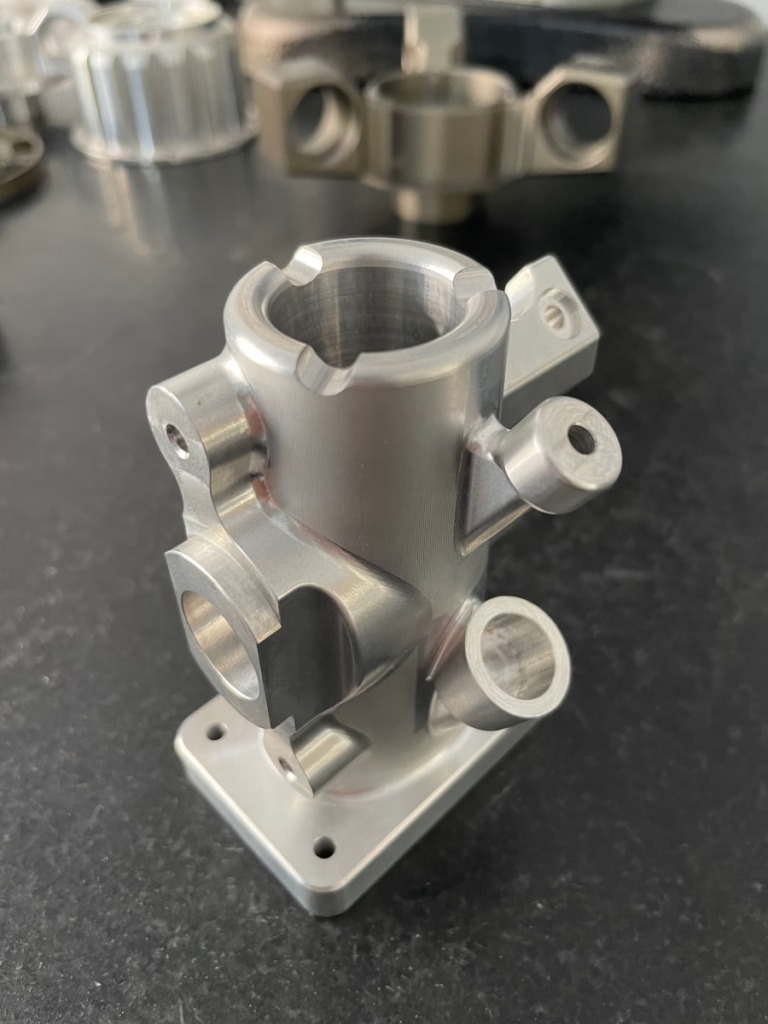
Every shop advertises tight tolerance. The question is whether the process can hold it across a full run, not just on the first article. A 5-axis machining center with a Ø400 mm rotary table and in-process probing can hold ±0.005 mm on features that are accessible in one setup. That is the key: fewer setups means fewer datum shifts means less stacking error.
When a part has six sides and three datums, a 3-axis shop will move it between fixtures four or five times. Each move adds a setup error of 5–15 μm. By the final operation, the tolerance budget is gone. A 5-axis machine reaches the same features from two or three angles, so the error stays under ±0.005 mm on the critical bore or face.
Ask for the inspection report before you ask for the price. A shop that measures every part and can send raw material certs, in-process logs and a final CMM report is doing the work. A shop that only sends a packing slip is hoping you never check. For Minneapolis buyers shipping parts into aerospace or medical assembly, that report is not optional.
- 15-axis with probingBest for complex geometry and tight true position.
- 23-axis with multiple fixturesFine for simple plates, but budget extra setup error.
- 3Mill-turn centersGood for round parts with cross holes and slots.
2. Lead time: why 3–5 days is a process, not a promise
Lead time is not just machine speed. It is the sum of material availability, programming, fixturing, machining, finishing and inspection. A shop that quotes 3–5 days for standard runs is telling you it has material in stock, programmers on staff and a finishing line under the same roof. If any of those steps are outsourced, the date slips.
GreatLight runs 127 CNC machines across three plants, including 16 simultaneous 5-axis centers and 16 mill-turn centers. That capacity matters because it lets us start production within 24 hours of a confirmed order and ship standard parts in 3–5 days. Historical late-delivery probability is below 2%, which is the number to ask for when you compare suppliers.
One trap: a low price often comes with a long queue. If a shop quotes 40% below everyone else, ask when the machine will actually run your parts. Cheap and slow is not cheap if your assembly line is waiting.
- 1Material in stockAluminum, stainless, steel, titanium and plastics on the floor.
- 2Programming in-houseNo waiting on an external CAM contractor.
- 3Finishing in-houseAnodizing, plating and bead blasting without a second vendor.
3. MOQ and material range: the prototype-to-production question
Many Minneapolis buyers start with a prototype and scale to production. If the shop has a 500-piece minimum, you either pay a penalty for the prototype or go elsewhere and lose the process knowledge. A supplier with no minimum order quantity can run one part and then 10,000+ parts on the same equipment, with the same fixtures and the same inspection plan.
Material range is the second half of that question. A shop that only cuts aluminum will struggle with 17-4PH stainless or Ti-6Al-4V. GreatLight machines 6061, 7075, 304, 316L, 17-4PH, 4130, 4140, Inconel, beryllium copper, PEEK, POM and carbon fibre. Each material changes speeds, feeds, tool wear and finishing.
Finish choices affect both function and lead time. Anodizing adds corrosion resistance and color. Electroless nickel adds hardness and uniformity on complex geometry. Bead blasting hides tool marks. If the shop sends finishing out, expect 2–4 extra days and a second quality document to chase.
- 1No MOQOne prototype to 10,000+ part runs.
- 2Wide material listAluminum, stainless, steel, titanium, copper, plastics.
- 3In-house finishingAnodizing, plating, powder coating, laser marking.
4. Certifications: match them to your industry
ISO 9001:2015 is the baseline. It tells you the shop has a documented quality system, but it does not tell you the shop understands your industry's failure modes. Automotive buyers need IATF 16949:2016, which adds traceability, PPAP discipline and change control. Medical device buyers need ISO 13485:2016, which covers validation and risk management.
For defense, aerospace and semiconductor work, information security matters too. ISO 27001:2022 covers how drawings, models and production data are protected. If your IP is the product, a shop without that certification is a risk you are accepting, not a risk you are managing.
Ask for the certificate scope, not just the certificate. A shop can hold ISO 9001 for one process and outsource the rest. The scope statement tells you what is actually covered. If the scope does not match the process you are buying, the certificate is decoration.
- 1ISO 9001:2015General quality management baseline.
- 2IATF 16949:2016Automotive and EV production parts.
- 3ISO 13485:2016Medical devices and instrumentation.
- 4ISO 27001:2022Data security for drawings and IP.
5. Quotingscope: the fine print that changes the price
Two quotes for the same drawing can differ by 40%, and the gap is usually not the hourly rate. It is the quotescope: what is included in the number. Does it cover material certification? Does it cover first article inspection? Does it cover deburring, cleaning and packaging? Does it assume you accept a standard finish, or does it price the Ra 0.8–1.6 μm surface your seal needs?
A useful habit is to send the same drawing to three shops and compare the assumptions, not the totals. The shop that lists what is excluded is easier to work with than the shop that gives one number and no breakdown. When a part fails inspection, the excluded items are where the argument starts.
At GreatLight, every quote comes with a free DFM analysis within 12 hours. That analysis flags features that will drive cost: deep pockets with small corner radii, thin walls, tolerances tighter than the process can hold, and finishes that require extra fixturing. Fixing those in the model is cheaper than fixing them on the machine.
- 1Material cert includedAsk for the mill cert with the shipment.
- 2Inspection report includedRaw material, in-process and final inspection.
- 3Finishing and packaging includedConfirm before the PO, not after.
6. Seven red flags in a supplier quote
Red flags are not about price. They are about what the shop cannot or will not tell you. If a quote has no lead time, no tolerance statement, no material specification and no inspection plan, the price is meaningless. You are comparing a number to a process.
The most common flag is a tolerance claim without a measurement method. "We hold ±0.005 mm" means nothing if the shop does not have a CMM or a controlled temperature room. The second is a lead time that starts when the shop feels like it, not when the PO is confirmed. Ask for the start date in writing.
The third is a shop that will not sign an NDA. Your drawings are your IP. If the supplier hesitates on confidentiality, walk away. The fourth is a shop that cannot name its finishing vendors. Outsourced finishing is where schedule and quality most often break.
- 1No lead time in the quotePrice without a date is not a quote.
- 2Tolerance with no methodAsk which machine and which gauge.
- 3No NDAConfidentiality is a baseline, not a favor.
- 4Unknown finishing sourceTraceability ends where outsourcing begins.
How to qualify a CNC machining service Minneapolis supplier in 6 steps
Run these steps in order. Each one filters out a different kind of risk.
- 11. Send the drawing and ask for DFM notesInclude material, tolerance, finish and quantity. A useful shop replies within 12 hours with cost drivers, not just a price.
- 22. Check the tolerance claim against the processAsk which machine will run the part and how the critical features will be measured. ±0.005 mm needs a CMM, not calipers.
- 33. Confirm the lead time start pointThe clock should start at PO confirmation, not at material arrival. Ask for a ship date, not a duration.
- 44. Verify certifications and scopeRequest the certificate and the scope statement. Match IATF 16949 for automotive, ISO 13485 for medical.
- 55. Ask about MOQ and scalingIf you plan to scale, confirm the same fixtures and inspection plan carry from prototype to production.
- 66. Sign the NDA before releasing filesUploads should be secure and confidential. If the shop stalls on the NDA, stop.
Frequently asked questions
How fast can a Minneapolis buyer get a quote?
GreatLight returns a quotation and free DFM analysis within 12 hours of receiving a drawing and quantity.
Production can start within 24 hours of a confirmed order, and standard parts ship in 3–5 days.
Do I need to order a minimum quantity?
No. There is no minimum order quantity, so one prototype and a 10,000+ part run are both possible.
The same equipment, fixtures and inspection plan carry across volumes, which keeps the prototype representative of production.
Which certifications should I require for automotive parts?
IATF 16949:2016 is the automotive quality standard and should be the baseline for production parts.
ISO 9001:2015 alone does not cover the traceability and change-control requirements automotive programs expect.
What tolerance can be held on complex 5-axis parts?
±0.005 mm is achievable on features machined in a single setup with in-process probing.
The practical limit depends on feature accessibility, material and surface finish. Deep pockets and thin walls will push the cost up before they push the tolerance out.
How are drawings and IP protected?
Uploads are secure and confidential, and an NDA is available on request. The shop holds ISO 27001:2022 for information security.
Sign the NDA before releasing files, and confirm who inside the shop will see the model.
What surface finishes are available in-house?
Anodizing (clear, color, hardcoat, conductive), electroless nickel, zinc, silver and gold plating, powder coating, black oxide, bead blasting, tumbling, brushing and polishing.
Laser marking and engraving are available with a minimum character height of 1.5 mm.
Send your drawing, get a quote and DFM notes in 12 hours
One prototype or 10,000+ parts. Uploads are secure and confidential, and an NDA is available on request.
12-hour quoteNo MOQ100% inspectionISO 9001 / IATF 16949 / ISO 13485 / ISO 27001
More machining notes
We publish setup notes, tooling trials and inspection data from the factory floor.











