
CNC Machining of Titanium Alloy
Titanium cuts like nothing else on the shop floor. This page explains why heat, springback, and tool wear behave the way they do, and which grades and geometries suit CNC machining of titanium alloy. Written for engineers and buyers who need to judge a part before it goes on the machine.
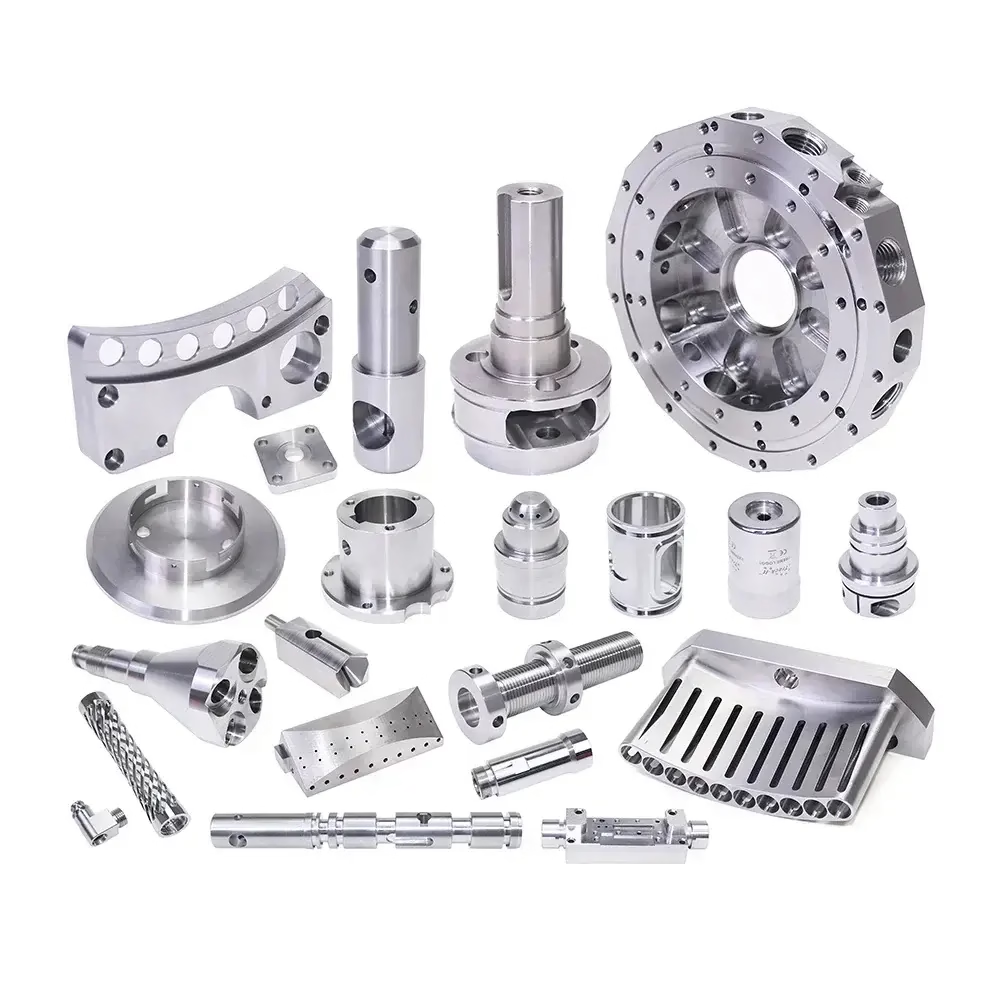
Why titanium resists the tool
Titanium conducts heat poorly. Its thermal conductivity is about a sixth of 6061 aluminum and roughly half of 4140 steel. Heat generated at the shear zone cannot escape into the chip or the workpiece fast enough, so it stays on the tool edge. Edge temperature climbs past 1,000 °C within seconds at aggressive feeds.
That trapped heat does two things. It softens the carbide binder and accelerates crater wear on the rake face, and it drives the titanium into a chemical reaction with the tool coating. Above roughly 600 °C, titanium readily absorbs oxygen, nitrogen, and hydrogen from the air and the coolant.
The practical result: a coated carbide insert that lasts four hours in 4140 may last forty minutes in Ti-6Al-4V at the same surface speed. Tool life is the cost driver, not machine time.
Which titanium grades behave well on a CNC
Commercially pure grades TA1 and TA2 (ASTM Grade 1 and Grade 2) machine closest to a tough stainless. They are soft, gummy, and prone to built-up edge, but they tolerate higher surface speeds and lighter fixtures. Good for chemical parts, brackets, and anything that needs corrosion resistance more than strength.
TC4, also written Ti-6Al-4V or ASTM Grade 5, is the workhorse. Alpha-beta structure, roughly 900 MPa yield, and a strong tendency to work-harden under a dull edge. It is the grade most engineers mean when they write 'titanium' on a drawing, and it is also the one that punishes a light finishing pass.
Beta alloys such as Ti-5553 and Ti-10V-2Fe-3Al push strength past 1,100 MPa but machine worse. They need lower surface speed, rigid setups, and more frequent insert changes. If the design does not require that strength, choosing a beta alloy costs money in the cut without a payoff.
Grade 7 and Grade 12 add palladium or nickel-molybdenum for crevice corrosion resistance in chlorides. They cut like Grade 2 with slightly better chip control, so the machining plan barely changes.
Deflection, chatter, and the thin-wall problem
Titanium has a low elastic modulus, about 110 GPa against 200 GPa for steel. A boring bar or end mill pushed through titanium bends twice as far for the same load. The tool digs in, releases, digs in again. That cycle is chatter, and it shows up as a rippled floor and a howling spindle.
Thin webs and ribs make it worse. A 0.8 mm wall on a titanium housing will deflect away from the cutter, so the finished thickness drifts and the surface tears. The usual fix is not a slower feed but a different support strategy: leave more stock, take lighter radial steps, and finish from both sides.
Tool runout matters more here than in aluminum. A 0.02 mm runout on a four-flute cutter means one flute does most of the cutting, and that flute burns out first. Indicating every holder before a titanium job is cheap insurance.
Cutting parameters that hold up in production
For Ti-6Al-4V with uncoated or AlTiN-coated carbide, surface speed usually lands between 40 and 60 m/min for roughing and 60 to 90 m/min for finishing. Feed per tooth runs 0.08 to 0.15 mm. Radial engagement stays low, often 6 to 10 percent of cutter diameter, so the heat leaves with the chip rather than soaking into the part.
High-pressure coolant through the tool is the single biggest lever. Directed at 70 bar or more, it breaks the chip, clears the heat, and stops the recut that dulls edges. Flood coolant alone is a compromise on deep pockets.
Climb milling is standard. Conventional milling on titanium rubs the edge before it cuts, which work-hardens the surface and makes the next pass harder than the last.
Roughing at full axial depth with a small radial step keeps the cutter engaged in a stable arc and reduces the number of entries into the material. Fewer entries means fewer chances to rub.
Where five-axis helps and where it does not
Five-axis motion helps titanium when it lets the tool approach a feature from a direction that keeps the cutter engaged and the chip thin. Impeller blades, medical bone plates with compound curvature, and aerospace brackets with angled bosses all benefit. One setup also removes the re-fixturing error that stacks up across three operations.
Five-axis does not fix a bad process. If the spindle lacks torque at low speed or the coolant pressure is low, tilting the table just changes the direction of the chatter. The machine is not the constraint; the thermal budget is.
For simple prismatic parts, a three-axis mill with a good vise and a rigid toolholder will outrun a five-axis center that is busy reorienting. Match the machine to the geometry, not to the brochure.
Titanium grade comparison for CNC work
Surface speed ranges assume coated carbide and high-pressure coolant.
| Grade | Typical use | Surface speed | Machining difficulty |
|---|---|---|---|
| TA1 / TA2 (Grade 1–2) | Chemical parts, brackets | 80–120 m/min | Low, gummy chips |
| TC4 (Ti-6Al-4V) | Aerospace, medical, motorsport | 40–90 m/min | Moderate to high |
| Grade 7 / Grade 12 | Chloride service, seawater | 70–100 m/min | Low to moderate |
| Ti-5553, Ti-10V-2Fe-3Al | High-strength airframe parts | 30–50 m/min | High, short tool life |
| Ti-6Al-4V ELI | Implant and surgical devices | 40–70 m/min | Moderate, clean finish needed |
The trade-off in one line
If the part is prismatic and strength is modest, choose a commercially pure grade and cut fast on a three-axis mill. If it carries load in service or has compound curvature, accept the slower speeds, specify TC4, and plan for five-axis plus through-tool coolant.
Questions engineers ask before quoting
Can titanium parts be machined to ±0.005 mm?
Yes, on the right features. We hold ±0.005 mm on bored holes, turned diameters, and ground faces where the setup is rigid and the wall is thick enough to resist deflection.
Long thin sections and unsupported webs are a different story. The elastic modulus of titanium means the part moves under the cutter, so we usually advise a realistic tolerance band on those features and finish them in a separate light pass.
What surface finish is realistic on Ti-6Al-4V?
As-machined finishing passes typically land at Ra 0.8–1.6 μm with a sharp, coated cutter and high-pressure coolant.
Ra 0.2–0.8 μm is achievable on sealing faces and bearing bores with a dedicated finish pass or a light abrasive step. It costs extra cycle time, so only call it out where the drawing needs it.
Does titanium need a post-machining heat treatment?
Usually not for TA1, TA2, or TC4 parts that were not heavily cold-worked. Stress relief may be needed after aggressive roughing on thin walls or on parts that will be welded later.
Beta alloys often require a solution treat and age to reach their rated strength. That step is normally done by a specialty heat treater, and it has to be planned into the route before the first cut.
Why does my titanium part come off the machine warped?
Most warping traces back to residual stress in the raw stock plus heat from the cut. Plate and bar carry internal stress from the mill, and removing material releases it unevenly.
Two fixes help. Rough with more stock, let the part rest, then finish in a second operation. And keep the coolant aimed at the cut so the part does not see the thermal cycling that drives distortion.
Is titanium machining more expensive than stainless?
The machine hour rate is similar, but cycle time and tool consumption are higher. Expect two to four times the cutting time of 316 stainless on the same geometry, plus more inserts per part.
The gap narrows when the titanium part replaces a stainless part that would have needed plating or a heavier wall to survive corrosion.
Which titanium parts should not be CNC machined?
Very large, simple panels and housings are often cheaper as sheet metal or casting, with CNC only on the critical interfaces.
Parts with deep internal channels that no end mill can reach are better served by additive manufacturing plus finish machining on the mating surfaces.
Send us the titanium drawing
We review geometry, grade, and tolerance together and reply with a quotation and a free DFM analysis within 12 hours.
12-hour quote100% inspectionNDA on request
More titanium and CNC process notes
We publish setup notes, tooling trials and inspection data from the factory floor.











