
Chinese Bulk CNC Machining Services Suppliers: A Buyer's Framework
This page is for engineers and procurement teams who need thousands of identical machined parts from a Chinese supplier, not just one prototype. It covers what to inspect during a shop audit, how tolerance drift happens across a production run, and which certifications actually change how a plant runs. Read this before you send an RFQ.
What separates a reliable bulk supplier from a cheap one
A framework for evaluating Chinese bulk CNC machining suppliers, written for people who will live with the parts long after the invoice is paid.
Why bulk doesn't automatically mean looser tolerances
A common assumption is that ordering 10,000 parts forces you to accept worse tolerances than ordering ten. That is not how a well-run plant works. Repetition is what makes precision repeatable, provided the process is locked down. On a single prototype, an operator can babysit the cut and hit ±0.005 mm by hand. At volume, nobody is watching every part, so the machine, the tooling, and the fixture have to hold the tolerance on their own.
The enemy at volume is drift. A carbide end mill wears maybe 0.02 mm over its life. Spindle and coolant temperatures swing through the shift. Chips pile up in a pocket and change the cutting load. None of this matters on part one. By part 4,000, it decides whether your bore is still in spec. Good plants compensate with tool-wear offsets, scheduled tool changes, and in-process probing rather than waiting for the final inspection to catch a problem.
So the right question is not whether a shop can cut metal accurately. It is whether their process holds accuracy without anyone touching the machine. Ask how they detect drift, how often they re-qualify a fixture, and what happens when a measurement trends toward the limit. The answers tell you more than any equipment list.
- 1First-article vs. thousandth partAsk to see measurement data from the last part of a run, not just the first.
- 2Tool life managementWorn tools are the main source of slow dimensional drift on long runs.
- 3In-process probingProbing on the machine catches trend before a batch goes out of spec.
- 4Thermal stabilitySpindle and coolant temperature control matters on tight-tolerance runs.
Reading a factory: what the floor tells you about capacity
Brochures list machine counts. The floor shows how those machines are used. When you audit a plant, look at how many spindles are actually running, how parts move between operations, and whether work-in-progress sits in labeled trays or piles. A shop with 127 machines but half of them idle may be between jobs, or it may be short on operators. Both change your lead time.
Machine mix matters as much as machine count. A plant with only three-axis mills will struggle with parts that need five-axis simultaneous cutting or mill-turn work, and you will see them farm the job out. Look for a balanced fleet: simultaneous five-axis centers for complex geometry, four-axis mills for multi-face work, mill-turn centers for parts that combine turning and milling, and wire or mirror-spark EDM for sharp internal corners and hardened material.
Size range is the other constraint. A shop that tops out at 500 mm will not help you with a 4,000 mm frame. Before you commit, confirm the travel envelope against your largest part, plus the fixture allowance. A Ø400 mm rotary table opens up work that a plain three-axis table cannot reach in one setup.
- 1Five-axis simultaneousUseful for contoured surfaces and parts that need fewer setups.
- 2Mill-turn centersBest for parts that need both turning and milling in one cycle.
- 3Wire and spark EDMHandles sharp internal corners and hardened tool steel.
- 4Travel envelopeConfirm max part size plus fixture space before quoting.
Capacity signals to check during a supplier audit
What to look at, and what each signal actually tells you.
| What to check | Good sign | Warning sign |
|---|---|---|
| Spindle utilization | Most machines running on scheduled jobs | Rows of idle machines, no clear schedule |
| Machine mix | Five-axis, mill-turn, and EDM in one plant | Only three-axis mills, no EDM |
| Max part size | Travel covers your part with fixture room | Your part sits at the edge of the envelope |
| Work-in-progress | Labeled trays with traveler documents | Unmarked bins, parts mixed by job |
| Inspection area | CMM and gauges near the machines | Inspection room far from the floor |
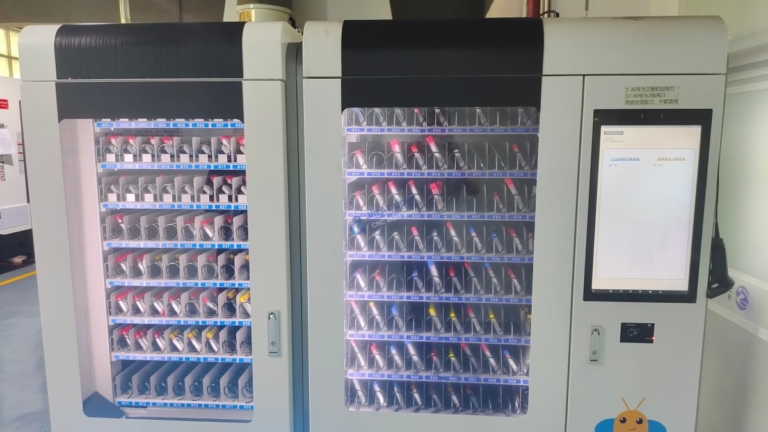
| Tool crib | Tracked tool life and regrind records | Loose tooling, no wear logs |
Certifications that change how a plant runs
Every supplier claims ISO 9001. Fewer hold IATF 16949, which is specific to automotive and forces tighter control over process changes, traceability, and corrective action. If your parts go into a vehicle or an EV battery pack, that difference is not paperwork. It shows up in how they handle a non-conformance and whether they can trace a batch back to the raw material lot.
For medical devices, ISO 13485 changes the rules again. It requires documented process validation, clean handling where relevant, and a complaint and CAPA system that survives an audit. A shop that holds it has already built the record-keeping you will need for your own regulatory file. ISO 27001 is less common in machining, but it matters when your drawings and CAD files are the crown jewels. It covers how the supplier stores and transmits your data.
The test is not whether the certificate hangs on the wall. It is whether the system behind it is alive. Ask to see a recent internal audit, a corrective action report, and a material certificate from a job similar to yours. A plant that can produce those in minutes is running a real system. One that has to go find someone is not.
- 1ISO 9001:2015The baseline. Confirms a documented quality system exists.
- 2IATF 16949:2016Automotive-grade control over changes, traceability, and CAPA.
- 3ISO 13485:2016Medical device process validation and record keeping.
- 4ISO 27001:2022Protects your drawings and CAD data through the supply chain.
Where hidden cost and real engineering support live
The lowest unit price is often the most expensive quote. A shop that underbids may skip the fixture, run the part on a general-purpose vise, and let the operator chase dimensions. You pay for that later in rework, sorting, and line stoppages. When comparing quotes, look past the number to what is included: material certification, first-article inspection report, and whether finishing is done in-house or subcontracted.
Engineering support is the quiet differentiator. A supplier that offers free DFM analysis before cutting metal can flag a wall too thin to hold, a corner a tool cannot reach, or a tolerance that adds cost without adding function. That feedback, delivered with the quote, saves a revision cycle. It also tells you whether the shop is reading your drawing or just pricing it.
For long runs, the relationship matters more than the transaction. A supplier who knows your part family can suggest a fixture that cuts cycle time, or a material substitute that meets the spec for less. That only happens when the same engineers stay on your account. Ask how they assign project engineers and whether you will talk to the same person next quarter.
Finally, confidentiality. Your drawings are your IP. Confirm how files are stored, who can access them, and whether an NDA is available before you upload anything. Secure uploads and a signed NDA are basic hygiene, not a favor.
- 1Quote scopeCheck whether inspection reports and material certs are included.
- 2DFM feedbackA useful supplier flags manufacturability issues before cutting.
- 3Account continuityAsk who your engineer will be next quarter.
- 4Data handlingConfirm storage, access control, and NDA before upload.
Questions engineers ask before committing to a bulk run
How do I know a supplier can hold ±0.005 mm across 10,000 parts?
Ask for measurement data from a completed high-volume job, not a sample. Look at the spread across the run, not just the first article. A supplier with real process control will show trend charts, tool-life records, and in-process probe data.
Also ask what happens when a measurement drifts toward the limit. If the answer is a defined offset or tool change, the process is controlled. If it is a rework plan, the process is reactive.
What is the minimum order quantity for bulk CNC machining in China?
It varies by supplier. Some set MOQs in the thousands, which makes prototype validation awkward. Others have no minimum and will run from one part to 10,000 or more on the same process.
If you need to validate a design before committing to volume, pick a supplier that runs both. That way the prototype and the production parts come off comparable processes, and your validation actually means something.
Which certifications actually matter for my industry?
ISO 9001 is the floor and applies everywhere. For automotive and EV work, IATF 16949 adds change control and traceability that your own quality system may require. For medical devices, ISO 13485 is often necessary for your regulatory file.
If your drawings are sensitive, ISO 27001 covers information security. Match the certification to your end market, not to a generic checklist.
How do I compare quotes that look different in scope?
Break each quote into material, machining, finishing, and inspection. Check whether first-article inspection and material certificates are included or billed separately. Confirm whether finishing is in-house or subcontracted, since that affects lead time and accountability.
A quote that is 20 percent lower often excludes something you will pay for later. Normalize the scope before you compare the numbers.
What lead time should I expect for a bulk order?
It depends on part complexity, material availability, and finishing. A supplier running a straightforward aluminum part may ship in days once production starts. A part that needs special material or multi-step finishing will take longer.
Ask for a process plan with milestones, not a single delivery date. That shows whether the supplier has actually planned the run.
How do I protect my design when outsourcing to China?
Use secure file transfer, not email attachments. Confirm who inside the supplier can access your drawings. Sign an NDA before you upload anything, and check whether the supplier holds an information security certification.
These steps are standard. A supplier that resists them is telling you something about how they handle everything else.
Send your drawing and get an engineering review, not just a price
We reply with a quote and a free DFM analysis within 12 hours, and we run from one prototype to 10,000+ parts on the same process.
12-hour quote and DFM100% inspection before shipmentNo minimum order quantityNDA available on request









