
Cheap Price Custom CNC Machining: Where the Cost Actually Comes From
This page is for engineers and buyers comparing quotes on custom machined parts. It breaks a quote into the cost drivers you control and the ones you cannot, so you can tell a lean process from a risky one before you place the order.
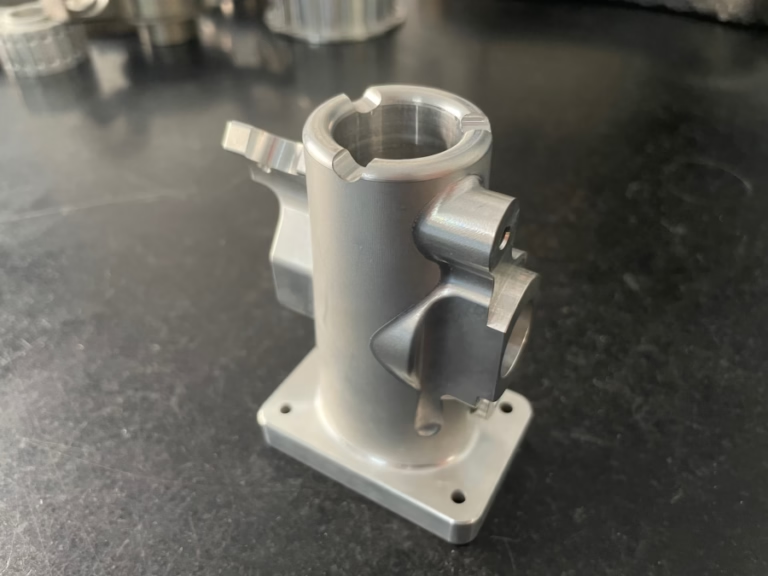
What makes a custom CNC part cheap, and what makes it expensive
A low unit price is the result of a design and a process that fit each other. Nothing else.
Seven cost drivers behind every custom CNC quote
Every quote we send out is a sum of the same few items: material, setup, machine time, tooling wear, finishing, inspection, and overhead. Setup is a fixed cost spread over the order quantity, so it dominates on one-off parts and almost disappears at 500 pieces. Machine time scales with the volume of metal you remove, not with the size of the part. A small bracket with deep pockets can cost more than a larger plate with simple contours.
Material is the line item people misread most often. The price per kilogram matters, but so does how the alloy behaves on the machine. Free-machining 6061-T6 cuts fast and holds tolerance; 316L stainless work-hardens, so you pay for slower passes and more tool changes. Choosing a material 20 percent cheaper per kilogram can raise the total by 30 percent if it machines badly.
Setup and fixturing show up twice: once in the programming hours and once in the physical workholding. A part with a flat face and two datum holes can sit in a standard vise. A part with no parallel faces needs soft jaws or a custom fixture, and that fixture may cost more than the parts themselves at low volume.
Inspection is the driver buyers try to cut first. We inspect 100 percent of parts before shipment, and the reports are available on request. For a non-critical spacer, a caliper check is enough. For a mating face held to ±0.005 mm, you need a CMM and the time it takes to run. Skipping that step does not remove the cost. It moves the cost to your assembly line.
- 1QuantitySetup amortizes; material and cycle time do not
- 2GeometryDeep pockets, thin walls and 3D contours add cycle time
- 3ToleranceTighter than ±0.025 mm needs more passes and more checks
- 4FinishAnodizing and plating are priced per batch, not per part
Which design choices lower the price without lowering quality
The cheapest change is usually a tolerance change. If a bore does not mate with anything, holding it to ±0.05 mm instead of ±0.01 mm removes a finishing pass and a CMM check. We flag these in the DFM report and let you decide. Nothing gets loosened without your sign-off.
Corner radii are the second lever. A pocket with a 1 mm internal corner needs a small cutter run at low feed, and small cutters break. Open it to 3 mm and the same pocket can be cut with a stiffer tool at three times the feed. The part works the same. The cycle time does not.
Wall thickness matters on thin parts. A 0.8 mm aluminum wall will deflect under normal clamping pressure, so it needs light passes, support material, or a different process. Moving that wall to 1.5 mm often cuts the cycle time in half. Where the thin wall is functional, we plan around it instead of quoting a low number we cannot hit.
One more item is finishing. Anodizing, plating and powder coating are batch processes. If you can accept the as-machined finish of Ra 1.6–3.2 μm on hidden surfaces and specify Ra 0.8–1.6 μm only on the sealing face, the finishing cost drops without touching function.
If the part does not need to be metal at all, say so. POM, PEEK or ABS can replace aluminum on covers, jigs and housings, and they cut faster with no finishing step.
- 1Relax non-critical tolerancesRemoves passes and inspection time
- 2Use standard corner radiiLarger cutters run faster and last longer
- 3Keep walls above 1.5 mmLess deflection means fewer light passes
- 4Machine only the faces that sealFinishing is priced per batch
When a cheap price custom CNC quote is a good sign, and when it is not
A low quote is a good sign when it comes with a DFM report that explains the number. That tells you the supplier read your files, found the easy path, and is willing to show the reasoning. We send quotation and free DFM analysis within 12 hours, and production can start within 24 hours after you approve.
A low quote is a warning sign when it arrives without any notes on your drawing. Either the parts were not fully reviewed, or the price assumes a tolerance the shop cannot hold. Both cases end with a phone call after the parts are made, and that call is always more expensive than the first quote.
Capacity is the other signal. A shop that runs everything through subcontractors has less control over scheduling and adds margin at each step. Our 127 machines, including 16 simultaneous 5-axis centers and 16 mill-turn centers, sit in three plants we own. That is why we can quote a competitive price without padding for outside vendors.
The process should match the part. A simple turned bushing belongs on a lathe, not a 5-axis mill. A housing with angled ports and intersecting bores is the opposite case. Quoting the wrong process is the most common reason one supplier comes in far below the others.
Finally, ask what happens when a dimension drifts. A shop with in-process monitoring catches it during the run. A shop that inspects only at the end ships the whole batch or scraps it. Our qualification rate is 99.99 percent, and that number comes from checking during the cut, not after.
- 1Good signLow price plus a written DFM report
- 2Warning signLow price with no comments on the drawing
- 3Good signProcess chosen for the part geometry
- 4Warning signPrice far below the rest of the field
How order size changes the price per part
At one piece, you are buying setup time. At 100 pieces, you are buying machine time. At 10,000 pieces, you are buying material and a little bit of everything else. This is why the same drawing can come back at wildly different unit prices from two shops, depending on what they assumed about quantity.
We have no minimum order quantity. A single prototype and a 10,000-part run go through the same planning step, because a prototype that cannot be produced at volume is not much use. If you expect to scale, tell us the target quantity when you request the quote. The DFM notes change.
For runs above a few thousand pieces, it is sometimes worth cutting a soft jaw set or a dedicated fixture. The fixture adds cost once, then removes setup time from every part after it. On a part with complex geometry, that pays back within a few hundred pieces.
Batch size also matters inside a run. Splitting 10,000 parts into four batches of 2,500 lets you inspect the first batch before the rest are cut, at the cost of three extra setups. For tight-tolerance work, that is usually the right trade.
- 11–10 partsSetup and programming dominate the price
- 2100–1,000 partsCycle time and material take over
- 310,000+ partsFixturing and batch planning decide the price
Material choice and its effect on machining cost
Material cost is not the same as material price. The table below shows how common alloys compare on machinability, which drives cycle time more than the invoice from the metal supplier.
Aluminum 6061-T6 is the default for a reason. It cuts fast, holds tolerance, and takes anodizing well. Where you need more strength, 7075 machines almost as well but costs more per kilogram and is less weldable. Where you need corrosion resistance, 5052 and 5083 are the marine choices, though both are gummier on the cutter.
Stainless is where budgets move. Grade 303 is the free-machining option and the cheapest to cut, but it is not suitable for welding. Grade 304 and 316L are stronger and more corrosion resistant, and both work-harden, so feeds must stay aggressive. Grade 17-4PH adds heat treatment and a second setup.
Titanium and Inconel sit at the top. Ti-6Al-4V needs low cutting speeds, high coolant pressure and sharp tooling, and Inconel is worse. Use them when the application demands the properties, not when the drawing simply lists them. Plastics cut fast but need care on clamping and chip evacuation, since they melt and scratch easily.
- 16061-T6Best balance of speed, strength and finish
- 2303 stainlessFree-machining, but not weldable
- 3316LCorrosion resistant, work-hardens, slower
- 4Ti-6Al-4VLow speeds, high tool wear, use only if needed
Machinability and typical use by material
Rough guide for early cost estimating. Confirm with a DFM review before release.
| Material | Machinability | Typical use | Cost impact |
|---|---|---|---|
| 6061-T6 aluminum | Excellent | Brackets, housings, jigs | Baseline |
| 7075 aluminum | Good | Aerospace structures, molds | +10–20% vs 6061 |
| 303 stainless | Very good | Shafts, fittings, spacers | +40–60% |
| 304 / 316L stainless | Moderate | Food, medical, marine parts | +60–90% |
| 17-4PH stainless | Moderate | High-strength shafts, valves | +90–130% |
| Ti-6Al-4V | Poor | Aerospace, implants | +200–350% |
| POM / PEEK | Excellent | Insulators, wear parts | Often below aluminum |
Common questions about cheap price custom CNC work
How can a quote be lower than everyone else's?
Usually one of three reasons: the shop found a simpler process, it is running the part on the right machine instead of a general-purpose one, or it has not finished reading the drawing.
The first two are good news. The third shows up later as a price change or a rejected batch. Ask for the DFM notes and you will know which one you are looking at.
Does a lower tolerance always cost more?
Not always, but tight tolerances on features that do not need them are the most common source of avoidable cost. A ±0.005 mm bore requires a finishing pass, a temperature-stable setup and a CMM check.
If that bore is a clearance hole, ±0.05 mm does the same job. We mark every over-specified tolerance in the DFM report and leave the decision to you.
Is there a minimum order quantity?
No minimum order quantity. We machine from one prototype to 10,000+ part runs.
Unit price still depends on quantity, because setup is spread over the batch. A single part and a 500-part run will never share the same unit price.
What lead time should I expect?
Quotation and free DFM analysis come back within 12 hours. Production can start within 24 hours after approval, and parts ship in 3–5 days.
The historical late-delivery probability is below 2 percent. Exact dates depend on material availability and finishing, and we confirm them in writing before the run starts.
How do you keep my drawings confidential?
Uploads are secure and confidential. An NDA is available on request before you send any files.
We hold ISO 27001:2022 for information security, alongside ISO 9001:2015, IATF 16949:2016 and ISO 13485:2016 for quality and medical work.
Can you take a part that was designed for another process?
Yes, and it is often where the biggest saving sits. Parts designed for casting or welding frequently have features that are slow to machine.
Send the original files and the target quantity. We will return a DFM report listing the changes that reduce cycle time without changing function.
Send the drawing and get a number you can check
Upload your files and we will return a quotation with a free DFM analysis within 12 hours. No minimum order quantity, 100 percent inspection before shipment, and an NDA available on request.
12-hour quoteFree DFM analysisNo MOQ100% inspection









