
Cheap Price Precision CNC Machining Services
This page explains where the cost of a precision machined part actually comes from, and which levers pull the unit price down without moving the tolerance. It is written for engineers and buyers comparing quotes on the same drawing. After reading it you can tell a genuinely efficient quote from one that hides risk.
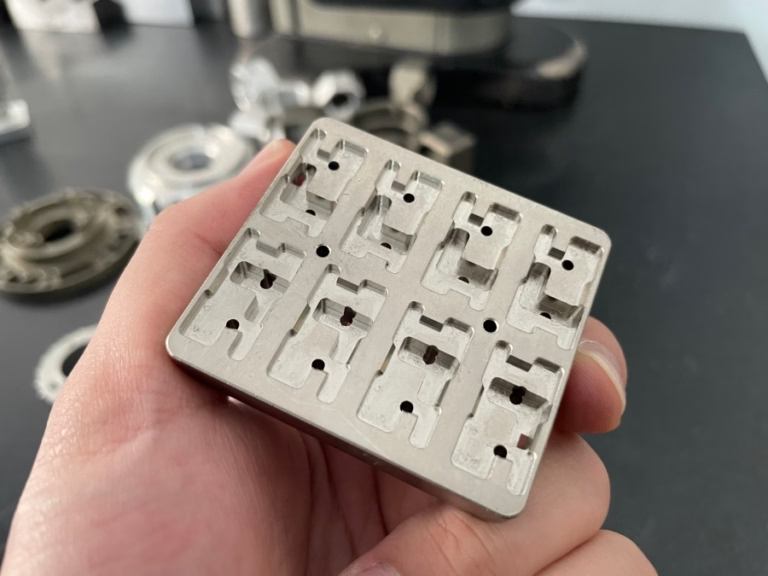
What Makes a Precision Part Cheap
Price is a process result. Change the process and the number moves.
Where the Money in a Quote Actually Goes
A machined part has four cost lines: setup, machine time, material, and inspection. Setup is fixed per operation, so it hurts small quantities and disappears at volume. Machine time scales with the volume of metal you remove and the number of setups. Material scales with stock size and the scrap you generate. Inspection scales with the tolerance and the feature count.
When someone quotes far below everyone else on a tight-tolerance part, one of those four lines was cut. Usually it is inspection, sometimes it is setup count. A shop that skips a second setup may hold the bore position on the first fifty parts and lose it on part two hundred, once the operator has to re-chuck by hand.
The floor on price is not a mystery number. It is the sum of the four lines at the efficiency the shop can actually reach. Two shops with identical machines can land 25% apart simply because one runs lights-out and the other does not.
- 1SetupCharged per operation; dominates one-off work
- 2Machine timeDriven by metal removed and setup count
- 3MaterialStock size plus scrap rate
- 4InspectionScales with tolerance and feature count
Five Axes Usually Cost Less Than Three Setups
Engineers often assume more axes means a higher price. On a part with features on four faces, the opposite is true. A 3-axis machine needs four fixtures and four setups; each setup adds a re-clamp, an operator hour, and a stack of positional error. A simultaneous 5-axis center reaches those faces in one operation from one datum.
We run 16 simultaneous 5-axis machining centers alongside 27 three-axis machines and 12 four-axis mills. The choice is made per part, not by default. Five axes win when the part has compound angles, deep pockets reachable only from an angle, or a positional tolerance tighter than about ±0.02 mm across faces.
Three axes win on flat plates, simple housings, and anything with one dominant face. On that geometry a 3-axis machine with a good fixture is faster and cheaper, and the tolerance is easier to hold because the part never moves.
The rule we use: count the setups first, then pick the machine. If the extra axes remove a setup, they cut cost. If they only remove a few minutes of cycle time, they add cost.
- 1Use 5-axisMultiple faces, compound angles, one datum
- 2Use 3-axisFlat plates, single-face parts, simple fixtures
- 3Watch forEach setup adds re-clamp error and labor
Drawing Details That Move the Price Most
Tolerance is the single biggest lever. A blanket ±0.005 mm callout on a part that only needs it in two places forces the shop to inspect everything to that band. Tighten the features that function and relax the rest. A bracket with one tight bore and a loose profile can drop a whole inspection step.
Corner radii matter more than people expect. A pocket with an internal radius of 1 mm requires a small cutter, which means low feed, more passes, and a higher chance of tool deflection. Opening that radius to 3 mm lets a stiffer tool run at full depth. Same part, shorter cycle, same function.
Thread depth, deep holes, and surface finish callouts behave the same way. A Ra 0.2–0.8 μm finish needs a separate finishing pass or a polishing step. If the drawing only needs Ra 1.6–3.2 μm, that pass disappears. Ask what the surface actually does before you specify it.
Material choice is the last big lever. 6061 aluminium machines fast and is cheap as stock. 316L stainless costs more per kilo and takes roughly twice the cycle time. Titanium TC4 (Ti-6Al-4V) costs more again and shortens tool life. Pick the cheapest alloy that survives the load and the environment.
- 1Blanket toleranceInspects everything to the tightest band
- 2Small internal radiiForces small cutters and slow feed
- 3Finish calloutsRa 0.2–0.8 μm adds a separate pass
- 4Alloy choice316L and TC4 cost multiples of 6061
Cycle Time and Cost Signals by Material and Feature
Relative figures, same part geometry, single setup.
| Material or feature | Relative machine time | Watch for |
|---|---|---|
| 6061-T6 aluminium | 1.0× (baseline) | Best cost-to-strength for most housings |
| 303 stainless | 1.6–1.8× | Free-machining grade, good for shafts |
| 316L stainless | 2.0–2.4× | Galling risk, needs sharp tooling |
| TC4 titanium | 3.0–4.0× | Heat at the cut, short tool life |
| Tolerance ±0.005 mm | Adds inspection | 100% inspection, reports on request |
| Internal radius under 1 mm | 1.5–2× on that pocket | Small cutter, low feed, deflection |
| Ra 0.2–0.8 μm finish | Adds a finishing pass | Only call it where it functions |
| Deep hole over 5× Ø | 2–3× on that feature | Peck drilling, chip evacuation |
How to Read a Quote That Looks Too Low
A low number is not automatically a bad sign. Three legitimate reasons exist: the shop owns the right machine for your geometry, it buys material in volume, or it has run a nearly identical part before and the program already exists. Those are real savings and they should show up in the price.
The warning signs are different. A quote with no setup line usually means setup is buried in the piece price, which penalizes you on reorders. A quote that does not mention inspection means you should ask who checks the parts and with what. A quote that arrives in an hour with no questions about the drawing means nobody read the drawing yet.
Ask two questions before you release a purchase order. Which machine will run this, and how many setups does it take? A shop that answers both in a sentence knows your part. A shop that answers vaguely is pricing a guess.
We send quotation and a free DFM analysis within 12 hours. That analysis lists the features we would change and the estimated saving on each. You can accept or ignore it; the price stands either way. Production can start within 24 hours of approval, and parts ship in 3–5 days.
- 1Normal low bidRight machine, volume material, existing program
- 2Red flagNo setup line, no inspection mention
- 3AskWhich machine, how many setups
Why In-House Capacity Keeps the Price Down
Outsourcing adds a margin at every handoff. When a shop sends parts out for anodizing, heat treat, or a second operation, the subcontractor marks it up and the schedule becomes someone else's problem. We keep machining, finishing, and inspection inside three wholly-owned plants covering 7,600 m² in Dongguan.
Machine count is the other half of it. With 127 high-precision CNC machines, a job does not wait for a slot. That matters for price because idle time between operations is paid for somewhere, usually in the quote. Spreading fixed cost across more spindle hours is the plainest way to lower unit price.
Tooling and fixtures are made in-house as well. A dedicated fixture that costs a few hundred dollars is worth building when it removes a setup from a 500-piece run. On a one-off prototype we skip it and eat the setup cost instead.
None of this changes the tolerance. We hold ±0.005 mm (±0.0002 in) on the features that need it and inspect 100% of parts before shipment, with raw material checks, in-process monitoring, and a final report on request.
- 13 plantsMachining, finishing, inspection in-house
- 2127 machinesLess waiting between operations
- 3In-house fixturesWorth building above a few hundred pieces
Questions Engineers Ask About Price and Precision
Can a low price really hold ±0.005 mm?
Yes, if the shop owns the right machine and inspects the parts. Tolerance is a capability question, not a price question. A 5-axis center in good condition holds ±0.005 mm on a well-fixtured part all day.
The risk is not the machine, it is the missing inspection step. Ask whether every part is measured before shipment and whether you can get the report. We inspect 100% of parts and supply reports on request.
What order quantity makes the unit price drop?
The first drop comes when setup is spread over more pieces, usually somewhere between 10 and 50 parts depending on setup count. The second drop comes when it is worth building a dedicated fixture, often around 200 to 500 pieces.
There is no minimum order quantity here. We run from one prototype to 10,000+ part runs, so you can price the same drawing at two quantities and see the curve.
Do I pay more if I ask for a DFM review?
No. Quotation and free DFM analysis come back within 12 hours, and the review is part of the quote.
The review names the features that raise cost, such as a blanket tolerance or a 1 mm internal radius, and gives an estimated saving for each change. You decide which ones to apply.
Which materials keep cost down without losing strength?
6061-T6 aluminium is the default for housings and brackets: fast to cut, stable, and cheap as stock. 303 stainless is the free-machining choice for shafts and fittings.
Step up only when the environment demands it. 316L for corrosion, TC4 titanium for strength-to-weight, 17-4PH where you need hardness after heat treat. Each step roughly doubles or triples machine time.
How fast can parts ship after I approve the quote?
Production can start within 24 hours of approval. Standard parts ship in 3–5 days.
Our historical late-delivery probability is below 2%. If a feature needs a fixture or a special tool, the DFM review will flag it before you commit.
Will you sign an NDA before I send drawings?
Yes. Uploads are secure and confidential, and an NDA is available on request. We are certified to ISO 27001:2022 for information security.
If your program requires it, tell us at the quote stage and we will have the document in place before any file moves.
Price the Same Drawing Two Ways
Send the file and get a quote plus a free DFM analysis within 12 hours. No minimum order quantity, 100% inspection before shipment.
12-hour quote±0.005 mm100% inspection









