
Buy Brass CNC Machining: How to Choose a Producer
This page is for engineers and sourcing staff who need brass parts turned or milled to tight limits. It covers which brass grades behave well on a CNC, where the process goes wrong, and what to ask before you buy brass CNC machining from any supplier.
What Actually Decides the Quality of a Brass Part
Brass is easy to cut and hard to hold. The second part is where most suppliers lose the job.
Not All Brass Machines the Same Way
Brass is a family, not a single material. Free-machining grade C36000 carries 2.5–3.7% lead, which acts as a chip breaker. Chips come off short and clean, so you can run high feed rates and hold size on a long production run. That is the grade most turning shops keep on the shelf, and it is usually the cheapest per part at volume.
C27400 and C28000 sit at the other end. They have no lead, or very little, so chips string out and tools load up. Cutting forces rise, heat goes into the part instead of the chip, and the workpiece moves. A shop that quotes C36000 rates for a C27400 job is guessing. Ask which grade the quote is based on and whether the shop has run it before.
The choice is driven by the end use, not by machinability. Drinking-water fittings and food equipment push you toward lead-free grades. Electrical contacts and connectors often want higher conductivity, which points to C101 or C110 copper rather than a true brass. Bushings and wear parts may run C93200 bearing bronze. Bring the drawing and the operating conditions, and we will tell you which one cuts cleanest for your geometry.
Holding ±0.005 mm in Soft Material
Brass is roughly three times more thermally expansive than steel and much softer. Both facts work against you on a tight-tolerance part. A 50 mm brass shaft grows about 0.019 mm for every 10 °C it warms up. If the shop measures hot parts against a cold gauge, the number on the inspection report will not match what the customer sees at 20 °C.
The fix is process discipline, not a better machine alone. Rough the part, let it cool, then take the finishing pass. Use light depth of cut and sharp, polished tooling with high rake angles. Keep coolant flowing to carry heat away from the workpiece. Support thin walls with soft jaws or a pot chuck rather than clamping hard on a finished surface.
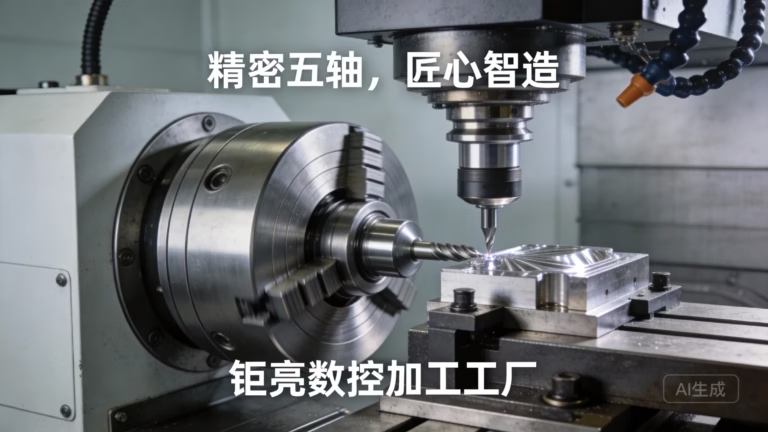
GreatLight runs 127 high-precision CNC machines, including 16 simultaneous 5-axis centers, 16 mill-turn centers and 12 four-axis mills. For brass work the mill-turn cells matter most: turning, milling, cross-drilling and parting happen in one setup, so concentricity is set by the machine rather than by a second fixture. Fewer setups means fewer chances for a soft material to shift.
We hold ±0.005 mm (±0.0002 in) on brass when the geometry allows it. Some features will not. A 0.4 mm wide, 12 mm deep slot in soft brass will deflect no matter who cuts it. When that happens we say so at the DFM stage and propose a change instead of quoting a number we cannot repeat.
Common Brass and Copper Grades for CNC Work
Match the grade to the function first, then to the machining plan.
| Grade | Typical use | Machining note |
|---|---|---|
| C36000 | Fittings, valves, high-volume turned parts | Best chip control; highest safe feed rates |
| C27400 / C28000 | Lead-free plumbing, decorative hardware | Stringy chips; needs peck cycles and coolant |
| C101 / C110 | Bus bars, contacts, RF shielding | Gummy; sharp tools and light radial DOC |
| Beryllium copper | Spring contacts, non-sparking tools | Machines well; dust control required |
| C93200 bronze | Bushings, bearings, wear plates | Abrasive to tooling; expect shorter tool life |
Surface Finish, Tarnish and Final Checks
Freshly cut brass tarnishes within days in humid air. For decorative parts or any component that sits in storage before assembly, plan the finish at the same time you plan the machining. Vibratory finishing and tumbling knock down burrs and produce a uniform satin look. Bead blasting gives a matte surface that hides tool marks. Polishing gets you to a mirror finish on visible faces.
Plating is common on brass because it solves two problems at once: appearance and corrosion. Electroless nickel adds wear resistance and a consistent gray tone. Silver and gold plating serve electrical contacts. Clear lacquer holds a polished look but scratches. Each of these changes the dimensions slightly, so call out which surfaces are critical and which are cosmetic. A 5 μm nickel layer on a Ø6.000 mm pin makes it Ø6.010 mm.
Inspection is where a low quote usually shows its seams. Every brass part should get a raw material check, in-process monitoring and a final inspection before shipment, with reports available on request. For safety-related or regulated parts, ask for the actual measurement data, not a pass stamp. We inspect 100% of parts before shipment and hold a 99.99% qualification rate across production.
GreatLight holds ISO 9001:2015, IATF 16949:2016, ISO 13485:2016 and ISO 27001:2022. The last one matters more than people expect: it covers how your drawings and CAD files are stored and who can open them. Uploads are secure and confidential, and an NDA is available on request.
Where the Money Goes on a Brass Job
Bar stock is a large share of the part cost on a brass job, larger than on steel or aluminum. That makes stock size and remnant strategy worth a conversation. A part turned from Ø25 mm bar when Ø22 mm would do wastes material on every piece. Nesting several parts across one bar, or running them on a bar feeder, changes the unit price at volume.
Cycle time is the other lever. Brass cuts fast, so the machine often spends more time loading and gauging than cutting. Mill-turn centers cut that overhead. So does scheduling: family grouping small lots of the same alloy reduces changeover and tool reset time.
Tool life behaves differently in brass. Free-machining grades are easy on carbide, but bronze and beryllium copper are abrasive. A supplier who tracks tool wear per alloy can quote a realistic price. One who applies a single rate to every copper-based material will either lose money or cut corners.
We do not set a minimum order quantity. One prototype or a 10,000-piece run both go through the same process. Quotation and a free DFM analysis come back within 12 hours, production can start within 24 hours, and parts ship in 3–5 days. For brass specifically, lead-free grades sometimes need to be ordered in, so mention the grade early.
The 3 plants cover 7,600 m² with 150 technicians, and the largest travel is 4,000 × 400 × 150 mm. Most brass work fits well inside that envelope. Long slender shafts and thin-wall bushings are the cases that need a fixture discussion before quoting.
Questions Engineers Ask Before Ordering
Can you machine lead-free brass to the same tolerance as C36000?
Yes, with changes to the process. Lead-free grades produce longer chips and higher cutting forces, so we reduce depth of cut, add peck cycles and keep coolant on the cut. Tolerance capability stays at ±0.005 mm on features that are not thin-walled.
The cost difference comes from slower cycle times and more frequent tool changes, not from a different tolerance class.
What surface finish can I expect straight off the machine?
As-machined brass typically lands in the Ra 1.6–3.2 μm range. With a finishing pass and sharp tooling we reach Ra 0.8–1.6 μm, and down to Ra 0.2–0.8 μm on turned faces where the geometry allows it.
Bead blasting, tumbling or polishing can replace or follow the cutting pass, depending on whether you need a functional or cosmetic surface.
How do you stop brass parts from tarnishing before they reach us?
Parts are cleaned and packed with a vapor-phase corrosion inhibitor, and we can apply a clear lacquer or a plated finish if the parts will sit in storage for months.
Tell us the shelf life you need and whether the parts will be handled during assembly. Both affect the finish choice.
Do you machine brass prototypes as well as production runs?
Both, from a single part upward, with no minimum order quantity. Prototypes usually run on the same machines as production so the process carries over without a re-qualification step.
If the design is still moving, rapid prototyping services can produce a fit-check part before you commit to a production fixture.
Which files do you need for a brass machining quote?
A 3D model (STEP or IGES) plus a 2D drawing with tolerances, material grade and finish callouts. The drawing carries the information the model cannot: datums, critical dimensions and surface requirements.
Uploads are secure and confidential. An NDA can be signed before you send anything.
Can you combine brass machining with assembly or other processes?
Yes. Press-fit inserts, threaded components and small sub-assemblies can be handled in-house, along with die casting, sheet metal and surface finishing.
Keeping the steps under one roof removes the shipping and re-inspection cycles that come with splitting a job across vendors.
Send a Brass Drawing and Get a Real Number
A quotation and free DFM analysis within 12 hours, with the grade and finish you actually need.
12-hour quote100% inspectionNDA on request









