
Automotive Parts Magnesium Die Casting: Where the Process Fits
This page explains how magnesium die casting is used for automotive parts, which alloys and wall sections work, and where the process stops making sense. It is written for design engineers and sourcing teams who need to pick a process and defend the choice.
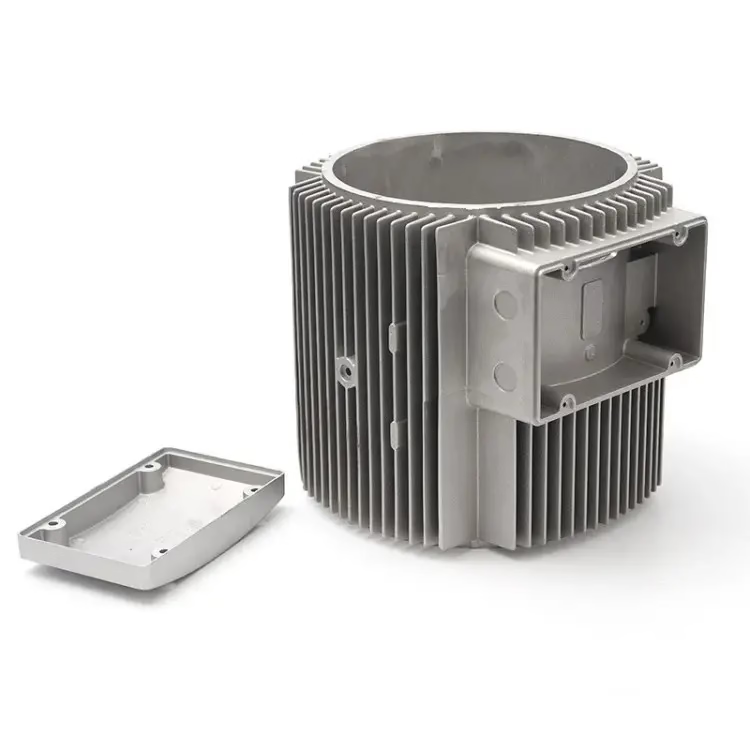
What this page covers
Magnesium die casting is a hot-chamber or cold-chamber process, and the choice between it and aluminum usually comes down to wall thickness, stiffness and volume.
How magnesium die casting actually runs
Molten alloy is injected into a hardened steel die at high speed. For small parts, a hot-chamber machine keeps the melt in a heated gooseneck and shoots it directly, which shortens cycle time. Larger structural parts usually run on cold-chamber machines, where a ladle pours melt into a shot sleeve before the plunger drives it into the cavity. Castings for cars sit mostly on cold-chamber equipment because thin structural walls need higher locking force and better shot control.
Tooling drives the economics more than the metal does. A die for a steering column bracket or a display frame can run several hundred thousand shots before it needs repair, but the first article cost is high. That pushes the process toward programs with steady volume. If your annual demand is a few hundred pieces, the amortized tool cost will not beat a machined billet or a vacuum-cast part.
Magnesium does not behave like aluminum at the die. It has lower latent heat, so it freezes faster, which helps thin walls fill but makes cold shuts more likely if the shot profile is wrong. It also oxidizes quickly, so the melt needs a protective gas blanket, usually SF6 or a fluoride-based alternative, rather than plain air.
Porosity is the main defect to design around. Gas trapped during the shot ends up as micro-voids, and they show up after machining or after heat exposure. High-integrity parts may need vacuum-assist die casting or squeeze casting rather than a standard shot. We machine a lot of castings after the fact, and the ones that hold a leak-tight seal are the ones where the foundry controlled shot velocity, die temperature and venting together.
Which magnesium alloy to specify
AZ91D is the default for high-volume castings. It gives good castability, decent strength at room temperature and the best surface finish of the common alloys. Most brackets, housings and covers in production today are AZ91D. Its weakness is creep above roughly 125 °C, so it is a poor choice for parts bolted directly to a hot engine block.
AZ31B is a wrought alloy, not a casting alloy, but it appears in our shop as sheet and plate for prototypes that later move to casting. It has better ductility and welds more easily. If you need a cast part with better high-temperature behavior, look at AS41 or AE44 rather than trying to push AZ91D beyond its range.
AM60 is the middle option. It trades some strength for elongation, which matters for parts that see impact, such as seat frames and instrument panel structures. Thinner walls and longer flow lengths are easier with AM60 than with AZ91D, though the as-cast surface is slightly rougher.
Alloy choice also affects downstream machining. AZ91D chips cleanly and holds a good finish, but it is more reactive than aluminum, so tooling and coolant must be selected for magnesium. Fine chips ignite easily if they are allowed to accumulate. We run dedicated extraction and never let magnesium fines sit in a bin.
Common magnesium alloys for cast automotive parts
Typical values only. Confirm the exact temper and spec with your foundry before release.
| Alloy | Typical use | Wall range | Notes |
|---|---|---|---|
| AZ91D | Brackets, housings, covers | 0.8–3 mm | Best castability, creep limit near 125 °C |
| AM60 | Seat frames, IP structures | 1.0–3 mm | Better elongation, good for impact parts |
| AS41 | Hot-side brackets | 1.5–4 mm | Improved creep resistance, harder to cast |
| AE44 | Engine-adjacent structures | 1.5–4 mm | Good creep strength, higher cost |
| AZ31B | Prototype sheet and plate | n/a | Wrought, not die cast; good for mockups |
Wall thickness, draft and features to avoid
Thin walls are the reason to pick magnesium. A 1.0 mm wall is routine, and 0.8 mm is possible on small parts with short flow lengths. Going below that usually costs more in scrap than it saves in weight. Thick sections are the opposite problem: anything over about 4 mm cools slowly, shrinks unevenly and pulls porosity toward the center. If a boss needs to be thick, core it or step it down.
Draft matters more than it does in aluminum because magnesium shrinks hard against the steel. Plan 1.5° minimum on inside walls and 1° on outside walls, more on deep ribs. Sharp corners concentrate stress and restrict flow, so use fillets of at least half the wall thickness. Ribs should be about 0.6 to 0.8 of the wall they stiffen, with draft on both sides.
Threads are usually cut after casting, not cast in place. Cast threads have poor tolerance and tear easily. Same for sealing faces and bearing bores. Leave 0.3 to 0.5 mm of stock on any surface that will be machined, and design the casting so a single setup can reach all critical faces.
Magnesium is not the answer for every part. It corrodes if it sits against a dissimilar metal in a wet environment without isolation, so galvanic contact with steel fasteners needs a coating or a barrier. Parts that see continuous temperatures above 125 °C, or that need very high stiffness in a small envelope, are usually better in aluminum or steel.
Machining and finishing after the cast
Castings rarely ship as-cast for automotive use. Critical faces, bores, thread holes and sealing surfaces get machined to tolerance. We hold ±0.005 mm on those features and turn the rest of the casting as the datum, which means the first operation has to establish a reliable reference from a surface that may vary a few tenths.
We run castings on 5-axis centers when several faces need work in one setup. That reduces the stack-up error you get from moving a part between fixtures. For a housing with bores on two perpendicular faces, one 5-axis cycle is usually cheaper than two operations plus an inspection step in between.
Finishing follows the function. Powder coating and anodizing are common for visible or corrosion-exposed parts, though magnesium anodizing is a different chemistry from aluminum anodizing and does not produce the same hard, decorative film. Chromate-free conversion coatings are the usual base for paint. Laser marking handles part numbers and traceability codes down to 1.5 mm character height.
Inspection is where magnesium parts earn or lose their reputation. We check wall thickness on the first article, monitor bores in process, and inspect 100% before shipment. Reports are available on request. If a casting program is new, we ask for a DFM review before tooling is cut, because fixing a draft angle on paper costs nothing.
Questions engineers ask
Is magnesium die casting cheaper than aluminum?
Per kilogram, magnesium costs more than aluminum. The argument is per part, not per kilo. Magnesium is about a third lighter, so a part that meets the same stiffness target can weigh much less, and less weight means lower material cost and faster cycle times.
For low volumes, tooling cost usually decides the answer. Above roughly 10,000 pieces a year, a die-cast magnesium part often wins. Below that, machining from billet or vacuum casting is usually the better path.
What wall thickness can we realistically cast?
Around 1.0 mm is comfortable on most parts, and 0.8 mm is achievable on small components with short flow paths. Below 0.8 mm the process window narrows fast, and scrap rates climb.
If you need a very thin wall, keep the flow length short, use AM60 or AZ91D, and expect to tune the shot profile during trial runs.
How do we control porosity?
Porosity comes from gas trapped during the shot or from shrinkage in thick sections. You control it with venting, shot velocity, die temperature and wall design. Uniform walls are the biggest single lever.
For parts that must be leak-tight or highly loaded, vacuum-assist die casting or squeeze casting gives a denser structure than a standard shot. Those routes cost more per part.
Can magnesium parts be anodized like aluminum?
Magnesium can be anodized, but the coating behaves differently from aluminum anodizing. It is generally less hard and less decorative, and it works best as a base for paint or as a corrosion barrier.
For most automotive parts, a chromate-free conversion coating plus powder coat gives better durability for the cost. Tell us the exposure conditions and we will suggest a finish.
Does magnesium corrode in service?
Magnesium corrodes when it is wet and in contact with a more noble metal. Isolate steel fasteners with coated washers or a barrier layer, and avoid trapping moisture against the casting.
In dry interior applications, corrosion is rarely the deciding factor. Underbody and road-splash locations need a real coating system and a design review.
How do castings move into machining at GreatLight?
We receive castings, review the datum strategy, and machine critical features on 3-axis, 4-axis or 5-axis centers. Tolerances on machined faces hold ±0.005 mm where the drawing calls for it.
Tooling and coolant are set up specifically for magnesium, with chip extraction in place. Parts ship in 3–5 days once the process is proven, and 100% inspection runs before shipment.
Send us the casting drawing or the machined part model
We will review wall thickness, draft and datum strategy, then quote casting plus CNC machining as one package. Quotation and DFM feedback within 12 hours.
12-hour quote100% inspection±0.005 mmNDA on request









