
Analysis of the CNC Machining Market in Various US States
This is a working read of US regional machining demand, written for engineers and sourcing teams who need to match a part to the right shop. We cover what each industrial cluster buys, which processes and tolerances those parts actually require, and when a US supplier is not the practical answer.
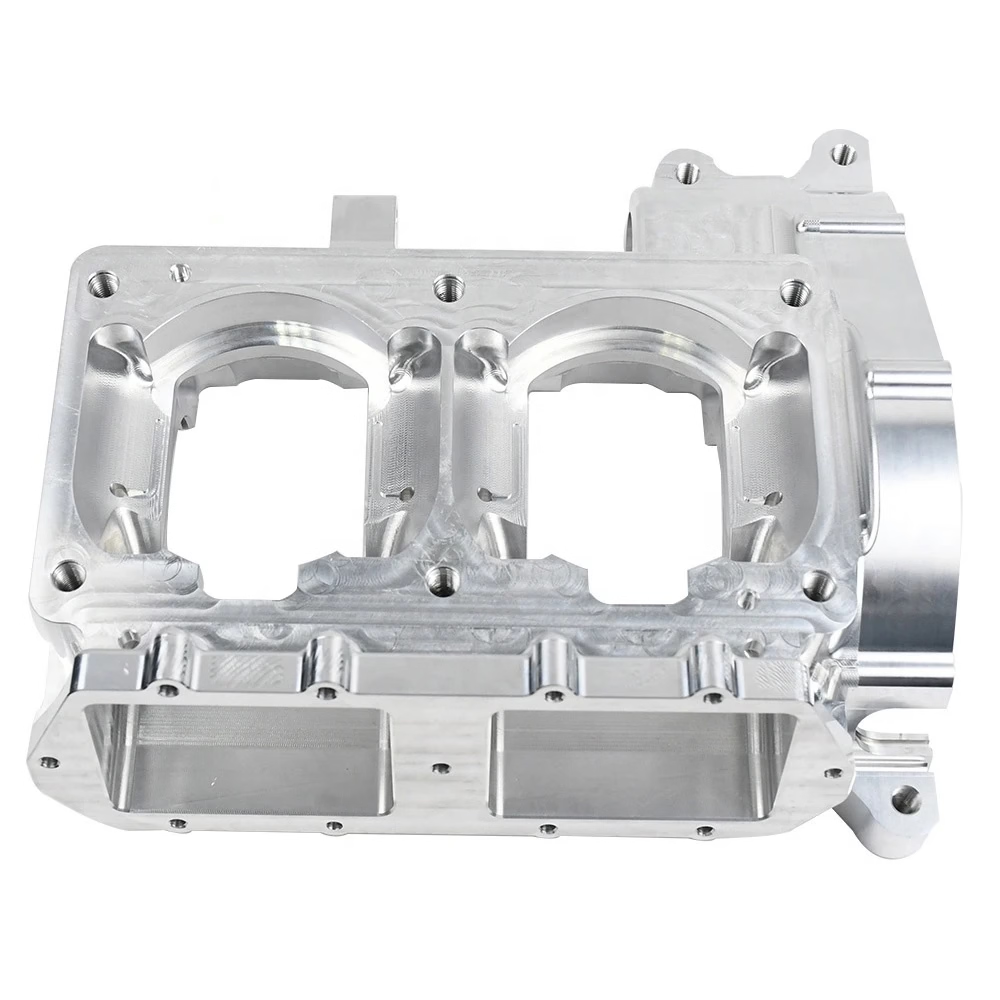
What an analysis cnc machining market actually tells a buyer
Regional demand is a signal about part mix, not a price list.
Why US machining demand is regional, not national
The US does not have one machining market. It has a dozen overlapping ones, each shaped by whatever its anchor industries need. Michigan buys transmission housings and EV battery tray fixtures. Washington buys airframe brackets and nacelle components. Massachusetts buys surgical instruments and pump manifolds in small lots. A shop that quotes well on one of these will often be wrong for the others, because the machine mix, the metrology, and the documentation are different.
When people ask for an analysis cnc machining market, the useful output is a map of part families. A part family is defined by material, envelope size, tolerance band, and surface finish. Once you know which family your part belongs to, you can tell which region has the capacity and which one is just geographically close.
The numbers below come from what we see in incoming quote requests and from published industrial output data. They are directional, not exact. Treat them as a checklist for asking better questions, not as a market forecast.
- 1Michigan and OhioHigh-volume automotive, die castings, tight cycle times, IATF documentation expected.
- 2Washington and ArizonaAerospace structures and engines, 5-axis work, material traceability to heat lot.
- 3CaliforniaElectronics, medical, and prototype-heavy work with short runs and frequent revisions.
- 4Texas and the SoutheastEnergy equipment, heavy machinery, larger envelopes, moderate tolerances.
- 5Minnesota and MassachusettsMedical devices, small precise features, cleanroom-adjacent handling, ISO 13485.
Matching a part family to a machining process
Most parts fall into one of four families. Prismatic housings and brackets need 3-axis or 4-axis milling, usually from 6061-T6 or 7075 aluminium, with tolerances around ±0.05 mm and an as-machined finish. Impellers, turbine blades, and medical bone plates need simultaneous 5-axis work, because the feature geometry cannot be reached in three setups without losing position.
Shafts, bushings, and fittings belong to turned parts. A mill-turn center does the turning and the cross-drilling in one setup, which matters when a Ø6 mm cross hole has to sit within ±0.02 mm of a shoulder. Anything with a sealing face, a bearing bore, or a press-fit diameter falls here.
The fourth family is low-volume castings and prototypes. Metal die casting and vacuum casting make sense above a few hundred pieces or when wall thickness rules out machining from billet. Below that, machining from plate is usually faster and cheaper. Choosing the wrong family adds cost at both ends: too much process for a simple bracket, too little rigidity for a thin-wall part.
A quick test: if your part has three or more faces that must be machined and any of them are non-orthogonal, look at 5-axis. If it has one dominant axis of symmetry, look at turning.
- 13-axis and 4-axisFlat plates, covers, brackets, manifold blocks with features on one or two faces.
- 25-axis simultaneousImpellers, blades, contoured medical implants, parts with undercuts and compound angles.
- 3Mill-turnShafts, fittings, valve bodies needing concentricity between turned and drilled features.
- 4Casting plus finishingHigher-volume housings where machining every feature from billet wastes material.
Region, typical part family, and the process that fits
Directional only. Confirm against your own drawing and volume.
| Region | Dominant sectors | Typical process | Tolerance and finish |
|---|---|---|---|
| Michigan / Ohio | Automotive, EV, tooling | 3-axis, 4-axis, die casting | ±0.02 mm, Ra 1.6–3.2 μm |
| Washington / Arizona | Aerospace, defence | 5-axis simultaneous | ±0.01 mm, Ra 0.8–1.6 μm |
| California | Electronics, medical, robotics | 5-axis, mill-turn, prototyping | ±0.005 mm, Ra 0.2–0.8 μm |
| Texas / Gulf Coast | Energy, heavy machinery | 3-axis, large-envelope milling | ±0.05 mm, Ra 1.6–3.2 μm |
| Minnesota / Massachusetts | Medical devices, instruments | Mill-turn, 5-axis, clean handling | ±0.005 mm, Ra 0.2–0.8 μm |
| Southeast (GA, SC, TN) | Automotive, appliances, aerospace | 4-axis, die casting, sheet metal | ±0.03 mm, Ra 0.8–1.6 μm |
What actually drives cost in each region
Setup count is the first driver. A part that needs four setups costs more than one that needs two, even if the cycle time is identical, because each setup carries its own fixture, its own alignment, and its own chance of position error. This is why 5-axis work is not automatically expensive: fewer setups can offset the higher machine rate.
Material is the second. Aluminium 6061 is common and cheap to cut. Inconel, TC4 titanium, and 17-4PH stainless machine slowly, wear tools faster, and often need stress relief between roughing and finishing. A part in Inconel 718 can take four times the cycle time of the same geometry in 6061.
Inspection is the third, and the one most often underestimated. Aerospace and medical parts carry first-article inspection, material certificates, and sometimes full dimensional reports. A simple bracket with a full report can cost more to document than to machine. Ask early what the quality record needs to contain.
Labor rates explain part of the regional spread, but not all of it. Energy costs, tooling supply, and how busy a shop's spindles are matter just as much. A quote from a busy shop during a peak quarter can be 20 percent above the same shop in a slow month.
A last factor: geometry that fights the tool. Deep pockets with a high depth-to-diameter ratio force long, thin end mills that deflect. Thin walls vibrate. Both push cycle time up and finish quality down, and both are decided at the design stage, not at the machine.
- 1Count setups firstEvery extra setup adds fixture cost and a tolerance stack.
- 2Check machinabilityInconel and titanium can multiply cycle time several times over aluminium.
- 3Ask about documentationFAI, material certs, and dimensional reports change the price as much as the cut.
- 4Respect tool reachPockets deeper than 4× the tool diameter need a different strategy or an EDM step.
When a US supplier is the right call, and when it is not
A domestic supplier is the right call when the part is in a qualification loop, when a design change is likely within weeks, or when the customer's own contract requires domestic origin. Prototype iterations move faster when the shop is in the same time zone and shipping is a one-day truck, not a two-week ocean leg.
A domestic supplier is also right when the part is physically large. Anything approaching 4,000 mm in length is expensive to ship internationally, and freight can exceed the machining cost. Envelopes like 4,000 × 400 × 150 mm are usually best kept in region.
Overseas production makes sense for stable designs heading into repeat runs. Once the drawing is frozen, a supplier with the right machine mix can hold ±0.005 mm and Ra 0.2–0.8 μm on a consistent basis, ship in 3–5 days by air, and still land below a domestic quote. The trade-off is communication latency on changes, and that is manageable if the shop returns DFM feedback quickly.
One practical rule: keep the first article and the qualification build wherever the engineering team sits, then move the frozen revision to the lower-cost source. This keeps the learning loop short without locking in domestic pricing for the life of the program.
Wherever the part is made, the questions are the same. What machine will run it? How many setups? What is the inspection plan? Can the shop show a first-article report before the full run?
Common questions on US CNC machining demand
Does the US machining market cover all process types?
Yes, but not evenly. Milling and turning capacity is spread across every state with any industrial base. Simultaneous 5-axis capacity concentrates near aerospace and medical clusters, because those are the sectors that pay for it. Die casting sits near automotive assembly plants. Vacuum casting and rapid prototyping cluster around design-heavy regions.
If your part needs a less common process, expect to ship it rather than find it locally.
How tight a tolerance should I specify?
Specify the loosest tolerance the function allows. A clearance hole does not need ±0.005 mm, and calling it out adds cost with no benefit. Reserve tight bands for fits, sealing faces, and bearing bores.
For reference, our machining holds ±0.005 mm (±0.0002 in) when the drawing requires it, with finishes from Ra 0.2–0.8 μm up to Ra 1.6–3.2 μm as machined.
Which materials are easiest to source in each region?
Aluminium 6061 and 6061-T6 are available everywhere. 7075 and 2024 are common near aerospace clusters. Stainless 303, 304, and 316 are widely stocked, while 17-4PH and 440C take longer. Titanium TC4 (Ti-6Al-4V) and Inconel have longer lead times and narrower supplier lists.
Plastics behave differently: POM and ABS are easy, PEEK and carbon fibre are specialist items.
Do regional shops differ in quality systems?
They differ in which systems they hold, not in whether they hold any. Automotive work drives IATF 16949. Medical work drives ISO 13485. Aerospace primes require their own approvals on top. Information security, covered by ISO 27001, matters more when drawings are exchanged across borders.
Ask which certificate applies to the process you are buying, not just which ones the company lists.
How do I compare quotes from different states fairly?
Normalize before comparing. Ask each shop to state the machine, the setup count, the material specification with temper, the finish callout, and the inspection level. A quote without those is not comparable to one with them.
Then check the shipping and the documentation separately. A lower machining price with a full dimensional report added may not be lower at all.
What lead time is realistic for a repeat order?
For a frozen design with material in stock, a well-equipped shop can start production within 24 hours and ship in 3–5 days. First articles and new fixtures add time, usually a few days, because the fixture has to be built and proven before the run starts.
Treat any quote that promises first-article delivery on the same timeline as a repeat order as a question worth asking.
Send the drawing, get a process answer
Upload your CAD file and we return a quotation with free DFM analysis within 12 hours. No minimum order quantity, from one prototype to 10,000+ parts.
12-hour quoteFree DFM analysisNDA on request100% inspection









