
Australian Navy orders more metal 3D printed warship prototype parts
The Royal Australian Navy has placed a follow-on order for wire-arc additively manufactured metal prototype parts for warship programs. This page explains what that shift means for engineers and buyers: which features the process handles well, which still need CNC finishing, and how to choose between the two routes.
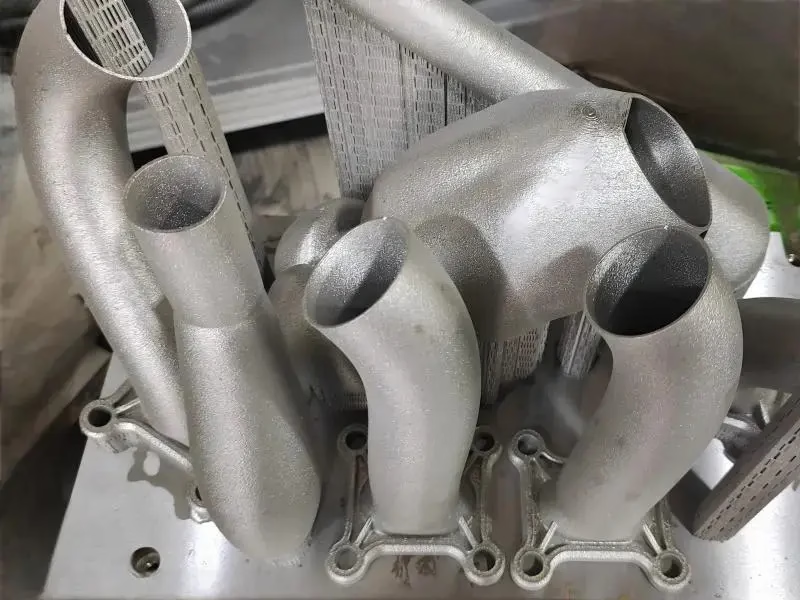
Why a repeat order matters more than the first one
A prototype order proves a process can work. A repeat order proves the supply chain, the inspection routine and the cost model all hold up.
What wire-arc additive manufacturing does well on a warship part
Wire-arc additive manufacturing builds a metal part by depositing weld wire layer by layer under a controlled arc. The feedstock is standard welding wire, so material cost stays low compared with powder-bed processes. Deposition rates are high, often several kilograms per hour, which is why the process suits large near-net shapes rather than small intricate ones.
For a warship prototype, that profile fits stiffener brackets, mounting lugs, ducting adapters and frame nodes. These parts are often several hundred millimeters across and carry modest loads. Buying them as castings needs a pattern and a long lead time. Machining them from solid plate wastes most of the stock. WAAM deposits only what the shape needs, then a CNC pass brings critical faces into tolerance.
The process also shortens the loop between design and hardware. A revised bracket geometry can be printed in days rather than waiting on a foundry slot. That matters when a prototype is still being iterated and the drawing changes between builds.
- 1Good fitLarge brackets, lugs and nodes with a modest surface finish requirement
- 2Poor fitThin walls, fine internal channels and parts under 100 mm
- 3MaterialStainless and low-alloy steel wire grades are the common choice
- 4Post-processStress relief, then CNC finishing on all mating and sealing faces
Where the printed shape stops and the cutting tool starts
An as-deposited WAAM surface is not a finished surface. Expect roughly 0.5–2 mm of stock on a face, with local variation from heat distortion. That is fine for a non-critical web and unacceptable for a bolted joint or an O-ring groove. The practical answer on most defense prototypes is a hybrid route: print near net, then machine the interfaces.
On our 5-axis centers we hold ±0.005 mm on critical features and reach Ra 0.8–1.6 μm on sealing faces. A printed bracket that arrives with 1.5 mm of stock on a mounting pad is a straightforward setup. A printed part with 0.2 mm of stock and a warped flange is not, because there is no clean reference surface left to pick up.
So the print parameters and the machining datum need to be planned together. Leave a machining allowance on every surface that will be clamped, and leave a boss or pad that can be faced flat as the first operation. If the print shop and the machine shop are the same supplier, that conversation happens before deposition starts.
Choosing a route for a large metal prototype part
The right answer depends on size, feature detail and how many units you actually need.
| Route | Best for | Typical limit | Lead time |
|---|---|---|---|
| WAAM + CNC finish | Large stiffeners, lugs, frame nodes | Min 0.5 mm stock on machined faces | Print plus finish, quoted per part |
| CNC from solid billet | Tight geometry, small batches, no porosity | Up to 4,000 mm travel | Parts ship in 3–5 days |
| Powder-bed printing | Small complex parts, internal channels | Build envelope is the constraint | Depends on build height |
| Casting plus CNC | Repeat runs above a few hundred units | Pattern and tooling cost up front | Longest of the four |
What the Navy order signals about qualification
A repeat order is a statement about repeatability. The first build proves the geometry. The second build has to prove that the same geometry comes out again, with the same material properties, from a documented process. That is a paperwork problem as much as a manufacturing one.
For any defense-adjacent prototype, plan for traceability. Wire heat number, deposition parameters, heat treatment cycle, machining setup and final inspection results all need to sit in one record tied to the part serial. Without that, a printed part is just a shape.
Inspection is where printed and machined parts converge. Both need dimensional reports, and both need a documented check on material condition. Our standard flow is raw material check, in-process monitoring and 100% inspection before shipment, with reports on request. On a printed part we also want to see the deposit before machining, so a defect in the build is caught before value is added.
When to machine instead of print
Printing is not automatically the cheaper route. For a bracket under 150 mm, machining from 6061 or 17-4PH bar is usually faster and gives a better surface without a second operation. The economics flip when the part gets large, when the buy-to-fly ratio on a billet is poor, or when the geometry has a lot of removed material.
There is also a porosity question. Wire-arc deposits can carry small voids, and on a pressure boundary or a fatigue-critical fitting that is a real risk. If the part sees cyclic loading at a stress concentration, a wrought billet is the safer starting point. Printing earns its place on stiffness-driven shapes and on one-off geometry that would otherwise need tooling.
We run both routes under one roof, so the recommendation is not tied to a single process. If printing does not make sense for your part, we will say so and quote the machined version.
Common questions from engineers and buyers
Can you machine a metal printed part that another supplier produced?
Yes, if there is enough stock left on the faces we need to cut. We prefer to see the print drawing first so we can confirm the allowance before the part ships.
Parts with warped flanges and no clean reference surface are the main problem case. In that situation we usually ask for a reprint with a larger allowance rather than fight the setup.
What is your minimum order quantity for a prototype?
There is no minimum order quantity. We run from one prototype to 10,000+ part runs.
For a single unit, the setup cost dominates the price, so it is worth sending the drawing early to get a realistic number.
How do you handle confidentiality on defense-related work?
Uploads are secure and confidential, and we can sign an NDA on request before drawings are shared.
We hold ISO 27001:2022 for information security management, which covers how files and records are stored and accessed.
What materials can you machine for a warship prototype part?
Common picks are 17-4PH stainless, 316L, 4130 and 4140 steel, plus 6061-T6 and 7075 aluminium for non-corrosive brackets.
For printed near-net shapes, stainless and low-alloy steel wire grades are the usual feedstock.
How fast can you turn around a quote and the first parts?
Quotation and a free DFM analysis come back within 12 hours. Production can start within 24 hours of approval.
Machined parts typically ship in 3–5 days. Printed parts depend on build height, so we quote that timing per part.
Do you provide inspection reports with the parts?
Yes. Our standard flow is raw material check, in-process monitoring and 100% inspection before shipment, with reports on request.
Tell us which dimensions are critical and we will build the inspection plan around those features.
Send the drawing and we will tell you which route fits
Upload a STEP file and get a quotation plus a free DFM analysis within 12 hours. If printing is the wrong call for your part, we will say so.
12-hour quote100% inspectionNDA available









