
Advantages of CNC machined aluminum parts in manufacturing
This page is for design engineers and sourcing teams who need to decide whether a machined aluminum part fits their application. It covers what aluminum does well under the cutter, which alloys to pick, what tolerances and finishes are realistic, and the cases where another material or process serves you better.
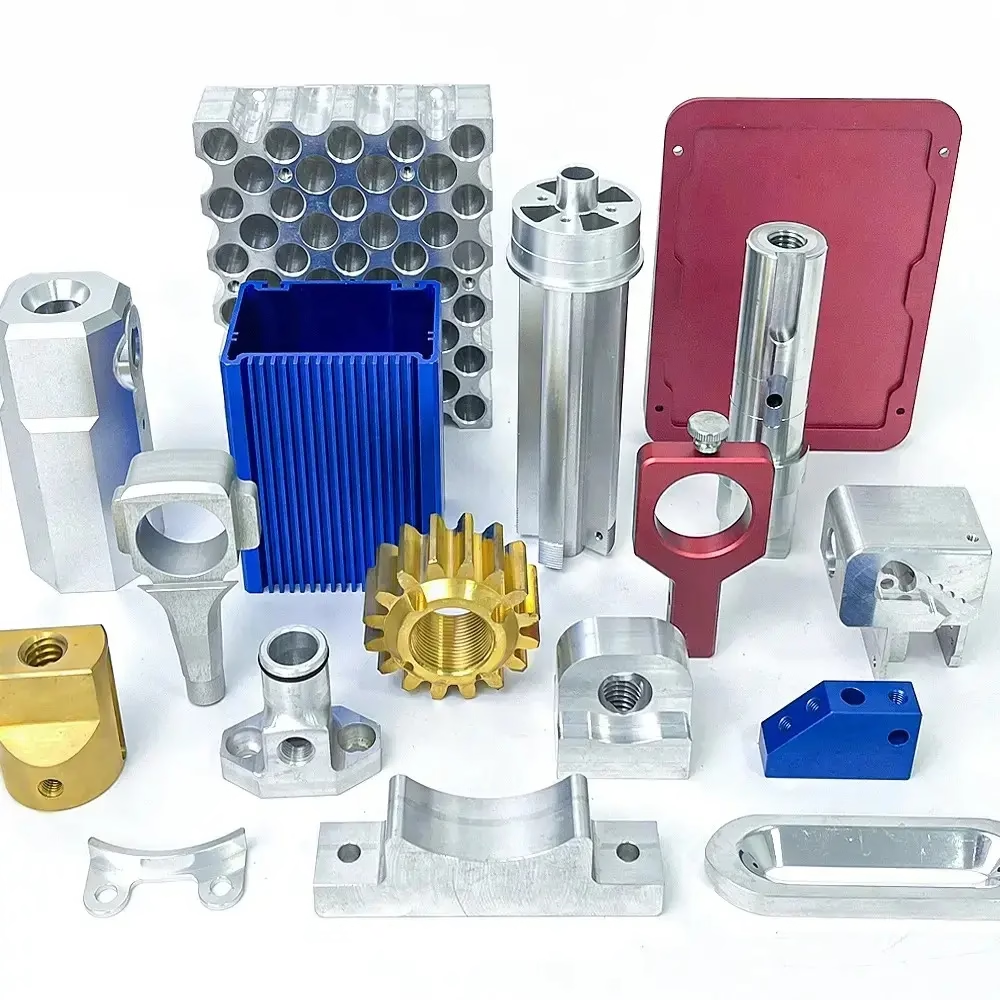
Why aluminum and CNC machining fit together
Aluminum is not automatically the right call for every part. Here is how to tell when it is.
What aluminum does at the spindle
CNC machining is subtractive: a controlled cutter removes material from solid stock until the geometry matches the CAD model. Milling, turning, drilling and tapping all fall under the same roof, and most aluminum parts move through several of them in one setup.
Aluminum cuts fast. Its high thermal conductivity pulls heat away from the cutting edge, so tools last longer and surface finish stays consistent across a long run. Specific cutting force is roughly a third of what low-carbon steel demands, which means lighter fixturing, higher feed rates and less spindle load for the same depth of cut.
Chips break cleanly and evacuate well. That matters on deep pockets and internal channels where chip packing is the usual cause of scrapped parts. On a 5-axis machine the cutter can stay engaged at a constant angle, so wall thickness and floor finish stay uniform instead of drifting at the corners.
- 16061-T6General purpose. Good strength, welds well, machines cleanly. Start here for most brackets, housings and fixtures.
- 27075High strength, closer to steel. Use when weight is critical and the part carries real load.
- 32024Excellent fatigue resistance. Common in aerospace structures, but poor corrosion resistance without coating.
- 46082 / 6063Extrusion-friendly. Useful when a part starts as profile stock and only needs partial machining.
Accuracy, repeatability and what the numbers mean
The reason machined aluminum parts hold tight dimensions is not the alloy. It is the machine, the fixture and the thermal state of the workpiece. A rigid setup on a controlled machine holds ±0.005 mm on a 50 mm aluminum feature without heroics. Push to a 500 mm part and the same machine will drift more from thermal expansion than from cutter deflection.
Repeatability is the quieter advantage. Once a program and fixture are proven, part 1 and part 400 sit in the same place. That is what makes machined aluminum practical for bridge tooling, test rigs and pilot production runs where you cannot afford to re-qualify the assembly every batch.
Geometry also matters. Thin walls under 1 mm tend to move after the vise releases. Deep pockets need a smaller cutter, which flexes more. We check these cases in the DFM step and tell you where a 0.2 mm wall add or a corner radius change will save the part.
- 1Tight tolerances±0.005 mm is achievable on critical features, not on the whole part.
- 2Surface finishRa 0.2–0.8 μm on fine finishes, Ra 0.8–1.6 μm on standard machined faces.
- 3HardwareLaser marking and engraving needs a minimum character height of 1.5 mm.
- 4InspectionRaw material check, in-process monitoring, final inspection. Reports on request.
Aluminum alloys we machine and where each one fits
Choose by load path, environment and secondary operation, not by habit.
| Alloy | Typical use | Machinability | Watch out for |
|---|---|---|---|
| 6061-T6 | Brackets, housings, fixtures | Excellent | Lower strength than 7075 |
| 7075 | Aerospace, high-load frames | Good | Higher cost, less weldable |
| 2024 | Wing and fuselage structures | Fair | Needs coating for corrosion |
| 5052 / 5083 | Panels, tanks, marine | Good | Not heat treatable |
| 6063 / 6082 | Extruded profiles, frames | Good | Lower strength than 6061 |
| ADC12 | Die-cast housings, post-machining | Good | Porosity can surface on cuts |
Where cost actually comes from
Aluminum stock is cheap compared to titanium or stainless. The money sits in setup, programming and inspection, which is why the geometry you draw decides the price more than the alloy you pick. Every new fixturing orientation adds a setup, and every setup adds a chance for stack-up error.
Design decisions that cut cost: keep features reachable from one or two directions, use standard drill and tap sizes, avoid deep narrow slots, and put a real corner radius where the cutter has to turn. A part that needs a 3 mm end mill in a 40 mm deep pocket will cost more than the same part redesigned with a 6 mm cutter.
Quantity changes the picture too. One prototype and a 5,000-part run use different processes: the prototype runs on a 3-axis or 5-axis mill with soft jaws, the production run gets a dedicated fixture and sometimes a mill-turn center so both sides finish in one cycle. We quote both paths when the volume is unclear.
Where machined aluminum parts are used
Aerospace. Aluminum still carries a large share of airframe brackets, housings and structural fittings. Weight matters on every gram, and 7075 or 2024 with anodizing gives a good strength-to-mass ratio. Machined prototypes let engineers test a design before committing to tooling.
Medical devices. Housings, instrument frames and imaging components benefit from the combination of light weight and clean surfaces. Aluminum is easy to anodize and hardcoat, so the part can take repeated handling and cleaning without losing its finish. Non-magnetic grades suit equipment where magnetic interference is a problem.
Electronics and industrial machinery. Enclosures, heat sinks, control chassis and robot arms use machined aluminum because it moves heat and stays stiff at low mass. For heat sinks, the alloy and the fin geometry both matter, so it is worth running a thermal check before locking the design.
Automotive and EV. Battery housings, motor mounts and sensor brackets are common. Aluminum reduces unsprung and overall vehicle mass, and machined prototypes bridge the gap between a design and a production casting or extrusion.
Finishes and secondary operations
Machined aluminum rarely ships bare. Anodizing is the most common step: clear anodizing gives a natural finish with mild corrosion protection, color anodizing adds identification, hardcoat anodizing builds a wear surface on sliding or contact areas, and conductive anodizing keeps electrical grounding paths alive.
Plating covers electroless nickel, zinc, silver and gold. Electroless nickel gives a hard, uniform layer on complex geometry where electroplating would build unevenly. Silver and gold are used where contact resistance matters.
Mechanical finishes change both look and function. Bead blasting hides tool marks and gives a matte surface. Tumbling deburrs edges in volume. Brushing leaves a directional grain. Polishing reaches a reflective finish. Powder coating and black oxide cover cases where a painted or dark surface is required. All of these run after machining, so the order of operations belongs in the drawing notes.
Common questions from engineers and buyers
Which aluminum alloy should I specify for a machined part?
Start with 6061-T6 unless the load case says otherwise. It machines cleanly, takes anodizing well and covers most brackets, housings and fixtures.
Move to 7075 when strength-to-weight is the limiting factor, or 2024 when fatigue life matters. Both cost more and need a coating for corrosion protection.
How tight a tolerance can you hold on aluminum?
We hold ±0.005 mm on critical features under controlled conditions. That is a per-feature figure, not a blanket tolerance across a 500 mm part.
Thermal expansion, wall thickness and fixture rigidity all move the number. If a drawing carries a global tight tolerance, we will flag which dimensions can actually meet it.
Is CNC machining aluminum cost-effective at low volume?
Yes, and that is one of its main advantages. There is no tooling to amortize, so a single prototype and a 10,000-part run use the same basic process.
Unit price drops with volume because setup is spread across more parts. We quote both a prototype path and a production path when volume is uncertain.
Can machined aluminum parts be recycled?
Aluminum is one of the most recycled metals in use. Scrap from machining goes back into the melt stream, and post-service parts can be recycled without losing the base material.
Anodized and plated surfaces do not prevent recycling, though the coating adds a step at the recycler.
What surface finish can I expect on a machined aluminum part?
As-machined faces sit around Ra 1.6–3.2 μm. Standard machined finishes reach Ra 0.8–1.6 μm. Fine finishes go to Ra 0.2–0.8 μm.
The finish you get depends on the tool path, the cutter and the alloy. Very fine finishes on large faces take longer to cut, so they carry a cost.
How do you handle confidential drawings?
Uploads are secure and confidential. We sign an NDA on request before reviewing drawings.
Files stay inside the project team and are not shared outside the manufacturing chain.
Send drawings, get a quote and a DFM review
Quotation and free DFM analysis within 12 hours. Uploads stay confidential, NDA available on request.
12-hour quote100% inspectionNo minimum order quantityNDA on request









