
3D Printing Used to Treat Seriously Burned Children
This page covers where 3D printing used to treat seriously burned children actually helps: facial compression masks, splints, conformers, and surgical guides. It is written for design engineers and hospital procurement teams who need to judge whether a part belongs on a polymer printer or a CNC machine.
What Additive Manufacturing Can and Cannot Do on a Burn Ward
Patient-specific shapes are the easy part. Load, heat, and cleaning cycles decide the rest.
Why Burn Treatment Needs Patient-Specific Geometry
A deep partial or full-thickness burn contracts as it heals. On a child's face, neck, or hand, that contraction can pull the mouth, eyelid, or finger out of position within weeks. Off-the-shelf compression garments are knitted from flat patterns and cannot follow an irregular graft boundary or a jawline that is still changing shape.
This is the gap 3D printing used to treat seriously burned children fills. A structured light or CT scan captures the surface, the file is mirrored and thickened in CAD, and the printer builds a shell that matches that one patient on that one day. Nothing is shared between cases.
The geometry problem is solved quickly. The materials and process problem is not. A printed mask sits on healing tissue for 20 hours a day, gets washed in disinfectant, and must hold compression of roughly 15–25 mmHg without creeping. Those constraints, not the shape, decide which process you pick.
- 1Irregular contoursGraft seams and scar ridges are hard to fit with flat-pattern garments
- 2GrowthChildren need a new scan and a new shell every few months
- 3Short runsOne to a few hundred parts per year, not thousands
From Scan to Finished Device: The Steps That Matter
The chain starts with capture. Handheld structured light scanners resolve 0.1–0.2 mm on a still patient; a child who cannot hold still is often scanned under light sedation. CT or MRI data is used when the bone or cartilage interface matters, for example an ear or nose conformer.
Next comes CAD. The engineer offsets the scanned surface by the planned compression, adds vent windows, and thickens the wall to 2–3 mm so the shell does not flex under a strap. Mirroring the healthy side is common on facial cases. This stage is where most of the engineering hours sit, not in printing.
Printing follows. SLA or DLP resin gives the smoothest surface and the tightest fit for facial masks. SLS nylon is tougher and better for hand and neck splints that take impact. FDM is rarely the right answer here: layer lines trap bacteria and the surface is hard to clean.
Post-processing decides whether the device survives clinical use. Resin parts are washed, post-cured, and often given a silver-ion or plasma coating. Nylon parts are dyed and sealed. Every device is then checked against the digital model before it leaves the shop.
- 1Wall thickness2–3 mm is typical for a facial mask before it distorts under strap load
- 2CompressionOffset by 1–3 mm from the scanned surface, tuned by the clinician
- 3Vent windowsLaser-cut or printed in, to keep the skin dry and visible
Printed Polymer vs. Machined Part for Burn Devices
Use this to decide whether a component stays on a printer or moves to a mill.
| Factor | 3D printed polymer | CNC machined part |
|---|---|---|
| Fit to one patient | Excellent, direct from scan | Good, needs CAM from the same scan |
| Lead time per unit | Hours to a few days | 3–5 days after programming |
| Surface finish | Ra 1.6–3.2 μm as printed | Ra 0.8–1.6 μm typical, Ra 0.2–0.8 μm polished |
| Tolerance | ±0.1 mm on most resin systems | ±0.005 mm on metal, ±0.02 mm on plastics |
| Reusable hardware | Not suitable | Stainless 316L, titanium, PEEK |
| Best use | Masks, conformers, splints, guides | Clamps, hinges, brackets, instrument parts |
Where Machined Parts Enter the Same Device
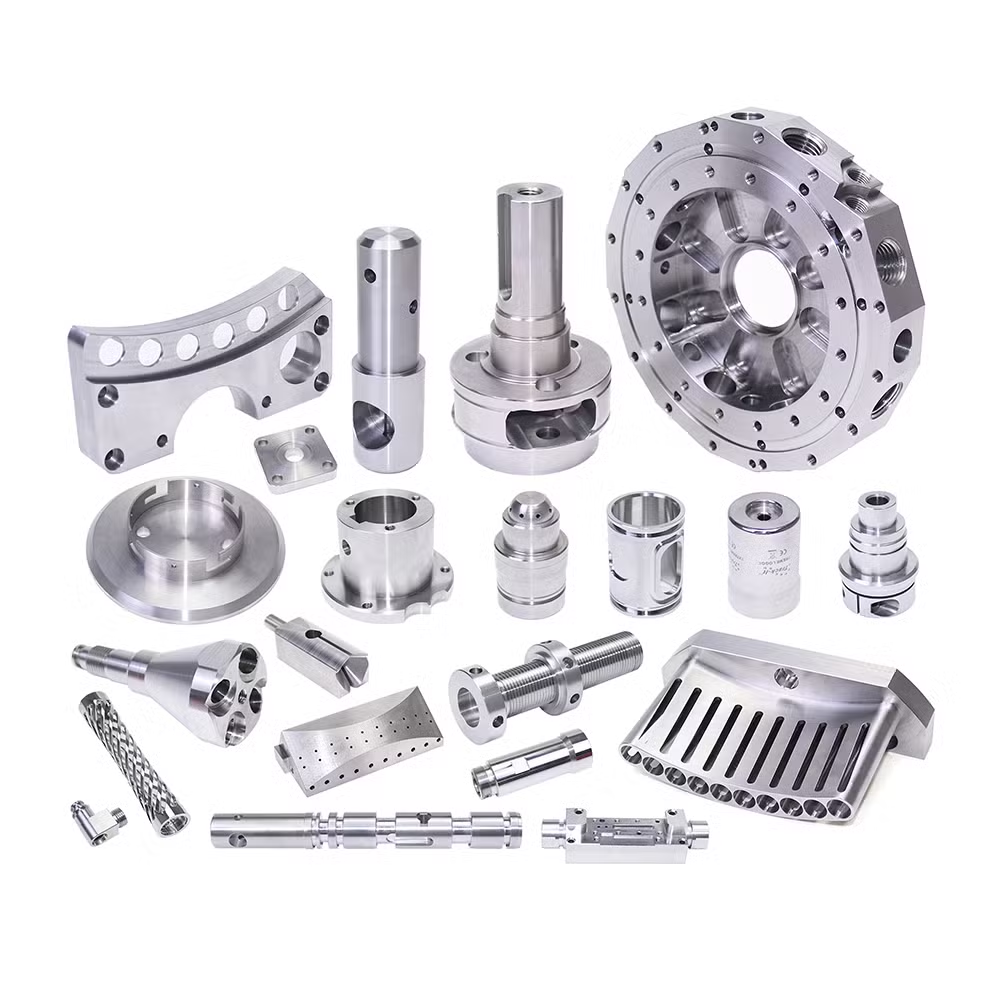
Printed shells are the visible half of the device. The other half is the hardware that holds them in place, and that hardware is usually machined. A mask tensioner needs a repeatable spring rate. A splint hinge needs to survive thousands of open-close cycles. A surgical guide needs a stainless bushing that will not ovalize when the drill spins.
We machine these parts in 316L stainless, Ti-6Al-4V, PEEK, and acetal. A printed mask and a machined titanium bracket are often shipped as one kit, because the two processes solve different halves of the same problem.
One example is the adjustable strap anchor on a pediatric neck conformer. The printed shell is replaced every few months as the child grows, but the anchor and its screw threads are reused. Those threads are cut on a mill-turn center to a Class 2 fit so the same screw works for the life of the treatment.
Tolerance on these small parts matters more than on the shell. A 0.05 mm mismatch on a hinge pin is a rattle. At ±0.005 mm, we hold the pin and the bore so the joint moves the way the therapist intended on the first assembly.
- 1Materials316L, Ti-6Al-4V, PEEK, acetal, 6061-T6 aluminium
- 2FinishesBead blasting, electropolishing, anodizing, laser marking at 1.5 mm character height
- 3VolumeNo MOQ. One prototype or a 10,000-part run
When 3D Printing Is the Wrong Choice
Printing is not always the answer, and saying so early saves a project. If a device must be steam-autoclaved at 134 °C, most photopolymer resins soften or yellow. Move the part to PEEK, PEI, or stainless and machine it.
If the device carries structural load, for example a halo-style neck brace or a hand therapy rig with a lever, printed resin will creep under sustained stress. Machined aluminium or titanium is the correct call.
If the hospital wants an off-the-shelf size that already fits 60% of patients, a printed custom part adds cost and paperwork for no clinical gain. Custom geometry earns its place when standard sizes fail.
There is also a regulatory layer. A patient-specific device made under the treating clinician's own specification is handled differently from a device placed on the market. ISO 13485:2016 gives the process framework for the parts we make, but the clinician's prescription defines the design input.
- 1Autoclave134 °C steam rules out most resins, favors PEEK or stainless
- 2Sustained loadResin creeps. Use machined metal or PEEK
- 3Standard sizesIf a stock size fits, do not print a custom one
What We Need to Quote a Burn-Care Component
Send a 3D scan, an STL, a STEP file, or a hand sketch with critical dimensions. We return a quotation and a free DFM analysis within 12 hours. Production can start within 24 hours of approval, and parts ship in 3–5 days.
For patient-specific work, the useful inputs are the scan file, the target compression, the body site, and how the device will be cleaned. That last one changes the material choice more often than people expect.
We run 127 high-precision CNC machines across three plants in Dongguan and Singapore, including 16 simultaneous 5-axis centers. Machining up to 4,000 mm is available, though burn-care hardware is usually small. Everything is inspected before shipment, and reports are available on request.
Uploads are confidential. An NDA is available on request, and files are not shared outside the project team.
- 1Quote turnaround12 hours, including free DFM analysis
- 2First article100% inspection with dimensional report on request
- 3ConfidentialityNDA available, secure file handling
Common Questions
What is 3D printing used to treat seriously burned children actually used for?
The most common devices are facial compression masks, neck and hand conformers, splints, ear and nose prostheses, and surgical guides for graft or release procedures.
Each is built from a scan of that patient, so the fit follows the scar boundary instead of an average body shape.
Which print process fits a facial compression mask?
SLA or DLP resin is the usual choice because it gives the smoothest surface and a wall you can keep at 2–3 mm without losing shape.
SLS nylon is used where the device takes impact, such as hand splints. FDM is avoided because the layer lines are hard to clean.
Can printed resin parts be sterilized?
Most photopolymer resins will not survive 134 °C steam autoclave cycles without warping or yellowing.
If the device needs autoclaving, specify PEEK, PEI, or a machined stainless part instead, and design the printed shell to be a disposable outer layer.
How often does a pediatric device need to be remade?
Children grow, and scar tissue changes as it matures, so a new scan and a new shell every few months is normal.
This is why short-run and one-off production matters more than unit cost. We have no minimum order quantity.
What tolerances can I expect on the machined hardware?
We hold ±0.005 mm (±0.0002 in) on metal parts, with surface finish from Ra 0.2–0.8 μm after polishing.
That level is used for hinge pins, bushings, strap anchors, and drill guides, not for the printed shell itself.
Do you sign an NDA for patient scan data?
Yes. An NDA is available on request, and uploads are handled as confidential files.
Scan data is used only for the quoted part and is not shared outside the project team.
Send a Scan or a Sketch, Get a Quote in 12 Hours
Upload your file and we return pricing plus a free DFM analysis. Machined hardware and printed shells quoted as one kit.
12-hour quote100% inspectionNo MOQISO 13485:2016









