
3D Printing Can Be Used to Repair Leaky Devices
This page is for maintenance engineers and sourcing staff who need to stop a leak without waiting weeks for an OEM spare. It covers which leak paths a printed part can actually seal, which materials hold up against oil, water and fuel, and the point where a printed repair stops being the right answer.
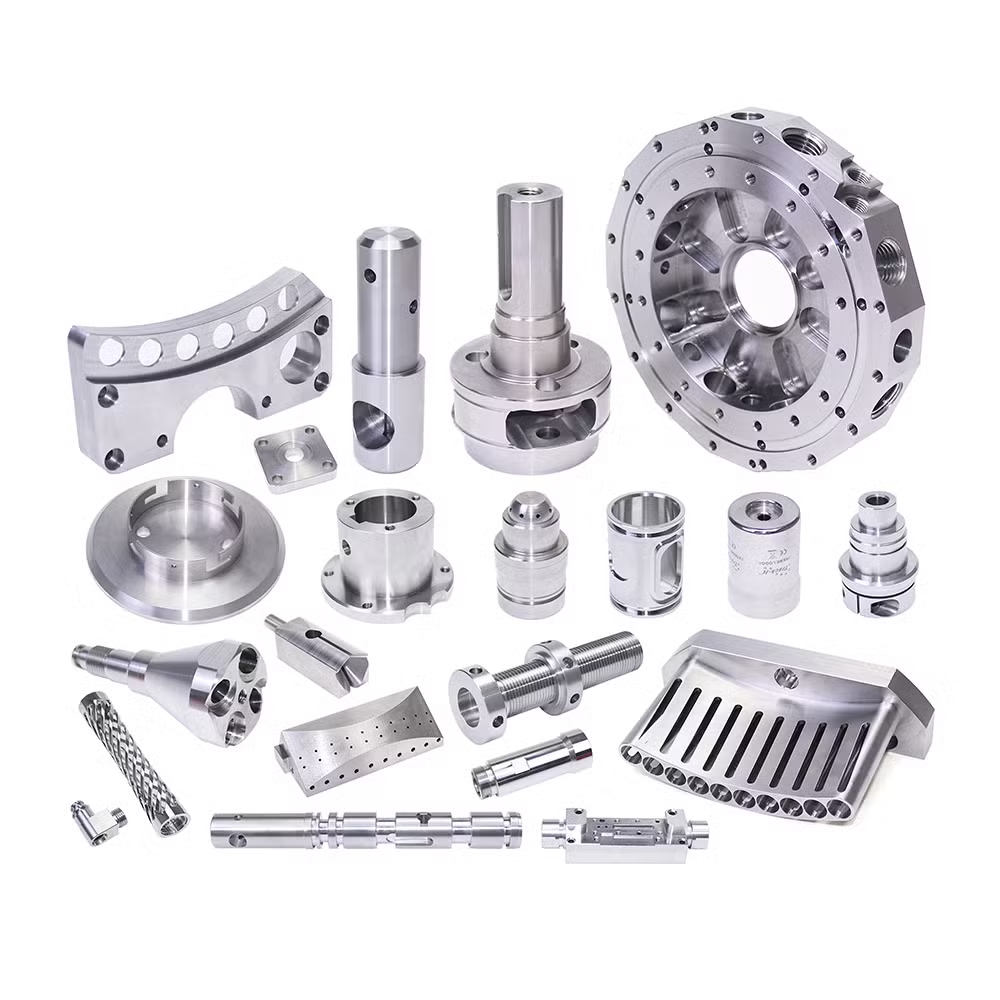
What a printed repair part can and cannot do
3D printing can be used to repair leaky devices when the failed part is a clamp, a cover, a spacer or a low-pressure gasket. It is not a patch for a cracked pressure vessel.
Which leaks a printed part can close
Most leaks on pumps, valve bodies, gearboxes and instrument housings start at a joint, not in the middle of a wall. A flange face loses preload, a cover distorts, a gasket hardens. The usual fix is a new clamp, a new cover or a thicker gasket, and that is exactly the shape a printer builds well.
A printed repair part works as a mechanical stop. It holds a sealing face under load, fills a gap where the original gasket has compressed, or covers an opening so that splash and mist stay inside. Pressure still has to be carried by the original wall. The printed piece only keeps the seal seated.
Repair clips are the common case. A cracked mounting ear on a filter housing, a broken clamp on a coolant line, a missing retainer on a sight glass. These parts see low stress and moderate temperature. A printed replacement can be fitted the same day and kept as a spare until the OEM part arrives.
Leaks from corrosion pitting or a through-wall crack behave differently. Wrapping a printed shell around the pipe may slow the drip, but it hides the defect. The wall keeps thinning underneath. For those cases we machine a proper sleeve or replace the section, not print a cover over it.
- 1Good fitLow-pressure joints, covers, clamps and spacers where the part only holds a seal in place.
- 2Poor fitPressure boundaries, vibrating lines, hot steam and anything the printed wall must carry on its own.
Choosing a material for the fluid and the temperature
The fluid decides the polymer. Water and mild detergents are easy. Oil, coolant, hydraulic fluid and fuel narrow the list fast, because many common print resins swell, soften or lose strength after weeks of contact.
For water and air lines up to about 60 °C, PA and PETG printed parts hold up well and stay dimensionally stable. They are cheap to reprint and easy to fit. Keep them out of direct sunlight if the part is outdoors, since UV breaks them down over months rather than days.
For oil, grease and hydraulic fluid we move to POM, PA or PEEK depending on temperature. PEEK survives higher heat and resists most solvents, but it needs a high-temperature printer and costs far more per part. On a small repair clip the cost is still low compared with a shutdown.
Chemical resistance matters as much as strength. A part that swells 2% overnight will lose the clearance that made it fit. We ask for the fluid, the concentration and the working temperature before we pick a resin, because the same clip in the same machine can need two different materials.
Printed repair material by fluid and temperature
Guide only. Confirm with the fluid data sheet and a test fit before production.
| Fluid | Working temp | Suggested material | Watch out for |
|---|---|---|---|
| Water, air | Up to 60 °C | PA, PETG | UV exposure outdoors |
| Coolant, mild oil | Up to 80 °C | PA, POM | Slow swelling over weeks |
| Hydraulic fluid | Up to 100 °C | POM, PEEK | Higher cost per part |
| Fuel, solvents | Up to 120 °C | PEEK | Needs high-temp printer |
| Steam, hot oil | Above 120 °C | Not suitable | Use machined metal |
Design details that decide whether the repair holds
Print orientation sets the weak direction. A layer line running across a sealing face will open under load. Turn the part so the load runs along the layers, not between them, and the same resin behaves very differently.
Wall thickness needs headroom. A 2 mm wall on a printed clip is enough for a cover, but a load-bearing clamp needs 4 mm or more, plus fillets at every corner. Sharp internal corners concentrate stress and crack first.
Sealing faces should be printed oversize and then faced flat. A printed surface has layer steps of 0.1 to 0.3 mm, which is far too rough to seal against a gasket. We normally print 0.3 mm proud and machine the face to Ra 0.8–1.6 μm so the gasket has something flat to compress against.
Tolerances follow the process. A printed part holds roughly ±0.3 mm on a 100 mm feature. When a repair needs ±0.005 mm, or a metal sealing face, printing is the wrong tool. That is when the part goes on a mill instead.
- 1Load along layersOrient the print so tension and bending run with the layers, not across them.
- 2Machine the seal facePrint oversize, then face the gasket land flat to Ra 0.8–1.6 μm.
- 3Add filletsRound every internal corner. Sharp corners are where printed parts crack.
When CNC beats printing for a repair part
Printing wins on speed and shape freedom. A one-off clip with an internal channel or a curved profile can be printed in hours with no tooling. That is the whole reason 3D printing can be used to repair leaky devices at all, and it is why maintenance teams keep a printer near the line.
CNC wins on strength, tolerance and temperature. A machined aluminium or stainless part handles the same load with a thinner wall, holds ±0.005 mm, and does not care about oil or heat. For a repair that must last years, metal is usually the cheaper answer once downtime is counted.
A practical split: print the first part to confirm the fit, run it for a few days, then cut the final part from metal if the repair is permanent. We do both in-house, so the same drawing moves from a printed prototype to a machined spare without a second supplier.
For low-volume runs we also machine HDPE and POM directly. Those plastics resist many fluids, machine to a fine finish, and avoid the layer-line weakness of a print. It is often the best middle ground for pump and valve spares.
Getting a repair part made and fitted
Start with the failed part in hand. Measure the sealing face, the bolt pattern and the gap that the gasket must fill. A photo with a ruler in frame is often enough for us to model the replacement.
Send the fluid, the working temperature and the pressure at the joint. These three numbers decide the material and the wall thickness. Without them we are guessing, and a guess that swells or cracks sends the leak back.
We can turn a quote and a DFM note around within 12 hours, and production can start within 24 hours. Printed and machined repair parts normally ship in 3–5 days. No minimum order quantity applies, so a single clip is fine.
Fit the part dry first. Check the bolt holes line up and the gasket sits flat before you tighten anything. If the joint still weeps after a correct fit, the seal face is the problem, not the clamp, and the face needs machining.
Common questions
Can a printed part seal a pressurized line?
No. A printed part can hold a gasket in place, but it should not be the pressure boundary. The original wall or pipe still carries the pressure.
If the wall itself is cracked or pitted, use a machined metal sleeve or replace the section.
How long will a printed repair last?
It depends on the fluid and temperature. Water and air lines at moderate temperature can run for months. Oil and solvents shorten that.
Treat a printed repair as a stopgap and keep a metal spare on order.
Which material should I pick for an oil leak?
POM, PA or PEEK, chosen by working temperature. POM and PA cover most coolant and mild oil cases up to about 80 °C.
PEEK handles higher heat and more aggressive fluids but costs more per part.
Can you machine the same part in metal instead?
Yes. We machine aluminium, stainless steel and engineering plastics to ±0.005 mm with finishes down to Ra 0.2–0.8 μm.
For a permanent repair, a machined part is usually the better choice.
What do you need to quote a repair part?
A photo or drawing of the failed part, the key dimensions, and the fluid, temperature and pressure at the joint.
Quotation and free DFM analysis come back within 12 hours.
Do you keep the drawing confidential?
Yes. Uploads are secure and confidential, and we can sign an NDA on request.
Your files are not shared outside the project.
Send the failed part, get a repair plan
Share a photo and the fluid details. We will tell you whether to print it or machine it, with a quote and DFM note within 12 hours.
12-hour quoteNo minimum order100% inspection









