
3D Printing Advances in Early Detection of Milk Fever
Milk fever is a calcium crash in dairy cows, and catching it before the animal goes down decides the outcome. This page is for engineers building on-animal sensors, lab-on-chip calcium testers and handheld readers. We cover where printed parts fit, where they do not, and what tolerance and material choices actually matter.
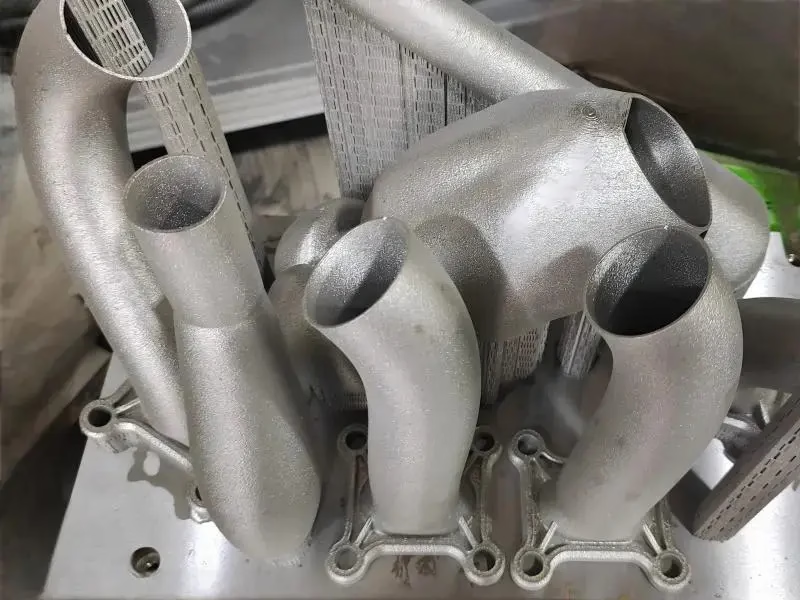
What printed hardware can and cannot do for herd health
Printed parts solve geometry and speed problems. They do not solve chemistry problems.
The detection problem is a calcium measurement problem
A cow with milk fever is short on ionized calcium in the blood. Clinical signs show up late. By the time the animal is recumbent and cold to the touch, the blood calcium has already dropped far below the normal range and treatment is a rescue job rather than a prevention job.
That gap is what sensor developers are trying to close. The target is a reading taken hours before visible symptoms, from a device the animal barely notices. Every part of that device has to survive a barn: moisture, dust, ammonia vapor, rough handling and a 600 kg animal leaning on it.
Additive processes matter here because the mechanical envelope is unusual. A housing that clamps to an ear tag, a collar or a leg band is not a box. It is a thin-wall shape with cable exits, sealing grooves and a battery pocket, and it may be needed in 20 units for a field trial long before anyone commits to tooling.
Where additive processes earn their place in a diagnostic device
Three areas keep coming back in herd-health hardware. The first is the fluid path: printed microfluidic chips and cartridge bodies let a designer put a serpentine channel, a mixing chamber and a reagent well into one part without a bonding step. Print resolution on a resin system handles channel widths down to a few hundred microns, which is enough for an ion-selective electrode cell.
The second is the enclosure. Conformal housings that follow the curve of a neck or a leg are cheap to print and expensive to mold. If the design is still moving, printing wins. Once the shape freezes and volumes climb, the economics flip.
The third is tooling itself. Printed jigs, nests and alignment fixtures hold the sensor during potting or calibration. A printed nest that locates the electrode within ±0.1 mm is enough for a bench fixture, and it takes a day to make.
What printing does not give you is a sealing surface. A gasket groove printed in resin will not hold a reliable seal at Ra 12 μm. That face gets machined, or the whole part moves to CNC.
- 1Printed chipsGood for channel geometry and quick iterations before a mold exists.
- 2Printed housingsGood for low-volume field trials and ergonomic shapes.
- 3Machined facesNeeded anywhere a gasket, O-ring or optical window must seal.
- 4Machined insertsThreaded bosses and connector seats hold up better in metal.
Matching the process to the part
A quick read on which route suits which feature in a calcium-sensing device.
| Feature | Printed route | Machined route | Why |
|---|---|---|---|
| Microfluidic channel | Resin printing | Not practical | Internal channels need no tooling |
| Sensor housing | Resin or filament | Aluminium 6061 | Print for trials, mill for production |
| O-ring groove | Poor seal | Ra 0.8–1.6 μm | Sealing faces need a cut surface |
| Threaded boss | Weak threads | Steel or brass insert | Repeated assembly strips printed threads |
| Optical window seat | Rough surface | ±0.005 mm flatness | Light path needs a true face |
| Calibration nest | Fine | Fine | Low load, low wear, either works |
Material choices that survive a barn, not a shelf
A printed prototype in standard resin will crack within a week of ammonia exposure. For anything that touches the animal or sits in the milking parlor, the shortlist is narrower: PA12, PA12 with glass fill, PEEK for high-temperature steam cleaning, and polypropylene for chemical resistance.
When the part is machined, the same logic applies. 6061-T6 aluminium is the default for housings and brackets. 316L stainless goes where washdown chemicals are aggressive or where the part contacts milk. PEEK machined parts handle autoclave cycles that would deform a printed housing.
Surface finish is not cosmetic in this context. A machined seal face at Ra 0.8–1.6 μm holds an O-ring. A bead-blasted exterior at Ra 1.6–3.2 μm hides handling marks and sheds dust. Anodizing on aluminium gives a hard, non-conductive skin that resists the salt and ammonia in a barn.
What the tolerances actually need to be
Not every feature needs ±0.005 mm. Over-tolerancing a housing drives cost with no benefit. The features that carry the measurement are the ones that matter: the electrode seat, the optical window face, the channel depth that sets sample volume, and the connector interface.
For a printed channel, layer height sets the floor on depth control. A 50 μm layer gives roughly ±25 μm on channel depth, which is usually fine for a reagent well and marginal for a metering channel. If the channel volume sets the dose, machine it instead.
For the machined housing, we hold ±0.005 mm on the sealing face and the electrode seat, and ±0.05 mm on everything else. That split keeps the critical geometry tight and the cosmetic geometry affordable. We inspect 100% before shipment and can supply reports on request.
Moving from a printed prototype to a production device
The usual path runs print, then print again, then machine. A resin housing validates fit and ergonomics. A machined version in 6061 or 316L validates the sealing and the connector. If volumes stay under a few thousand a year, the machined version may be the production version.
GreatLight runs both sides of that handoff. We have 127 high-precision CNC machines, including 16 simultaneous 5-axis centers, 12 four-axis mills and 27 three-axis machines, plus mill-turn centers for parts that need turning and milling in one setup. Maximum processing size is 4,000 mm, which covers any handheld reader or bench analyzer.
There is no minimum order quantity. A single prototype and a 10,000-part run go through the same inspection process. Quotation and free DFM analysis come back within 12 hours, and production can start within 24 hours of approval. Parts ship in 3–5 days.
Send the printed model and the drawing together. The DFM notes will tell you which faces we would machine, which threads we would insert, and where a printed feature will not hold tolerance over a production run.
Questions engineers ask before committing
Can a printed part be the final production housing for a herd-health sensor?
Sometimes, if the volume is low and the environment is mild. For a field trial of 20 to 200 units, a PA12 or glass-filled PA12 housing is a reasonable production choice.
It stops being reasonable once the part needs a sealed gasket face, repeated connector mating, or steam cleaning. Those features push the design to machined aluminium or 316L stainless.
How tight can a printed microfluidic channel be?
Resin printing holds channel width in the low hundreds of microns and depth to roughly ±25 μm at a 50 μm layer height.
That is enough for a mixing chamber or a reagent well. When the channel volume sets the sample dose, machine the channel or mold it, because printed surfaces vary enough to shift the volume.
Which material should contact milk or sit against the animal?
316L stainless for machined parts that see washdown chemicals or direct milk contact. PEEK where autoclave or steam cleaning is routine.
For printed parts, PA12 and polypropylene are the practical choices. Standard resin is not appropriate for anything in prolonged contact with the animal.
Do we need ±0.005 mm on the whole housing?
No. We hold ±0.005 mm on the electrode seat, the optical window face and the sealing groove, and ±0.05 mm elsewhere.
Tightening cosmetic surfaces adds cost without improving the measurement. The DFM pass will flag any tolerance on the drawing that looks tighter than the function requires.
What do you need to quote a machined version of a printed part?
The 3D file, a 2D drawing with tolerances and surface finish callouts, the material, and the quantity.
If the drawing does not exist yet, send the printed model with a note on which features are critical. We return a quotation and free DFM analysis within 12 hours.
Can you keep a new sensor design confidential?
Yes. Uploads are secure and confidential, and we sign an NDA on request before any file review.
We hold ISO 27001:2022 for information security, alongside ISO 9001:2015, IATF 16949:2016 and ISO 13485:2016.
Send the printed model and the drawing
We will mark the faces that need machining, the threads that need inserts, and the tolerances that will not survive a production run.
12-hour quoteFree DFM analysis100% inspectionNo minimum order quantity









