
3018 500W CNC Router Machine: Capability, Limits, and Upgrade Path
This page covers what a 3018 500W CNC router machine can actually cut, how the 500W spindle changes the cut, and which jobs belong on a benchtop and which do not. Written for engineers and buyers who need a straight answer before spending money.
What the 3018 500W Actually Is
A 3018 is a class of desktop gantry router with a work envelope of roughly 300 × 180 × 45 mm. The 500W version replaces the common 100W or 200W DC spindle with a 500W spindle, usually air-cooled, running up to about 12,000 rpm. That single change is the whole story of this model. The aluminum extrusion frame, the GRBL controller, and the lead screws or belts on the axes stay close to the base machine.
The control side is simple: GRBL firmware, USB or offline controller, and a CAM toolchain that most users already know from other desktop machines. Power draw from the wall rarely exceeds 200 W in normal cutting, so a standard outlet works. Weight sits around 10–12 kg, which means one person can move it. None of this is industrial hardware, and treating it as such is where users get into trouble.
Where the machine earns its place is small flat parts with modest depth. Engraving, profile cutting, facing, and through-cuts in sheet stock all fall inside its range. Where it struggles is anything that needs deep pockets in metal, tight corner radii in steel, or repeated accuracy over hundreds of parts. The frame flexes, the spindle has limited torque at low rpm, and thermal drift shows up after 30 minutes of continuous cutting.
- 1Work envelopeAbout 300 × 180 × 45 mm, enough for small plates and enclosures
- 2Spindle500W air-cooled, roughly 12,000 rpm, ER11 collet
- 3FrameAluminum extrusion and sheet, bolted, not cast iron
What a 500W Spindle Can and Cannot Cut
Spindle power sets the chip load you can sustain. At 500W, the practical ceiling in aluminum is a 3–4 mm single-flute cutter at 0.5–1.0 mm depth of cut per pass, with a light mist or air blast. Harder aluminum grades like 7075 push that down. Brass and copper cut cleanly with sharp single-flute tools but tend to grab if you feed too slowly, so keep the chipload up and the rpm moderate.
Wood, MDF, and most plastics are comfortable. A 3.175 mm two-flute upcut bit in MDF at 8,000–12,000 rpm and 800–1,200 mm/min feed is a reasonable starting point. Acrylic needs a slower feed and an O-flute to avoid melting. Carbon fiber and glass-filled plastics will dull a carbide cutter quickly and produce abrasive dust that the open frame does not contain well. If you cut those, plan on dust extraction and frequent tool changes.
What it cannot do is meaningful steel cutting. The spindle lacks the torque at low rpm, and the frame lacks the rigidity to take the cutting forces. A light scratch pass in mild steel is possible with a carbide burr, but you will burn through tooling and time. Stainless and titanium are out of scope. Anyone who tells you otherwise is selling something.
- 1Good fitMDF, plywood, acrylic, ABS, POM, engraving brass, 6061 aluminum sheet
- 2Marginal7075 aluminum, thicker copper, glass-filled plastics
- 3Not suitableSteel, stainless, titanium, Inconel, deep pockets in any metal
Starting Parameters for Common Materials
Values assume a sharp carbide cutter, a rigid workholding setup, and light air cooling. Adjust in small steps and listen to the cut.
| Material | Tool | Speed and feed |
|---|---|---|
| MDF | 3.175 mm 2-flute upcut | 10,000 rpm, 1,000 mm/min |
| Plywood | 3.175 mm 2-flute compression | 9,000 rpm, 900 mm/min |
| Acrylic | 3.175 mm O-flute | 8,000 rpm, 600 mm/min |
| ABS and POM | 3.175 mm 2-flute | 9,000 rpm, 800 mm/min |
| 6061 aluminum | 3 mm single-flute | 12,000 rpm, 300 mm/min, 0.5 mm DOC |
| Brass (engraving) | 3 mm single-flute | 10,000 rpm, 250 mm/min, 0.3 mm DOC |
Accuracy Limits and How to Improve Them
A stock 3018 with lead screws holds roughly ±0.05 mm on a good day, and often ±0.1 mm once the frame flexes under load. That is fine for signage and enclosures, tight for press-fit parts. The two biggest error sources are backlash in the lead nuts and flex in the Z axis. Backlash shows up as rounded corners and undersized slots. Z flex shows up as chatter and a wavy floor on pocket bottoms.
Fixes that work: replace the stock Z plate with a thicker one, add a second anti-backlash nut, tram the spindle so it is perpendicular to the bed, and stiffen the bed with a spoilboard bolted to the frame. For metal work, switch from climb to conventional milling on the finishing pass if chatter is the problem. Keep depth of cut shallow and increase the number of passes rather than pushing the spindle.
Repeatability is a separate issue from accuracy. Even a well-tuned benchtop will drift as the spindle and frame warm up. Let the machine run a warm-up cycle for 10–15 minutes before cutting a critical part, and re-zero after that. If you need ±0.005 mm on a batch of 200 parts, this class of machine will not get you there no matter how much you tune it.
- 1BacklashAdd anti-backlash nuts, check with a dial indicator on each axis
- 2Z flexThicker Z plate, shorter tool stickout, climb finish pass
- 3TramDial indicator sweep on the bed, shim the spindle mount
- 4WorkholdingBolt the stock down, do not rely on double-sided tape for metal
Router, Benchtop Mill, or Industrial 5-Axis
People mix up routers and milling machines constantly. A router spins fast and moves the tool or the gantry over a large flat area, which suits sheet stock and soft materials. A milling machine spins slower, moves a heavy quill in a rigid frame, and takes axial loads. The 3018 sits on the router side of that line, even though sellers sometimes call it a mill. Choose based on the material and the shape, not the label.
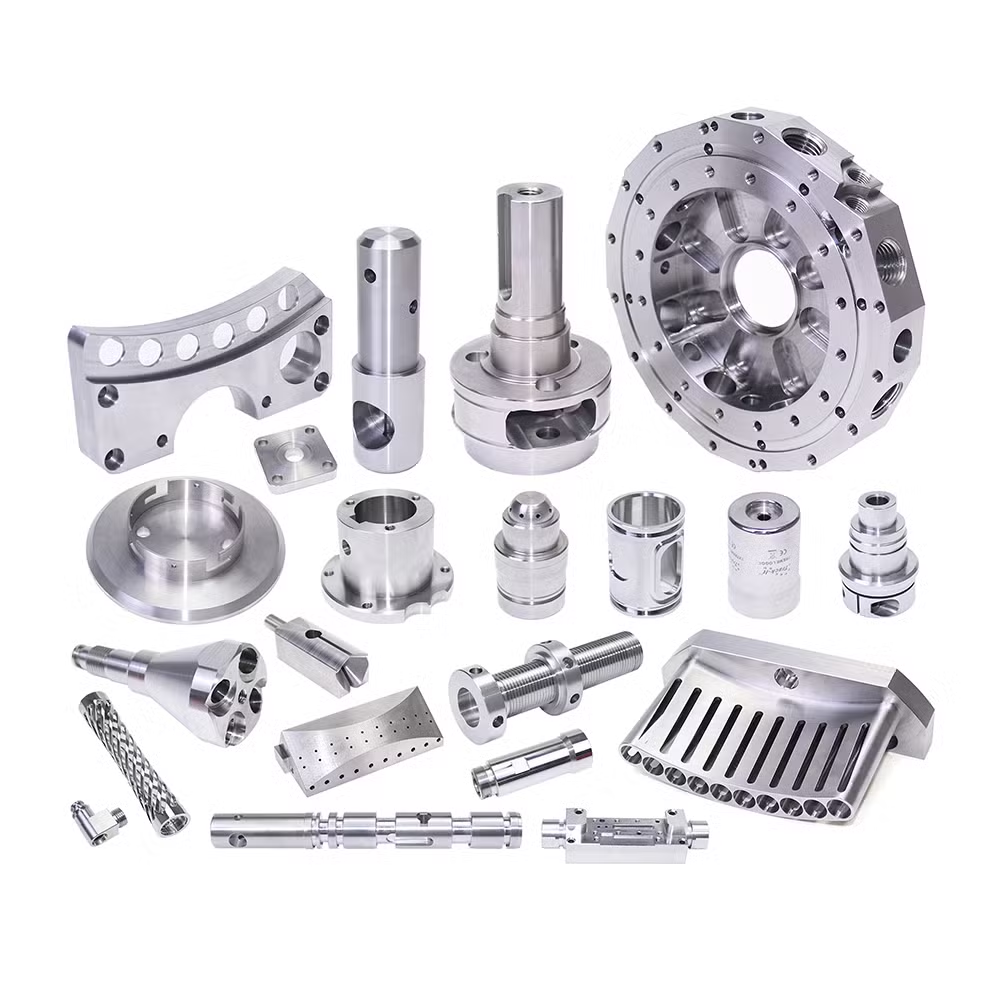
When a part needs multiple faces, tight tolerances, or repeatable output across hundreds of units, the benchtop stops making sense. That is the point where shops move to a 3-axis, 4-axis, or 5-axis machining center. A 5-axis machine cuts complex geometry in one setup, which removes the fixture stack-up that ruins tolerance on multi-setup work. For aluminum, steel, titanium, and medical-grade plastics, that is the only route that holds ±0.005 mm.
We run 127 CNC machines across three plants in Dongguan and Singapore, including 16 simultaneous 5-axis machining centers, 12 four-axis mills, and 27 three-axis machines. Maximum processing size is 4,000 mm, with travels like 4,000 × 400 × 150 mm and 750 × 1,150 × 550 mm. That range covers everything from a one-off prototype to a 10,000-part run with no minimum order quantity.
- 1Stay on the benchtopFlat parts, soft materials, prototypes, one or two units
- 2Move to a machining centerMulti-face parts, hard metals, tolerance below ±0.02 mm
- 3Move to 5-axisComplex contours, undercuts, single-setup accuracy on medical and aerospace parts
When the Upgrade Pays Off
The upgrade math is straightforward. If a part takes four hours on the benchtop and forty minutes on a machining center, and you make fifty of them a month, the benchtop is costing you money. Add the scrap rate from tolerance misses and the picture gets clearer. The crossover usually lands somewhere between ten and fifty parts per month, depending on material and tolerance.
We quote and return a free DFM analysis within 12 hours, and production can start within 24 hours. Parts ship in 3–5 days, with a historical late-delivery probability below 2%. Inspection covers raw material check, in-process monitoring, and final inspection, with reports on request. Tolerances hold at ±0.005 mm, finishes from Ra 0.2–0.8 μm on fine work to Ra 1.6–3.2 μm as-machined.
Materials we cut include 6061, 6061-T6, 2024, 5052, 5083, 6063, 6082, 7075, and ADC12 aluminum; 303, 304, 316, 316L, 17-4PH stainless; 1018, 1045, 4130, 4140, 4340, and tool steel; copper and brass grades; titanium TA1, TA2, and TC4; Inconel; and plastics from ABS and POM to PEEK and carbon fiber. Finishing runs from anodizing and plating to bead blasting, powder coating, and laser marking.
- 1Prototype to productionOne part or 10,000+, no minimum order quantity
- 2CertificationsISO 9001:2015, IATF 16949:2016, ISO 13485:2016, ISO 27001:2022
- 3ConfidentialitySecure uploads, NDA available on request
Frequently Asked Questions
Can the 3018 500W cut steel?
No, not in any practical sense. The spindle does not have enough torque at the low rpm steel requires, and the frame flexes under the cutting force. You can scratch mild steel with a carbide burr, but you will go through tooling fast and get poor surface finish.
If your part is steel, move to a machining center. We cut 1018, 1045, 4130, 4140, 4340, A36, and tool steel on 3-axis and 5-axis machines.
What router bits work best for aluminum on this machine?
Single-flute carbide cutters, 3–4 mm diameter, with a polished flute and no coating, or a ZrN coating if you cut often. Single flute clears chips well at the low chiploads a 500W spindle can push. Two-flute tools work but tend to clog in deep pockets.
Keep depth of cut at 0.5–1.0 mm per pass in 6061, use air blast or mist, and do not let the tool rub. Rubbing work-hardens the aluminum and dulls the cutter fast.
How do I improve accuracy on a 3018?
Start with the mechanical basics: tram the spindle to the bed, add anti-backlash nuts on all axes, and stiffen the Z plate. Bolt the stock down instead of taping it. Measure backlash with a dial indicator and dial it out in the controller.
Then address thermal drift. Run a 10–15 minute warm-up cycle, then re-zero before the critical cut. If you still need better than ±0.02 mm on a batch, the machine class is the limit, not your setup.
Is the 3018 500W suitable for beginners?
Yes, with realistic expectations. The control software is simple, the community is large, and mistakes are cheap. It teaches fixturing, feeds and speeds, and CAM workflow without a large investment.
The trap is expecting industrial results. Treat it as a learning platform and a light-production tool for wood, plastic, and thin aluminum, and it will serve you well.
When should I stop using a benchtop and order machined parts?
When tolerance drops below ±0.02 mm, when the part has more than two faces, when the material is steel or titanium, or when monthly volume passes roughly ten to fifty units. At that point the labor and scrap cost of the benchtop exceeds the cost of having parts machined.
Send us your files and we will return a quote and free DFM analysis within 12 hours. Production can start within 24 hours, and parts ship in 3–5 days.
Send Your Files, Get a Quote in 12 Hours
Upload your CAD and we will return a quote with free DFM analysis. One prototype or 10,000 parts, tolerances to ±0.005 mm.
12-hour quoteFree DFM analysis100% inspection before shipmentNDA on request









